|
VOOZH | about |
|
VOOZH | about |
Differentiation and Integration are two mathematical operations used to find change in a function or a quantity with respect to another quantity instantaneously and over a period, respectively. Differentiation is an instantaneous rate of change, and it breaks down the function for that instant with respect to a particular quantity, while Integration is the average rate of change that causes the summation of continuous data of a function over the given period or range. Both are the inverse of each other.
In this article, we will learn about what differentiation is, what integration is, and the formulas related to Differentiation and Integration.
Table of Content
Differentiation is a method to find the instantaneous rate of change of a function or curve with respect to other quantities. Mathematically, the Slope of the tangent at a point on the curve is called the Derivative of the Curve or Function, and differentiation is a method to find that derivative. In differentiation, we compute the rate at which a dependent variable 'y' changes with respect to the change in the independent variable 'x'. This rate of change is called the derivative of 'y' with respect to 'x', where y is a function of x given as y = f(x).
👁 Differentiation of f(x)The differentiation of a function is simply the Derivative of the Function at all differentiable points in its domain. For Example, if f(x) is differentiable at x = a in its domain. The Derivative of f(x) at x = a is given as
where h is the change in independent variable x.
For example, if we need to find the differentiation of a function f(x) = x2.
Then the differentiation of the function is given as f'(x) = 2x.
Here, in the above step, we reduce the power to 1.
The derivative of standard functions can be found by the formulas. We will learn the Differentiation formulas of the following functions:
y = f(x) | dy/dx |
|---|
y = f(x) | dy/dx |
|---|---|
ex | |
ax logea |
y = f(x) | dy/dx |
|---|---|
1/x |
Learn More: logarithmic differentiation
y = f(x) | dy/dx |
|---|---|
| cos x | |
| -sin x | |
| sec2x | |
| -cosec2x | |
| sec x.tan x | |
| -cosec x.cot x |
The above formulas are used when the functions are present alone or when multiplied by a scalar number, but when two functions are in product form or quotient form, then we can't simply differentiate each function separately; we need to follow some rules, particularly for the product and quotient case. Hence, we will look at differentiation by parts.
Also, read Differentiation of Inverse Trigonometric Functions.
Differentiation of Product of Functions: Let us assume 'u' and 'v' are two functions in the product (u.v), then the Differentiation of u.v is given by the product rule i.e.,
Differentiation of Quotient of Functions: Let us assume 'u' and 'v' are two functions in the quotient (u/v), then the Differentiation of u/v is given by the quotient rule i.e.,
Integration is a method to find the average rate of change of a function. As the name suggests, Integrate means adding all the functions' points. Integration is actually the anti-derivative of a differentiating function. Differentiation and Integration are inverses of each other. We can integrate the function in two ways, one is indefinite and the other is definite. In Indefinite Integration, we get a constant C with our expression, but in Definite we can find the value of that constant C by restricting its range or limit. The Integration of a function f(x) is given as
∫f(x)dx = F(x) + C
Where,
- f(x) is Integrand,
- dx is Integrating Agent,
- F(x) is anti-derivative of f(x), and
- C is Constant.
To explain we considered above result i.e. (1) - derivative of function f(x)
f'(x) = 2x
Integrating both sides,
∫f'(x) = ∫2x
Here,
We have to increase the power of derivative by 1 and also divide function with updated power of function,
After that add an integral constant with it.
Integration is called anti-derivative
To integrate various types of functions, we have different formulas for different types of functions. We will learn Integration Formulas for the following functions:
Formulas for the Integration of Algebraic Functions are
∫f'(x) | f(x) |
|---|---|
∫xn dx | |
logex + C |
Some commonly used formulas of Integration related to the exponential function are
∫f'(x) | f(x) |
|---|---|
∫exdx | ex + C |
∫ax logea dx |
The formula for the integration of some common Trigonometric Functions are:
∫f'(x) | f(x) |
|---|---|
∫ cos x dx | sin x + C |
∫sin x dx | -cos x + C |
∫ cot x dx | log|sin x | + C |
∫ sec x dx | log|sec x + tan x | +C |
∫ tan x dx | -log|cos x| + C |
∫cosec x dx | log|cosec x - cot x | + C |
∫sec2 x dx | tan x + C |
∫sec x tan x dx | sec x + C |
The above formulas are used when the functions are present alone or when multiplied by a scalar number, but when two functions are in product form or quotient form, then we can't simply integrate each function separately; we need to follow some rules, particularly for the product and quotient cases. Hence, we will look at Integration by Parts.
In integration by parts, we will learn the formulas for Integration when two functions are in product or quotient form:
Integration of Product of Functions: Let us assume 'u' and 'v' are two functions in the product (u.v), then the Integration of u.v is given as
∫u.v dx= u∫v dx - ∫ [(du/dx) ∫vdx] dx
Integration of Quotient of Functions: Let us assume 'u' and 'v' are two functions in the product (u/v), then the Integration of u/v is given as
∫u/v = u∫(1/v) dx - ∫ [(du/dx) ∫(1/v)dx)] dx
Also, Read
Area Under the Curve refers to the region enclosed by the graph of a function and the coordinate axes, or the intersection region of two graphs. Here, we will not have a regular shape, hence we can't use regular formulas. To calculate the area in such a case, we will use the concept of Integration. We will take an elemental area dx under the curve and integrate it over the defined range x = a to x = b.
The formulas for Differentiation and Integration of some frequently used functions are tabulated below:
Functions | Differentiation Formula | Integration Formula |
|---|---|---|
xn | d/dx(xn) = nx(n-1) | ∫xn dx = xn+1/(n+1) + C |
1/x | d/dx(1/x) = -1/x2 | ∫(1/x)dx = loge|x| + C |
ex | d/dx(ex) = ex | ∫ex dx = ex + C |
sin x | d/dx(sin x) = cos x | ∫sin x dx = -cos x + C |
cos x | d/dx(cos x) = -sin x | ∫cos x dx = sin x + C |
tan x | d/dx(tan x) = sec2 x | ∫tan x dx = -log|cos x| + C |
cot x | d/dx(cot x) = -cosec2 x | ∫cot x dx = log|sin x| + C |
sec x | d/dx(sec x) = sec x.tan x | ∫sec x dx = log |sec x + tan x| + C |
cosec x | d/dx(cosec x) = -cosec x.cot x | ∫cosec x dx = log |cosec x - cot x| + C |
The Properties of Differentiation and Integration are listed below:
d/dx{k.f(x)} = k.d/dx{f(x)} and ∫k.f(x)dx = k.∫f(x)dx
Where k is a scalar quantity.
d/dx{f(x) ± g(x)} = d/dx{f(x)} ± d/dx{g(x)}
and
∫{f(x) ± g(x)} dx = ∫{f(x)} dx± ∫{g(x)} dx
d/dx{f(x)} = f'(x) and ∫f'(x) dx = f(x)
d/dx{f(g(x))} = f'(x).g'(x)
The difference between Differentiation and Integration is as follows:
Differentiation | Integration |
|---|---|
| Differentiation involves the Division of component functions | Integration involves the Addition of components of a function |
| Reduces the power of the function | Increases the power of the function |
| Finds the gradient or slope of the curve | Finds the area under the curve |
| Calculated for a specific point in the function's domain | Calculated for a range of points within the function's domain |
| The derivative of a function is the antiderivative of the function | The integral of a function is the antiderivative of the function |
Example 1:
Differentiate with respect to x.
Solution:
Let
⇒
⇒
Example 2: Differentiate the following: i) x3 ii)
Solution:
i) Let y = x3
⇒\frac{dy}{dx} = \frac{d}{dx}(x^3)
⇒
ii) Let
Using, Quotient Rule,
Example 3: Find of derivative of
Solution:
Let
⇒
⇒
⇒
Example 4: Differentiate with respect to x.
Solution:
⇒
⇒
⇒
Example 5: Differentiate y = Sec2x with respect to x.
Solution:
Let y = sec2x
⇒
⇒ = 2 sec2 x tan x
Example 6: Differentiate sec2x + cos2x.
Solution:
y = sec2x + cos2x
⇒
⇒
Example 7: Integrate √x with respect to x.
Solution:
y = ∫√x dx
⇒ y =
⇒
⇒
Example 8: Integrate the following:
(i) e2x (ii) eax
Solution:
i) y=∫e2x
⇒
ii) y=∫eax
⇒
Example 9: Integrate sin2x+ + cos2x.
Solution:
y = ∫(sin2x + cos2x)dx
⇒ y = ∫dx
⇒ y = x + c
Example 10: Integrate sin 2x + cos 2x.
Solution:
y = ∫(sin2x + cos2x)dx
⇒ y = ∫sin2xdx + ∫cos2x dx
⇒ y =
⇒
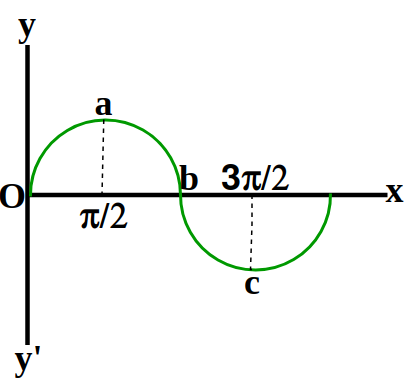
Example 11: Find the area bounded by the curve y = sin x between x= 0 and x = 2π.
Solution:
Let y = Sinx
The graph of y = sinx is like,
👁 y = sin xRequired area = Area of OABO + Area of BCDB
⇒ Required area
⇒ Required area
⇒ Required area
⇒ Required area = -cosπ + cos0 + cos2π- cosπ
⇒ Required area = 4 sq units.
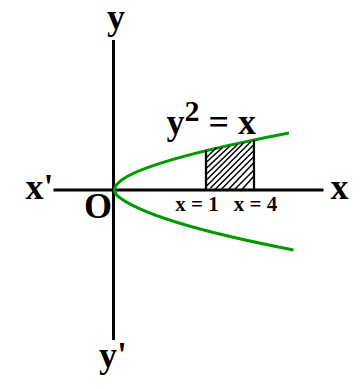
Example 12: The area bounded by the region of the curve y2 = x and the lines x = 1, x = 4, and the x-axis is :
Solution:
Let y2 = x a curve region bounded by the lines x = 1 and x = 4 about x-axis.
👁 y^2 = xRequired Area (Shaded Area) =
⇒ Required area
⇒ Required area
⇒ Required area
⇒ Required area
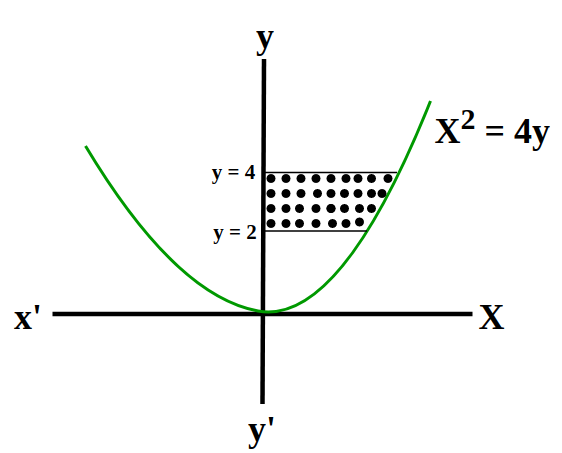
Example 13: The area of the region area integrate x with respect. y and take y = 2 as the lower limit and y = 4 as the upper limit. The given curve x^2 = 4y is a parabola, which is symmetrical about the y-axis.
Solution:
The given curve is parabola x2 = 4y which is symmetric to the y-axis.
👁 x^2 = 4yThe area bounded by the curve is shaded portion of the graph.
Required Area =
⇒ Required area
⇒ Required area
⇒ Required area
Question 1: Differentiate y = with respect to x.
Question 2: Differentiate y = with respect to x.
Question 3: Find the derivative of y = e3x sin(x) with respect to x.
Question 4: Differentiate y = using the quotient rule.
Question 5: Find the derivative of y = cos(2x).ln(x) with respect to x.
Question 6: Integrate ∫ () dx.
Question 7: Evaluate the integral ∫ e2x dx.
Question 8: Find the integral of ∫ 1/x2 + 4 dx.
Question 9: Integrate ∫ (x2 + 3x +5) dx.
Question 10: Evaluate ∫ sin(3x) dx.