|
VOOZH | about |
|
VOOZH | about |
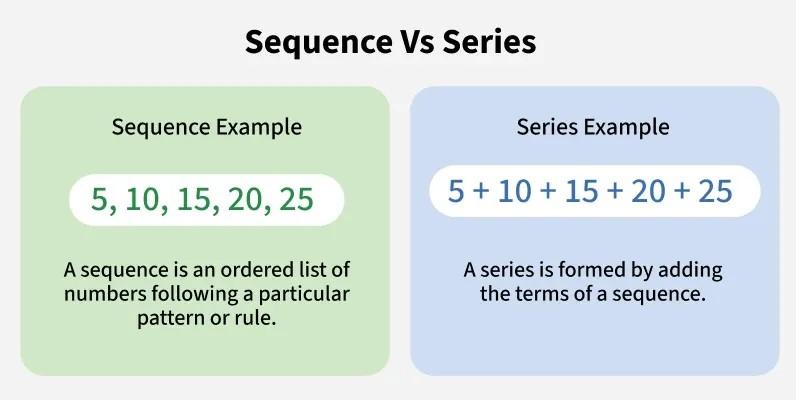
Sequences and Series are the most important topics in math, though many people get confused between them; they can easily be differentiated. A sequence refers to an arrangement in a particular order in which the related terms follow each other. When a sequence follows a particular pattern, it is called a progression. It is not the same as a series, which is defined as the summation of the sequence's elements.
A sequence is an ordered list of numbers arranged according to a certain rule or pattern. Each number in a sequence is called a term.
The terms of a sequence are usually denoted as:
a1, a2, a3, …, an, …
The subscript indicates the position of each term within the sequence:
The nth term is the number at the nth position of the sequence and is denoted by an. This term is also called the general term of the sequence.
For example, the sequence is 2, 4, 6, 8, 10, 12, . . .
- Here, 2 is the first term, 4 is the second term,6 is the third term, and so on.
- The dots at the end (. . .) indicate that the sequence continues indefinitely.
- This sequence has a constant difference (common difference) of 2, as each term is obtained by adding 2 to the previous term.
The sequence can be classified into different types:
A series is defined as the sum of terms of a sequence, where the order of the terms typically matters. Series can be classified into finite and infinite, depending on whether the underlying sequence has a finite or infinite number of terms.
Example:
- Finite series: 1 + 3 + 5 + 7 + 9
- Infinite series: 1 + 3 + 5 + 7 + …
Different types of series include:
This table comprises differences between sequence and series :
Sequence | Series |
|---|---|
Sequence elements are placed in a particular order following a particular set of rules. | In series, the order of the elements is not necessary. |
It is just a collection of elements in a particular pattern. | It is a sum of elements that follows a pattern. |
Represented as a1, a2, a3...... | Represented as Sn = a1 + a2 + a3 + a4.... |
The order of appearance of the number is important. |
|
Finite Sequence: 1, 2, 3, 4, 5 | Finite Series: 1 + 2 + 3 + 4 + 5 |
Infinite Sequence: 1, 2, 3, 4....... | Infinite Series: 1 + 2 + 3 + 4 + 5..... |
A sequence is just a list of numbers. | A series is the summation of a sequence’s terms. |
Used in computer science, physics, and patterns. | Used in calculus, economics, and physics for application. |
Question 1: Identify the sequence type: 3, 6, 12, 24, 48, …
Answer:
Geometric Sequence (Common ratio = 2).
Question 2: Determine if the sequence is arithmetic, geometric, or harmonic: 5, 9, 13, 17, 21, …
Answer:
Arithmetic Sequence (Common difference = 4).
Question 3: Classify the sequence: 1, 1/2, 1/3, 1/4, 1/5, …
Answer:
Harmonic Sequence (Reciprocals form an arithmetic sequence: 1, 2, 3, 4, 5, …).
Question 4: Identify the pattern: 0, 1, 1, 2, 3, 5, 8, …
Answer:
Fibonacci Sequence (Each term is the sum of the two preceding terms).