|
VOOZH | about |
|
VOOZH | about |
An equation is a mathematical statement that shows two expressions are equal. It uses an equals sign (=). For example: 2 + 3 = 5.
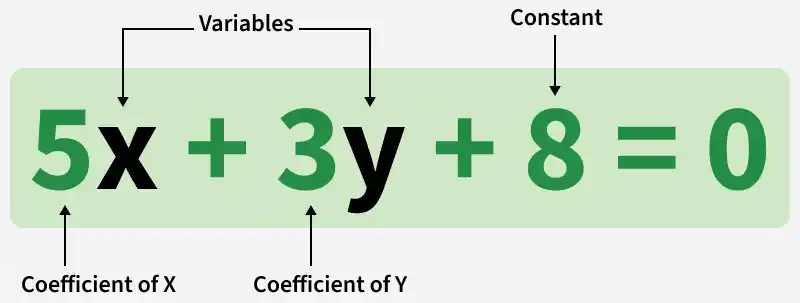
Equations can also contain unknown values called variables:
👁 standard_form_of_linear_equationSome key equation types in mathematics include linear equations, quadratic equations, polynomial equations, logarithmic equations, and exponential equations.
The linear equation is an equation that contains a constant, variable, or product of a constant and shows the relationship between variables and a constant. Linear equations can be represented on a single-line graph. The
The general form of a linear equation is:
Ax + By = C ,where A, B, and C are constants, with A and B are not equal to zero.
Example:
Linear Equation in One Variable: 2x + 10 = 0
Linear equation in Two Variables: 2x + 3y - 10 = 0
In a quadratic equation, a variable gets raised to the power of 2, making a U-shaped curve when graphed.
A quadratic equation can be written as
Ax2+ Bx + C = 0 ,where A, B and C are constant and A ≠ 0.
Example:
2x2 + 3x - 10 = 0 , where, A = 2, B = 3, C = -10.
A polynomial equation is a mathematical expression that includes variables, exponents (such as squares and cubes), and coefficients (numbers). The degree of the equation depends on the highest exponent present. When the highest exponent (or power) of any variable is 2, then a quadratic equation will be formed.
The general form of the polynomial equation is given as:
anxn + a(n-1)x(n-1) + ......+ a1x + a0 = 0
Where,
- an, a(n-1),....., a1, a0 are coefficients.
- x is a variable.
- n is a whole number that can't be negative and shows the highest degree of the polynomial.
Logarithmic equations use logarithmic functions, which are the reverse of exponential functions. In other words, these equations help us solve for the unknown variable that is found as an exponent in an exponential expression. The general form of a logarithmic equation is:
y = logb(x)
Where,
- log represents the logarithm.
- x is the number which needs to find.
- b is the base of the logarithm, and a positive number which is greater than 1.
- y is the result or exponent to which the base b must be raised to get x.
An exponential equation is a math equation that uses an exponential function. This type of equation can be written as:
f(x) = ax
The general form of an exponential equation is:
f(x) = a.ekx
Where,
- f(x) represents the value of the function at a given x
- a is the initial value or the function's value at x = 0.
- e is the base of natural logarithms (approximately 2.71828).
- k is a constant that determines the rate of growth or decay.
- x is the variable, which can take different values.
Solving an equation means finding the value(s) of the variable that make both sides of the equation equal.
Step 1: Simplify Both Sides
Remove brackets using distributive property.
Combine like terms, if possible.
Step 2: Isolate the Variable
Move variable terms to one side and constants to the other side.
Perform the same operation on both sides to maintain equality.
Step 3: Solve for the Variable
Use addition, subtraction, multiplication, or division to find the value of the variable.
Step 4: Verify the Solution
Substitute the obtained value back into the original equation.
Check whether the left-hand side (LHS) equals the right-hand side (RHS).
Example 1: 3x + 4 = 10
In the given equation subtract 4 from both sides
3x + 4 - 4 = 10 - 4
3x = 6
x = 6/3 ...... ( dividing both sieds by 3)
x = 2
On putting the value of x in the equation given:
3(2) + 4 = 10
6 + 4 = 10
∴ 10 = 10
Example 2: - 5x + 6 = 0
In the given equation:
a = 1, b = (-5), c = 6
Using the quadratic formula to solve for x:
Put he values of a,b, and c in the formula , we get:
⇒
⇒
On simplifying
x = (5±1)/2
Calculating x with '+' and '-' both
x1 = (5+1)/2
⇒ x1 =6/2
⇒ x1 = 3
Thus, x2 = (5-1)/2
⇒ x2 = 4/2
⇒ x2 = 2
∴ The solutions to the quadratic equation are x = 3 and x = 2
Example 3: 3x - 2(2x + 1) = 5
First simplify the equation
3x - 4x - 2 = 5
⇒ 3x - 4x - 2 - 5 = 5 - 5 ...... (subract 5 from both sides)
Solve the like terms
- x - 7 = 0
⇒ - x- 7 + 7 = 0+7 ...... (adding 7 on both sides)
⇒ - x = 7 ...... ( multiply both sides by -1 to make x positive)
∴ x = -7
Example 4: log(x) = 2
Write logarithmic equation in exponential form
log(x) = 2
⇒ 102 = x
⇒ 102 = 100
⇒ x = 100
Example 5: 2 = 16
convert the equation with same base
2(2x+1) = 24 ..... (eq 1.)
Solve the exponents first:
⇒ 2x+1 = 4
⇒ 2x + 1 - 1 = 4 - 1 ...... (subracting 1 from both sides)
⇒ 2x = 3
⇒ x = 3/2 ...... (dividing both sides by 2)
put he value of x in eq 1.
2(2 . [3/2] + 1) = 24
⇒ 2(3+1) = 24
⇒ 24 = 24
Q1. Solve for x in the exponential equation: 2x = 16
Q2. Factor the polynomial equation: x - 8x + 16x = 0
Q3. Tina is saving money for a new bicycle. She currently has ₹80 saved up and plans to save an additional amount each week. After 7 weeks, she wants to have ₹220 in total. What is the amount Tina plans to save each week?
Q4. Solve this quadratic equation: 2x2 - 5x + 3 = 0
Q5. A population of bacteria doubles every hour. If there are initially 100 bacteria, how many will there be after 5 hours?