|
VOOZH | about |
|
VOOZH | about |
Expressions and Equations are fundamental concepts in algebra. They help us represent mathematical relationships and solve problems in both mathematics and real-life situations. Understanding these concepts builds the foundation for solving simple as well as complex algebraic problems.
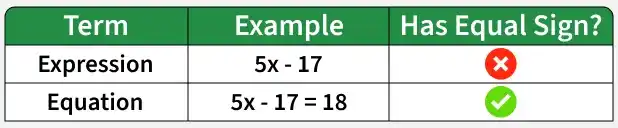
An algebraic expression is a mathematical combination of numbers, variables (letters that represent numbers), and arithmetic operations such as addition, subtraction, multiplication, and division. It represents a value and does not contain an equality sign (=).
There are different types of expressions. Some of them are mentioned below:
Numerical Expressions
These expressions contain only numbers and operations.
Example: 7 + 8 × 3
Algebraic Expressions
These expressions contain variables, numbers, and operations
Example: 3x2 + 7x - 3
Polynomial Expressions
These expressions contain algebraic expressions with multiple terms.
Example: 4x3 - 3x2 + 2x - 4
Rational Expressions
Expressions which have division of two or more polynomials are called as rational expressions.
Example: 1/x + 2/x + 3
Radical Expressions
Expressions which Include variables or numbers under a root sign are called as radical expressions.
Example: √3x + 7
An equation is a mathematical statement that maintain the equality of two expressions, separated by an equality sign =. We solve these equation to find the value of variable that make the equation true.
Example: x2 - 3x -3 = 0
This is an example of equation where x is variable and 1 , -3 and -3 are constants.
Linear Equations
Equations of the first degree i.e. the highest exponent of the variable is 1 is known as linear equation.
Example: 3x + 4 = 12
Quadratic Equations
Equations of the second degree i.e. the highest exponent of the variable is 2 is known as quadratic equation.
Example: 3x2 - 4x + 12 = 0
Polynomial Equations
Equations which have polynomial expressions is known as polynomial equation.
Example: 4x4 + 3x2 + 1 = 0
Rational Equations
Equations which involve rational expression such as fraction.
Example: 1/x + 2/x+1 = 3
Below is the key differences between expressions and equations in tabular form:
Characteristics | Expression | Equation |
|---|---|---|
Definition | A combination of numbers, variables, and operators | A statement asserting the equality of two expressions |
Contains | No equality sign | An equality sign (=) |
Purpose | Represents a value or set of values | Shows that two expressions are equal |
Example | 3x + 2 | 3x + 2 = 7 |
Example 1: Simplify the given expression: 2x+3x-4+7.
Solution:
We combine like terms:
2x + 3x = 5x -4 + 7 = 3
So, simplified expression is 5x + 3.
Example 2: Solve the following equation: 3x - 5 = 7
Solution:
3x - 5 = 7
Add 5 to both side of equation
3x - 5 + 5 = 7 + 5
3x = 12
x = 12/3
x = 4
Example 3: Factor the quadratic equation x2 - 5x + 6 = 0.
Solution:
Find two numbers that multiply to 6 and add to -5: these two numbers are -2 and -3 (x - 2) ( x - 3) = 0
So, factors are (x - 2) ( x - 3)
Example 4: Factor the quadratic equation x2 - 4x + 4 = 0.
Solution:
We can identify a pattern in this question:
(x)2 - (2)(2)(x) + (2)2
It is a question of pattern (a - b)2 = a2 -2ab + b
(x - 2)2 = 0
So, factors are (x - 2) ( x - 2)
Example 5: Solve the linear Equation 5x - 7 = 3x + 9.
Solution:
To solve the given linear term of given equation:
5x - 7 = 3x + 9
Subtract 3x from both sides
5x - 3x - 7 = 9
2x - 7 = 9
Add 7 to both sides:
2x - 7 + 7 = 9 + 7
2x = 16
Divide by 2:
x = 16/2 = 8