|
VOOZH | about |
|
VOOZH | about |
A factor is a number that divides another number exactly, without leaving any remainder. Factors can also be seen as pairs of numbers that, when multiplied together, result in the original number.
We can find all the factors of a given number using three ways:
In this method, we find pairs of numbers that multiply together to give the original number.
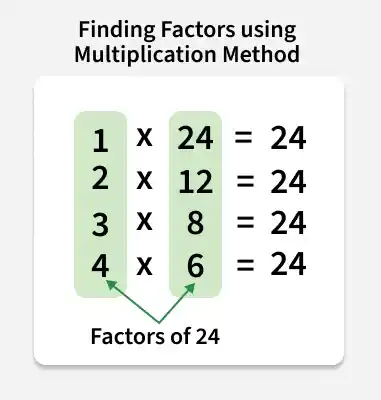
Example: Find all the factors of 24 using the multiplication method.
Solution: We have to find all the pairs of whole numbers whose product is 12, like
Here the product of the following pairs is 24.
(1, 24) , (2, 12), (3, 8) and (4, 6)
Hence, all these numbers 1, 2, 3, 4, 6, 8, 12 and 24 are factors of 24.
In this method, we have to find all the divisors of the given number which are exactly divisible by it. Here we start dividing the given number by 1 and continue dividing it by the next number until we reach the number itself.
Example: Find all the factors of 12 using the division method.
Solution: We will take every natural number less than 12 and will check whether it is divisible by 12 or not
- 12 ÷ 1 = 12 (remainder = 0)
- 12 ÷ 2 = 6 (remainder = 0)
- 12 ÷ 3 = 4 (remainder = 0)
- 12 ÷ 4 = 3 (remainder = 0)
- 12 ÷ 5 = 2 (remainder = 2)
- 12 ÷ 6 = 2 (remainder = 0)
- 12 ÷ 7 = 1 (remainder = 5)
- 12 ÷ 8 = 1 (remainder = 4)
- 12 ÷ 9 = 1 (remainder = 3)
- 12 ÷ 10 = 1 (remainder = 2)
- 12 ÷ 11 = 1 (remainder = 1)
- 12 ÷ 12 = 1 (remainder = 0)
So, the numbers that are exactly divides 12 are 1, 2, 3, 4, 6, and 12. Hence these numbers are the factors of 12.
A factor tree is a diagrammatic representation of the prime factors of a number. In this method, we find the factors of a number and then further factorize them until we get all the factors as prime numbers. Here, we consider the given number as the top of a tree and all its factors as its branches.
To find the prime factorization by factor tree method, we follow the below given steps:
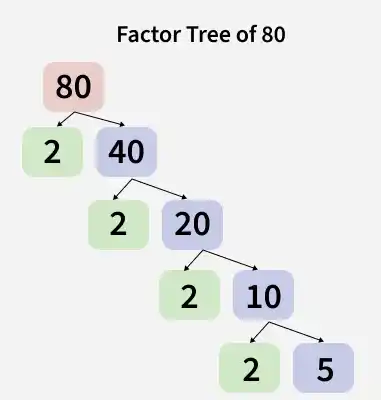
Example: Find the prime factors of 80 using the factor tree method.
Solution: We will break the number 80 into smaller factors and continue breaking them until we get only prime numbers.
Now all the numbers obtained are prime numbers.
So, the prime factors of 80 are: 2, 2, 2, 2, and 5 = 2 ⁴ × 5
Let us suppose N is a natural number with prime factors X p × Y q × Z r, where
Name | Formula |
|---|---|
Sum of Factors | [(X p+1-1)/X-1] × [(Y q+1-1)/Y-1] × [(Z r+1-1)/Z-1] |
Numbers of Factors | (p+1) (q+1) (r+1) |
Product of Factors | NTotal No. of Factors/2 |
Factors are the numbers which divides a number while multiples are the numbers which are obtained by multiplying a number with other number.
Factors | Multiples |
|---|---|
| Factors are the divisors of a number that divides the number without leaving any remainder | Multiples are the product obtained by multiplying the number with other number |
| Every Number is a Factor of itself | Every Number is a Multiple of itself |
| A number is the largest factor of itself | A number is the smallest multiple of itself |
| Number of Factors of a Number is finite | Number of Multiples of a Number is infinite |
| Factor of a number is smaller or equal to the number | Multiple is equal or larger than the given number |
| Factor is found by dividing the number | Multiple is found by multiplication |
Example 1: Find all the factors of 64 by multiplication method.
Solution:
Factors of 64
- 1 × 64 = 64
- 2 × 32 = 64
- 4 × 16 = 64
- 8 × 8 = 64
Hence the factors of 64 are 1, 2, 4, 8, 16, 32, and 64.
Example 2: Find common factors of 24 and 48.
Solution:
Factors of 24 = 1, 2, 3, 4, 6, 8, 12, and 24
Factors of 48 = 1, 2, 3, 4, 6, 8, 12, 16, 24, and 48
Hence the common factors of 24 and 48 are 1, 2, 3, 4, 6, 8, 12, and 24.
Example 3: Find all the factors of 32 by division method.
Solution:
Factors of 32
- 32 ÷ 1 = 32
- 32 ÷ 2 = 16
- 32 ÷ 4 = 8
- 32 ÷ 8 = 4
- 32 ÷ 16 = 2
- 32 ÷ 32 = 1
Hence the factors of 32 are 1, 2, 4, 8, 16, and 32.
Example 4: Check if 50 is a factor of 1550 or not.
Solution:
We have to check the divisibility of 50 and 1550
1550 ÷ 50 = 31 ( with remainder 0)
Hence 1550 is exactly divisible by 50 so 50 is a factor of 1550.
Example 5: Check if 21 is a factor of 525 or not.
Solution:
We will check the divisibility of 525 with 21
On evaluating we get, 525 ÷ 21 = 25, with remainder 0
Here 525 is exactly divisible by 21. Hence 21 is a factor of 525.
Q1: Find all factors of 28 and 36.
Q2: Check if 12 is a factor of 144 or not.
Q3: Find prime factorization of 169.
Q4: Find prime factorization of 640.
Q5: Find common factors of 12, 24 and 48.