|
VOOZH | about |
|
VOOZH | about |
The First Principle of Differentiation involves using algebra to determine a general expression for the slope of a curve. It is also referred to as the delta method. The derivative serves as a measure of the instantaneous rate of change, denoted by f'(x), which is equal to:
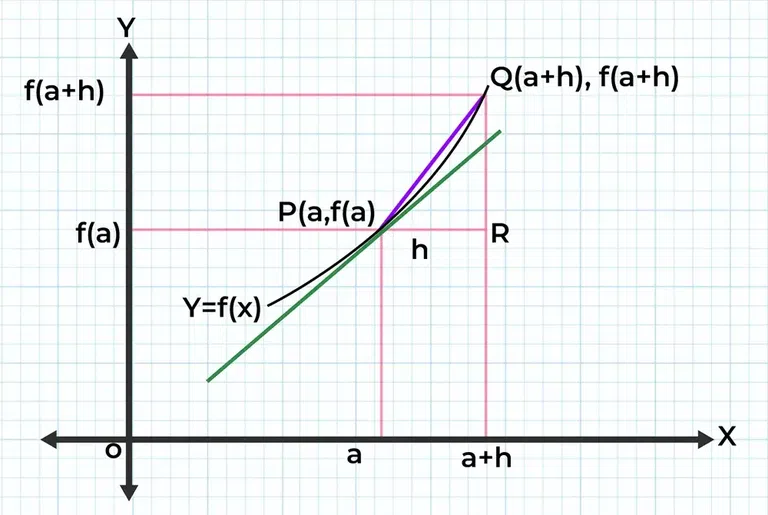
Let's understand the Derivative by the First Principle with the help of the image attached below:
Given a function f(x), we want to find its derivative f'(x). Using the definition of the derivative, we have:
Consider two points on the curve f(x) at x = a and x = a + h. The slope of the secant line passing through these points is given by:
As h approaches 0, the secant line becomes a tangent line, and its slope represents the derivative of the function at x = a .
Taking the limit of the difference quotient as h approaches 0 gives us the derivative at x = a:
This limit represents the instantaneous rate of change of the function f(x) at x = a .
Step 1: Start with the function (f(x)) for which you want to find the derivative.
Step 2: Use the definition of the derivative:
Step 3: Substitute f(x) into the formula.
Step 4: Calculate f(x + h) - f(x), which represents the change in ( y )-values between two points on the function.
Step 5: Divide the result by h, the change in x-values between the two points.
Step 6: Take the limit as ( h ) approaches zero.
Step 7: The resulting value is the derivative of f(x) with respect to ( x ), denoted as f'(x).
One-sided derivatives are derivatives calculated from one direction only, either from the left or the right of a specific point. They are useful when a function behaves differently on one side of the point compared to the other.
Example: Consider ( f(x) = x2 ) and find the one-sided derivatives at ( x = 1 ).
Solution:
Left-sided derivative ( f'-(1)):
f'(1-) = limh→0-
⇒ f'(1-) = limh→0-
⇒ f'(1-) = limh→0-
⇒ f'(1-) = limh→0-
⇒ f'(1-) = limh→0-
⇒ f'(1-) = limh→0- (2 + h) = 2Right-sided derivative ( f'+(1)):
f'(1+) = limh→0+
⇒ f'(1+) = limh→0+
⇒ f'(1+) = limh→0+
⇒ f'(1+) = limh→0+
⇒ f'(1+) = limh→0+ (2 + h) = 2So, both the left-sided derivative ( f'(1-)) and the right-sided derivative ( f'(1+)) of ( f(x) = x2 ) at ( x = 1 ) are equal to 2.
To differentiate trigonometric functions using the first principles of derivatives, use the definition of the derivative:
Given: f(x) = sin(x)
Using the definition of the derivative:
sin(x) = limh → 0
Applying the angle addition formula for sine:
limh → 0
⇒ limh → 0Using the limits:
sin(x) limh → 0 + cos(x) limh → 0
As limh → 0 = 1 and limh → 0 = 0 :
sin(x) · 0 + cos(x) · 1 = cos(x)
So, the derivative of sin(x) with respect to ( x ) using the first principles of derivatives is cos(x).
= limh → 0
Using the angle addition formula for cosine:
= limh → 0
= limh → 0
= cos(x) limh → 0 - sin(x) limh → 0As limh → 0 = 1 and limh → 0 = 0 \):
= cos(x) ⋅ 0 - sin(x) ⋅ 1 = -sin(x)
So, the derivative of cos(x) with respect to ( x ) using the first principles of derivatives is -sin(x).
Example 1: Find the derivative of the function f(x) = 3x2 + 2x - 1 using the first principles of differentiation.
Solution:
Using the definition of the derivative:
Substituting f(x) = 3x2 + 2x - 1 into the formula:
⇒
⇒
⇒⇒
⇒So, the derivative of f(x) = 3x2 + 2x - 1 with respect to x using the first principles of differentiation is
Example 2: Calculate the derivative of the function ( g(x) = √x) using the first principles of differentiation.
Solution:
Using the definition of the derivative:
Substituting (g(x) = √x) into the formula:
To simplify this expression, use the conjugate:
⇒
⇒
⇒
⇒ g'(x) = limh → 0Now, as ( h ) approaches 0:
So, the derivative of g(x) = √x with respect to x using the first principles of differentiation is
Example 3: Determine the derivative of the function h(x) = ex using the first principles of differentiation.
Solution:
Using the definition of the derivative:
⇒Substituting into the formula:
⇒
⇒
⇒Now, as h approaches 0:
Using the standard limit
So, the derivative of h(x) = ex with respect to x using the first principles of differentiation is h'(x) = ex.
Q1. Find the derivative of the function ( f(x) = x3 + 2x2 - 3x + 1 ) using the first principles of differentiation.
Q2. Calculate the derivative of the function ( g(x) = 1/x) using the first principles of differentiation.
Q3. Determine the derivative of the function ( h(x) = ln(x) ) using the first principles of differentiation.
Q4. Find the derivative of the function ( p(x) = 1/√x) using the first principles of differentiation.
Q5. Calculate the derivative of the function ( q(x) = e2x) using the first principles of differentiation.