|
VOOZH | about |
|
VOOZH | about |
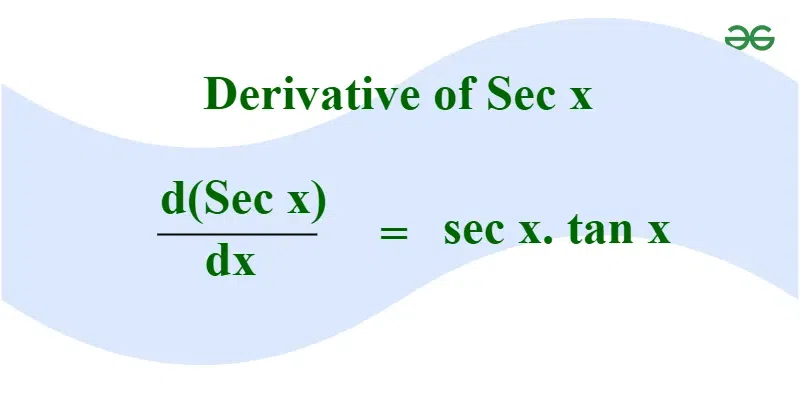
Derivative of Sec x is sec x tan x. Derivative of Sec x refers to the process of finding the change in the secant function with respect to the independent variable. The specific process of finding the derivative for trigonometric functions is referred to as trigonometric differentiation, and the derivative of Sec x is one of the key results in trigonometric differentiation.
In this article, we will learn about the derivative of sec x and its formula including the proof of the formula using the first principle of derivatives, quotient rule, and chain rule as well.
The derivativeof a function is the rate of change of the function with respect to any independent variable. The derivative of a function f(x) is denoted as f'(x) or (d /dx) [f(x)]. The differentiation of a trigonometric function is called a derivative of the trigonometric function or trig derivatives.
Read More: Calculus in Maths
The derivative of the sec x is (sec x ).(tan x). The derivative of sec x is the rate of change with respect to angle i.e., x. Among the trig derivatives, the derivative of the sec x is one of the derivatives. The resultant of the derivative of sec x is (sec x ).(tan x).
The formula for the derivative of sec x is given by:
d/dx [sec x] = (sec x).(tan x)
or
(sec x)’ = (sec x).(tan x)
The derivative of sec x can be proved using the following ways:
To prove derivative of sec x using First Principle of Derivative, we will use basic limits and trigonometric formulas which are listed below:
Let’s start the proof for the derivative of sec x ,assume that f(x) = sec x.
By first principle, the derivative of a function f(x) is,
f'(x) = limh→0[f(x + h) - f(x)] / h ... (1)
Since f(x) = sec x, we have f(x + h) = sec (x + h).
Substituting these values in (1),
f' (x) = limh→0 [sec (x + h) - sec x]/h
⇒ limh→0 1/h [1/(cos (x + h) - 1/cos x)]
⇒limh→0 1/h [cos x - cos(x + h)] / [cos x cos(x + h)]
⇒ 1/cos x limh->0 1/h [- 2 sin (x + x + h)/2 sin (x - x - h)/2] / [cos(x + h)] {By 1}
⇒ 1/cos x limh->0 1/h [- 2 sin (2x + h)/2 sin (- h)/2] / [cos(x + h)]
Multiply and divide by h/2,
⇒ 1/cos x limh->0 (1/h) (h/2) [- 2 sin (2x + h)/2 sin (- h/2) / (h/2)] / [cos(x + h)]
When h → 0, we have h/2 → 0. So,
⇒ 1/cos x Lim h/2->0 sin (h/2) / (h/2). limh->0(sin(2x + h)/2)/cos(x + h)
⇒ 1/cos x. 1. sin x/cos x {By 2}
⇒ sec x · tan x {By 3 & 4}
Therefore, f'(x) = d/dx [sec x] = sec x . tan x
To prove derivative of sec x using Quotient rule, we will use basic derivatives and trigonometric formulas which are listed below:
Let’s start the proof of the derivative of sec x, assume that f(x) = sec x = 1/cos x.
We have f(x) = 1/cos x = u/v
By quotient rule,
f'(x) = (vu' - uv') / v2
f'(x) = [cos x d/dx (1) - 1 d/dx (cos x)] / (cos x)2
⇒ [cos x (0) - 1 (-sin x)] / cos2x
⇒ (sin x) / cos2x
⇒ 1/cos x · (sin x)/ (cos x)
⇒ sec x · tan x
Therefore, f'(x) = d/dx [sec x] = sec x. tan x
To prove derivative of sin x using chain rule, we will use basic derivatives and trigonometric formulas which are listed below:
Let’s start the proof of the derivative of sec x, assume that f(x) = sec x = 1/cos x.
We can write f(x) as,
f(x) = 1/cos x = (cos x)-1
By power rule and chain rule,
f'(x) = (-1) (cos x)-2 d/dx (cos x) {By 3}
⇒ -1/cos2x · (- sin x) {By 1 & 2}
⇒ (sin x) / cos2x
⇒ 1/cos x · (sin x)/ (cos x)
⇒ sec x · tan x
Therefore, f'(x) = d/dx [sec x] = sec x. tan x
Read More:
Example 1: Find the derivative of sec x ·tan x.
Solution:
Let f(x) = sec x · tan x = u.v
By product rule,
f'(x) = u.v' + v.u'
⇒ (sec x) d/dx (tan x) + (tan x) d/dx (sec x)
⇒ (sec x)(sec2x) + (tan x) (sec x · tan x)
⇒ sec3x + sec x tan2x
Therefore f'(x)=sec3x + sec x tan2x.
Example 2: Find the derivative of (sec x)2.
Solution:
Let f(x) = (sec x)2
By power rule and chain rule,
f'(x) = 2 sec x d/dx (sec x)
⇒ 2 sec x · (sec x · tan x)
⇒ 2 sec2x tan x
Therefore f'(x)=2 sec2x tan x.
Example 3: Find the derivative of sec-1x.
Solution:
Let y = sec-1x.
Then, sec y = x ... (1)
Differentiating both sides with respect to x,
⇒ sec y · tan y (dy/dx) = 1
⇒ dy/dx = 1 / (sec y · tan y)... (2)
By one of the trigonometric identities,
[ tan y = √sec²y - 1 = √x² - 1 ]
⇒ dy/dx = 1/(x √x² - 1)
Therefore f'(x)= 1/(x √x² - 1).
1. Find the derivative of sec 7x
2. Find the derivative of x2.sec x
3. Evaluate: (d/dx) [sec x/(x2 + 2)]
4. Evaluate the derivative of: sin x. tan x. cot x
5. Find: (tan x)sec x
To find the derivative of \sec(x), we start by expressing as . Using the quotient rule for differentiation, where the derivative of a quotient is given by ), we let f(x)=1 and g(x)=cos(x). The derivatives are f′(x)=0 and g′(x)=−sin(x). Substituting these into the quotient rule, we get , which simplifies to. Recognizing that \frac we conclude that the derivative of sec(x) is sec(x)tan(x).