|
VOOZH | about |
|
VOOZH | about |
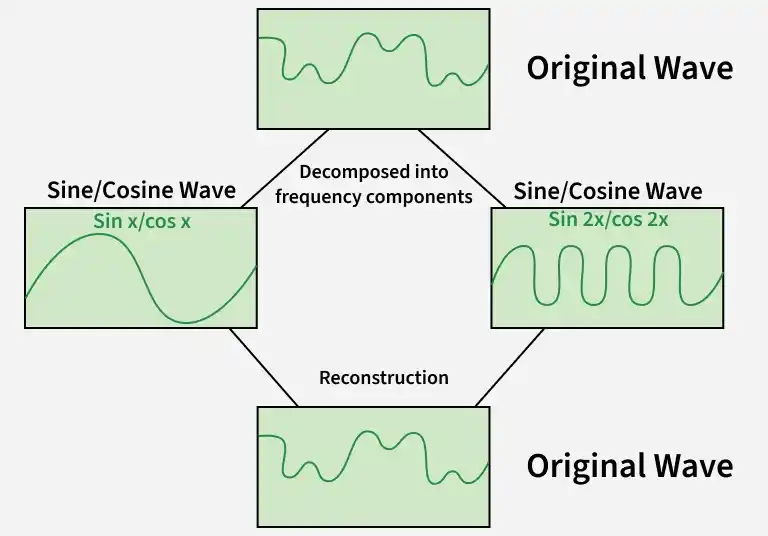
Fourier transform is a mathematical model that decomposes a function or signal into its constituent frequencies. It helps to transform the signals between two different domains, like transforming the frequency domain to the time domain.
The Fourier Transform decomposes a complex signal into simpler sine and cosine waves of different frequencies and amplitudes, which can be combined again to reconstruct the original signal.
For a continuous-time function f(t), the Fourier transform F(ω) is defined as:
F(ω) = f(t)eiωt dt
where:
The formula for the Fourier transforms of a function f(x) is given by:
f(x) = F(k)e2πikx dk
F(k) = f(x)e-2πikx dx
There are two types of Fourier transform i.e., forward Fourier transform and inverse Fourier transform.
The forward Fourier transform is a mathematical technique used to transform a time-domain signal into its frequency-domain representation. This transformation is fundamental in various fields, including signal processing, image processing, and communications. Forward Fourier Transform is represented by F(k). The symbol for forward Fourier transform is (k) and is defined as:
F(k) = f(x)e-2πikx dx
The inverse Fourier transform is the process of converting a frequency-domain representation of a signal back into its time-domain form. This is the reverse process of the forward Fourier transform. Inverse Fourier Transform is represented by f(x). Symbol for Inverse Fourier transform is (x) and is defined as:
f(x) = [F(k)] (x) = F(k)e2πikx dk
The table below shows the Fourier transform of various functions.
Functions | f(x) | F(k) = Fx[f(x)] |
|---|---|---|
1 | 1 | δ(k) |
Sine Function | sin(2πk0x) | (1/2) × i × [δ(k + k0) - δ(k -k0)] |
Cosine Function | cos(2πk0x) | (1/2) × [δ(k + k0) + δ(k -k0)] |
Inverse Function | -PV(1/πx) | i[1 - 2H(-k)] |
Exponential Function | e-2πk0|x| | (1/π)[k0 / (k2 + k20)] |
Gaussian Function |
Example 1: What is the Fourier transform of sin 4x.
Solution:
To find the Fourier transform of sine function we use formula:
Fourier transform of sin(2πk0x) = (1/2) × i × [δ(k + k0) - δ(k -k0)]
We have to find Fourier transform for sin 4x
Comparing
2πk0 = 4
k0 = 4/2π
k0 = 2/π
Putting in formula
F(k) = (1/2) × i × [δ(k + 2/π) - δ(k - 2/π)]
Example 2: What is Fourier transform of cos 2πx.
Solution:
To find the Fourier transform of cosine function we use formula:
Fourier transform of cos(2πk0x) = (1/2) × [δ(k + k0) + δ(k -k0)]
We have to find Fourier transform for sin 4x
Comparing
2πk0 = 2π
k0 = 1
Putting in formula
F(k) = (1/2) × [δ(k + 1) + δ(k - 1)]
Example 3: Find the Fourier transform of
Solution:
To find Fourier transform of is
We have to find the Fourier transform for
Comparing
a = π / 4
Putting in the formula
F(k) = 2