|
VOOZH | about |
|
VOOZH | about |
Fraction bars are visual and hands-on tools used to teach and understand fractions. They provide a simple way to see the size of different fractions and how they relate to each other. These are especially helpful in elementary and middle school education for introducing and reinforcing concepts of fractions.
In this article, we will understand fraction bars and solve some questions with fraction bars.
Table of Content
In mathematics, a fraction bar is a visual tool that helps compare fractions and perform fraction operations.
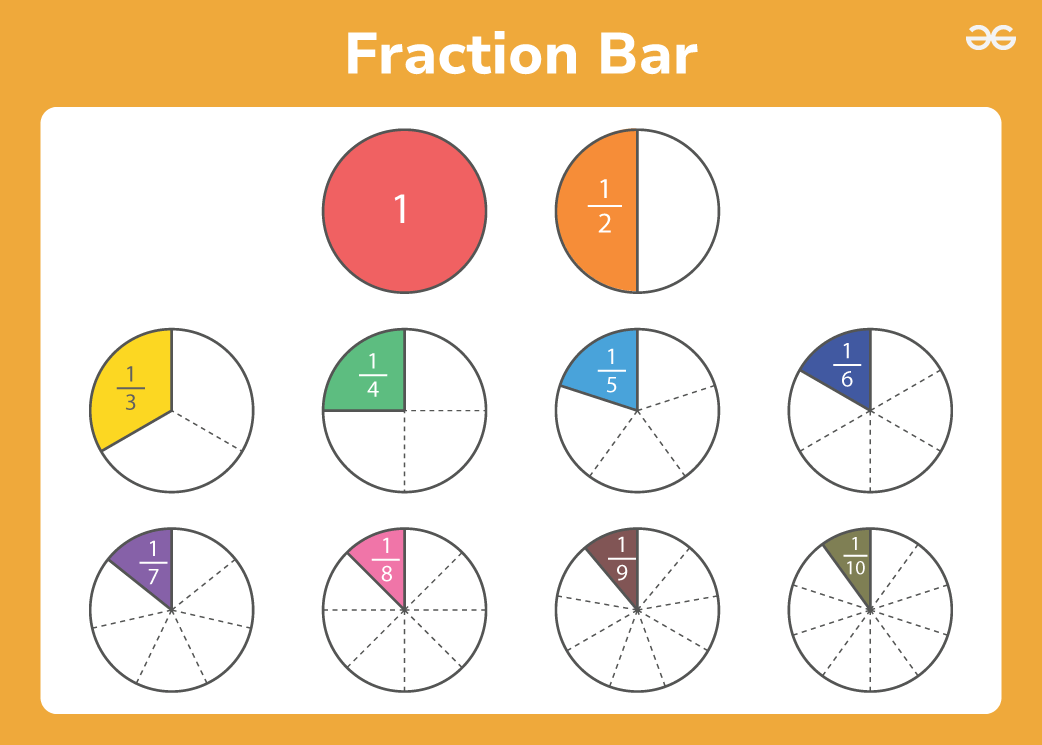
Fraction bars or strips represent a part-to-whole relationship. Each segment of a fraction bar represents one part of the whole. This is why it is called a part-to-whole representation.
A fraction bar is divided into equal parts, and the number of shaded parts shows the fraction being represented.
A fraction bar is a visual tool used in mathematics to represent fractions. It consists of a bar divided into equal segments, where each segment represents a part of the whole. This helps in comparing fractions and performing operations with them.
Fraction strips are rectangular pieces of paper that are divided into equal parts to represent different fractions. Each strip is usually marked with fractional values such as 1/2, 1/3, 1/4, and so on. They are often color-coded to make it easier to differentiate between various fractions.
Fraction strips or fraction bars are a visual and interactive tool that help students understand and compare the sizes of different fractions. They are helpful in comparing fractions in an easy way.
Here are few examples for the same:
Solution:
- Strips: Take the 1/2 strip and the 2/3 strip.
- Align Strips: Place both strips side by side, starting at the same point.
- Compare Lengths: Notice that the 2/3 strip is longer than the 1/2 strip, showing that 2/3 is greater than 1/2.
Solution:
- Select Strips: Take the 3/4 strip and the 5/6 strip.
- Align Strips: Place both strips side by side, starting at the same point.
- Compare Lengths: The 5/6 strip will be slightly longer than the 3/4 strip, indicating that 5/6 is greater than 3/4.
When solving an algebraic expressions that include fraction bars, it is important to consider these bars as grouping symbols, similar to parentheses. Some key points to use while solving algebraic expressions with fraction bars are:
Both the numerator and the denominator of a fraction can be considered to have invisible parentheses around them. Suppose, in an algebraic expression there is no visible parentheses. Hence, while solving the fraction, first all operations of the numerator and the denominator should be solved separately.
Like in the fraction given above,
numerator = 3 +3 = 6
denominator = 4 × 1 = 4
The new fraction becomes 6/4
Now, as the invisible parentheses of numberator and denominator are solved, we can solve the new fraction as a whole,
6/4 = 3/2
PEMDAS expands to parentheses, exponents, multiplication, division, addition and subtraction. Order of operations means, solving the algebraic expression using PEMDAS rule starting with operation P for parentheses then E, M, D, A, and S.
Suppose in an algebraic equation 3+4×2-5, we have to use PEMDAS rule.
This is how PEMDAS is used to solve an algebraic expressions.
NOTE: If, in an algebraic expression there are more than one brackets or parentheses, then solve the innermost parentheses first.
If there are actual parentheses within the numerator or denominator, those operations take precedence over the fraction bar. Solve everything inside these parentheses before addressing the fraction.
If there are parentheses outside of the fraction, the fraction bar itself takes precedence over the operations inside these outer parentheses.
Example: Given:
Solution:
First we will simplify the parentheses of numerator and denominator.
Now perform the operations in numerator and denominator
Numerator= 5 × 4 = 20
Denominator = 2 × 2 = 4
Now on simplifying the fraction, we get:
20/4 = 5
Read More:
Solution:
According to PEMDAS, we will first solve paranthesis 2+3 =5
Now we have no exponents, so we will solve multiplication operation: 5 × 5
As noted in the article above, we must the numerator and denominator must be considered as having invisible parenteses. Therefore, we will solve the denominator first before solving the division operation in the given expression.
Now we have 5 × 5 / 4-1
= 25/5
=5
Solution:
- Select Strips: Choose the fraction strips representing 7/10 and 4/5.
- Align Strips: Place both strips side by side, starting at the same point.
- Visual Comparison: Observe the lengths of the strips. You will see that the strip representing 4/5 is longer than the strip representing 7/10.
This comparison visually demonstrates that 4/5 is greater than 7/10.
Solution:
If a fraction bar is divided into 6 equal parts and 3 parts are shaded, the fraction of the bar that is shaded is 3/6 or 1/2.
Solution:
As the total parts we have in the rectangle are 8, so the denominator is 8.
The shaded part in the rectangles are 5. Therefore the numerator is 5.
The fraction so becomes and represented in fraction bar as 5/8.