|
VOOZH | about |
|
VOOZH | about |
Horizontal asymptotes are horizontal lines (parallel to the x-axis) that a graph approaches as , but typically never actually reaches.
A line y = L is a horizontal asymptote of a function f(x) if
or
Example:
Horizontal asymptote: y=0
For rational functions of the form where P(x) and Q(x) are polynomials:
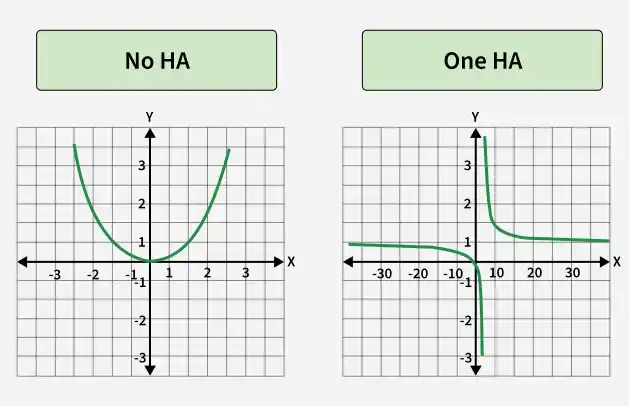
- If the degree of the P(x) is less than the degree of the Q(x), the horizontal asymptote is y = 0.
- If the degree of the P(x) is equal to the degree of the Q(x), the horizontal asymptote is where a and b are the leading coefficients of P(x) and Q(x), respectively.
- If the degree of the P(x) is greater than the degree of the Q(x), there is no horizontal asymptote.
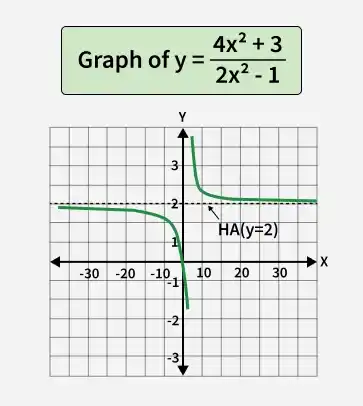
Example: Find the horizontal asymptote of
Step 1: Identify degrees
- Degree of numerator = 2
- Degree of denominator = 2
Step 2: Apply rule (degrees equal)
For functions of the form :
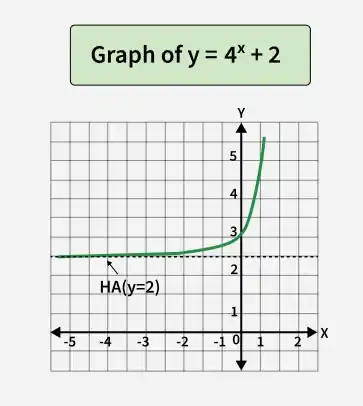
Example: Find the horizontal asymptote of
Step 1: Analyze behavior as
Step 2: Substitute limit
Horizontal Asymptote of Logarithmic Functions
For functions like there is no horizontal asymptote as the x to the or x to . However, the vertical asymptote is at x = 0.
Example 1: Find the horizontal asymptote of
Degree of Numerator: 3
Degree of Denominator: 3
Since the degrees are equal the horizontal asymptote is determined by the ratio of the leading coefficients:
Thus, the horizontal asymptote is y = 2.
Example 2: Determine the horizontal asymptote of the .
As x to , to 0 .
Therefore, g(x) to .
Thus, the horizontal asymptote is y = 0.
Questions 1. Find the horizontal asymptote of .
Questions 2. Determine the horizontal asymptote of .
Questions 3. What is the horizontal asymptote of ?
Questions 4. Find the horizontal asymptote of .
Questions 5. Determine if the function has a horizontal asymptote.