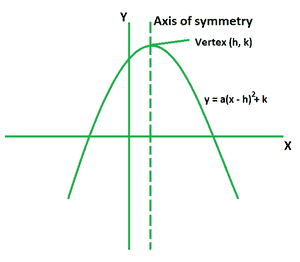
The vertex of a quadratic function is the point on the graph (parabola) where the function reaches its maximum or minimum value. It is the turning point of the parabola, where the graph changes direction.
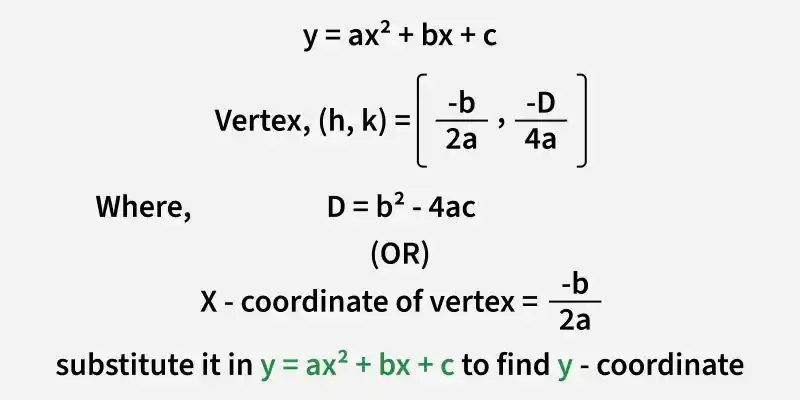
The vertex of a quadratic function of standard form f(x) = ax2 + bx + c can be found using the vertex formula:
h = -b/2a
k = f(h)
The (h, k) coordinates represent the vertex of the quadratic function.
The x-coordinate of the vertex is h, and the y-coordinate of the vertex is k. h is found by substituting -b/2a in the function, and the y-coordinate is the value of the function at h.
Steps:
Step 1: Identify the coefficients a and b in the quadratic function f(x) = ax² + bx + c
Step 2: Calculate the x-coordinate of the vertex using h = -b / (2a)
Step 3: Substitute the value of h into the function f(x) to find k, i.e., k = f(h)
Step 4: The coordinates of the vertex are (h, k).
Completing the Square Method
Using the completing the square method,we can convert the quadratic equation of form ax2 + bx + c to vertex form a(x - h)2 + k, where (h, k) is the vertex.
Steps:
Step 1: Start with the standard form of a quadratic equation: f(x) = ax² + bx + c
Step 2: If a ≠ 1, factor out a from the quadratic and linear terms: f(x) = a(x² + (b/a)x) + c
Step 3: Add and subtract the square of half the coefficient of x: f(x) = a(x² + (b/a)x + (b/2a)² − (b/2a)²) + c
Step 4: Form a perfect square: f(x) = a(x + b/2a)² − a(b/2a)² + c
Step 5: Simplify the equation: f(x) = a(x + b/2a)² + c − b²/4a
Step 6: Compare with vertex form: f(x) = a(x − h)² + k
Step 7: Identify the values: h = −b/2a k = c − b²/4a
Step 8: Therefore, the vertex is: (h, k)
By Graphical Analysis
In graphical analysis we plot the quadratic function and identify the vertex visually,i.e. by looking. This method is very useful for understanding the behaviour of the quadrafunction, and it is also used to confirm the results obtained using algebraic methods.
Steps for Graphical Analysis
Step 1: Plot the quadratic function. We will use graphing calculator or software to plot the function: f(x) = ax2 + bx + c
Step 2: Identify the Axis of symmetry. The axis of symmetry is the vertical line that passes through the vertex. It can be found using the formula x = -b/2a
Step 3: Vertex is the point where the parabola intersects the axis of symmetry. The coordinates of vertex is (h, k).