|
VOOZH | about |
|
VOOZH | about |
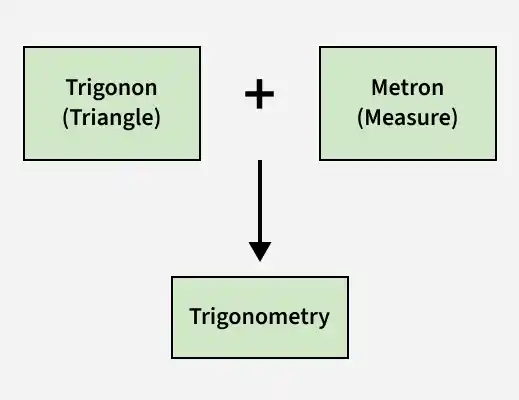
Trigonometry is a branch of mathematics that studies the relationship between the angles and sides of triangles, especially right-angled triangles, using ratios such as sine, cosine, and tangent. It is widely used to calculate distances, heights, and angles in mathematics, science, and real-life applications.
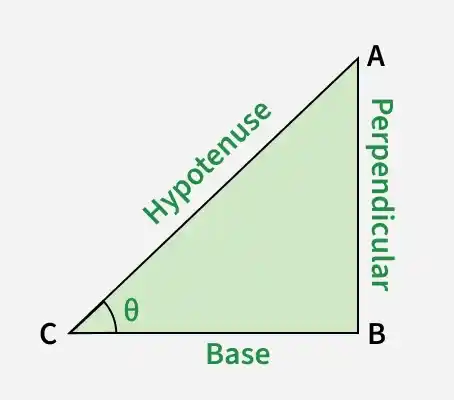
Trigonometry is based on the study of a right-angled triangle, where the relationship between its sides and angles helps define important trigonometric ratios. The three primary ratios—sine, cosine, and tangent—form the foundation of all trigonometric concepts, from which other ratios like secant, cosecant, and cotangent are derived.
In a right-angled triangle:
Trigonometric ratios define the relationship between the sides of a right-angled triangle with respect to a given angle θ. There are six basic trigonometric ratios:
The remaining three ratios are the reciprocals of these:
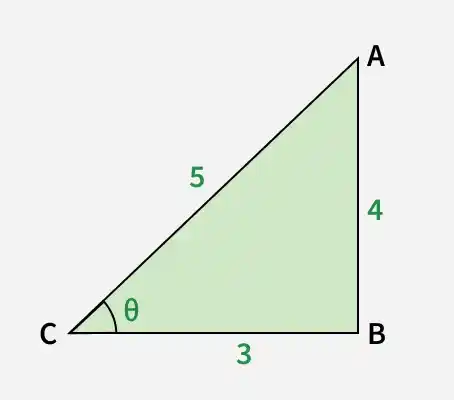
Example: Given sin θ = 4/5. Find all trigonometric ratios for angle θ.
Solution:
Given:
sinθ = AB / AC = 4 / 5
So,
AB = 4, AC = 5Using Pythagoras theorem:
AB² + BC² = AC²
4² + BC² = 5²
16 + BC² = 25
BC² = 9
BC = 3All Trigonometric Ratios:
sinθ = AB / AC = 4 / 5
cosθ = BC / AC = 3 / 5
tanθ = AB / BC = 4 / 3cosecθ = AC / AB = 5 / 4
secθ = AC / BC = 5 / 3
cotθ = BC / AB = 3 / 4
The trigonometric table shows the values of six trigonometric ratios (sin, cos, tan, cosec, sec, cot) for standard angles.
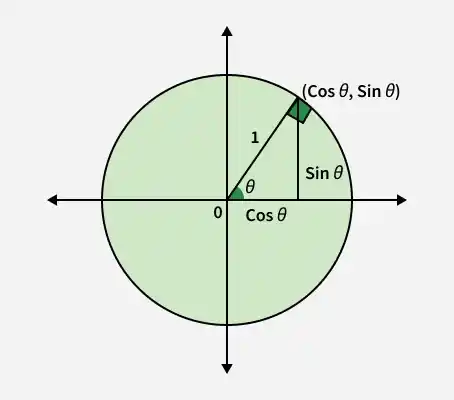
The unit circle helps in understanding and calculating the values of trigonometric functions. In this representation, cos θ corresponds to the x-coordinate and sin θ to the y-coordinate of a point on the circle.
Trigonometric identities are equations that hold for all values of the angle and help in simplifying trigonometric expressions.
1. Pythagorean Identities
2. Reciprocal Identities
3. Quotient Identities
4. Laws of Sine and Cosine
Example: Prove that,
Solution:
From Trigonometric Identity,
1 + tan2A = sec2A, and
1 + cot2A = cosec2A
Hence, the equation can be rewritten as,
Also, secA = 1/cosA, cosecA = 1/sinA,
⇒ LHS = tan2A
Hence, L.H.S. = R.H.S.
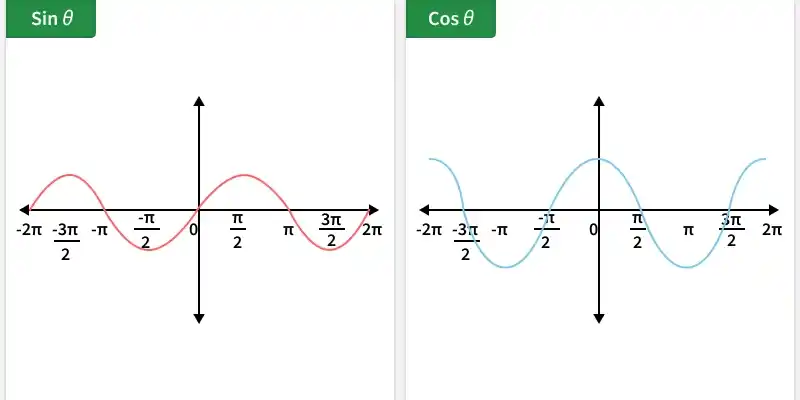
Trigonometric graphs help us understand the behaviour of functions like sine and cosine, including their domain, range, and periodic nature.
The graphs of the basic trigonometric functions, sine and cosine, are shown below.
The range of a trigonometric function refers to the set of values it takes for angles between 0° and 90° (first quadrant). For example, sin θ increases from 0 to 1 in this interval, so its range is [0, 1]. Similarly, each trigonometric function has a specific range and behaviour within this domain.
The table below shows the list of the range of trigonometric functions and their monotonic nature(Valid for 0° ≤ A ≤ 90°):
| ∠A | Range | Monotonicity |
|---|---|---|
| sin A | [0, 1] | Increasing |
| cos A | [0, 1] | Decreasing |
| tan A | [0, ∞) | Increasing |
| sec A | [1, ∞) | Increasing |
| cosec A | [1, ∞) | Decreasing |
| cot A | (0, ∞) | Decreasing |
Note: Monotonic means that, either the function will only increase or only decrease.