|
VOOZH | about |
|
VOOZH | about |
A Kite is a special type of quadrilateral that is easily recognizable by its unique shape, resembling the traditional toy flown on a string. In geometry, a kite has two pairs of adjacent sides that are of equal length. This distinctive feature sets it apart from other quadrilaterals like squares, rectangles, and parallelograms.
Diagonals of kite intersect each other at right angles. It is one of the unique quadrilateral and has some interesting properties that are covered below in the article. In this article, we will learn about, Kite Quadrilateral, Properties of kites, Examples, and others, in detail.
Table of Content
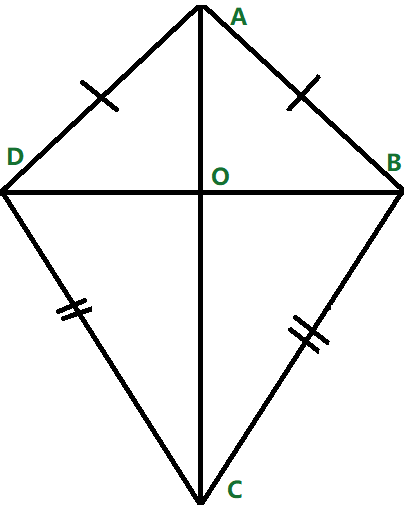
Kite is a quadrilateral, i.e. it is a polygon with four sides. In a kite, we have 2 pairs of equal-length sides and they are adjacent to each other. The image of a Kite is added below,
A kite have two diagonals, and the properties of the diagonls of the kite are added below,
In a kite we have four angles, as it a quadrilateral. The properties of the interior angles of the kite are,
Various properties of the kite are added below,
The interesting properties of the kite is that its diagonal are always perpendicular to each other. This is proved below, we have a kite ABCD, whose diagonal intersect each other at point O.
In ∆ABD and ∆BCD
AB = BC (Property of Kite)
AD = CD (Property of Kite)
BD = BD (Common Side)
Thus, ∆ABD ≅ ∆BCD (SSS congruency)
Now, in ∆ABC and ∆ADC
AB = BC (Property of Kite)
Hence ∆ABC is an isosceles triangle.
AD = CD (Property of Kite)
Hence ∆ADC is an isosceles triangle.
∠BAO = ∠BCO
BO = BO (Common Side)
Thus, ∆ABO ≅ ∆BCO (SAS rule of congruency)
Now we know ∠AOB = ∠BOC
Also, ∠AOB + ∠BOC = 180° (Linear Pair)
Hence, ∠AOB = ∠BOC = 90°
Hence diagonals of kite intersect at right angles.
There are two common formulas related to kite i.e.,
Area of Kite is calculated by the formula for area of quadrilateral. Generally Area of Kite is calculated by the formula added below,
Area of Kite = 1/2 × d1 × d2
Where,
- d1 is Shorter Diagonal of Kite
- d2 is Longer Diagonal of Kite
Perimeter of Kite is calculated by adding up the length of sides of the kite. If a Kite ABCD is given then formula is given as
Perimeter of Kite ABCD = AB + BC + CD + AD
Read More,
A kite is a type of quadrilateral with two distinct pairs of adjacent sides that are equal in length. The diagonals of a kite intersect at right angles, and one diagonal bisects the other. The area of a kite can be calculated using the formula Area= 1/2×Diagonal 1×Diagonal 2.
Example 1: Find the Area of a Kite whose diagonals are 40 cm and 35 cm.
Solution:
Area of Kite with diagonals as d1 and d2 is given as 1/2 × d1 × d2
Given,
- d1 = 40 cm
- d2 = 35 cm
Area = 1/2 × 40 × 35
Area = 700 cm2
Hence, the area of kite is 700 cm2
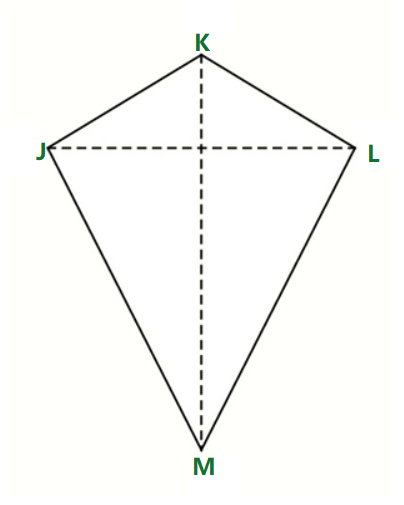
Example 2: Find the unknown angles of the kite added in the image below,
Given,
Solution:
We know that, main diagonal bisects the kite into two halves.
Thus,
∠KJL = ∠KLM
Hence ∠KLM = ∠KJL = 100° (given)
Sum of all angles of quadrilateral is 360°
Thus,
∠JML = 120°
Example 3: The Area of a kite-shaped field is 450 m² and the length of one of its diagonal is 50 m. A man wants to cross the field through the other diagonal. Find the distance the man has to travel.
Solution:
Given,
- Area of Kite = 450 m2
- Length of One Diagonal(d1) = 50 m
Let the other diagonal of kite is d2
Area of Kite = 1/2 × d1 × d2
450 = 1/2 × 50 × d2
d2 = 18 m
Hence, other man has to travel a distance of 18 m.
Example 4: A park is shaped like a kite. If the diagonals of the park are 120 meters and 160 meters, how much fencing is needed to enclose the park if the sides measure 50 meters and 80 meters?
Solution:
The perimeter of the park (kite) can be calculated by summing the lengths of all sides: Perimeter=2×(50m+80m)=2×130m=260m
Therefore, 260 meters of fencing is needed.
Example 5:In a kite, one pair of opposite angles is 70° and 110°. Find the measure of the other pair of opposite angles.
Solution:
In a kite, the sum of all interior angles is 360°. Let the other two angles be x and x (since they are equal): 70°+110°+𝑥+𝑥=360°
Simplifying: 180°+2x=360°
Subtract 180° from both sides: 2x=180°
Divide by 2: x=90°
So, the other two angles are each 90°.
Solution:
To find the area of a kite, we use the formula:
Area = 1/2 × d1 × d2
Given:
- Diagonal d1 = 12 cm
- Diagonal d2 = 30 cm
Area = 1/2 × 12 × 30 = 180 cm2
In summary, a kite is a unique quadrilateral with two pairs of equal adjacent sides and diagonals that intersect at right angles. Its distinct properties, such as symmetry and specific angle relationships, make it an important shape in geometry. The area and perimeter of a kite can be easily calculated using simple formulas, and understanding these properties is essential for solving various geometric problems and real-world applications.