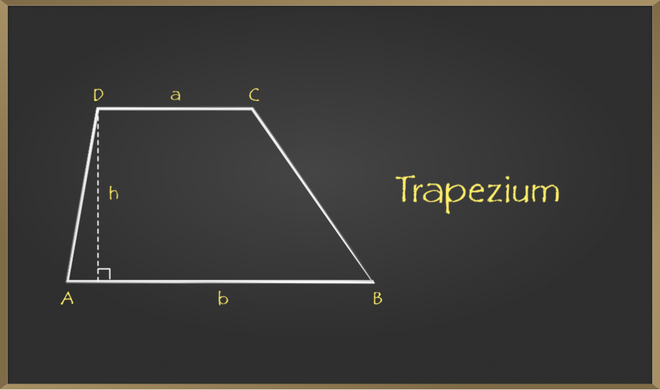
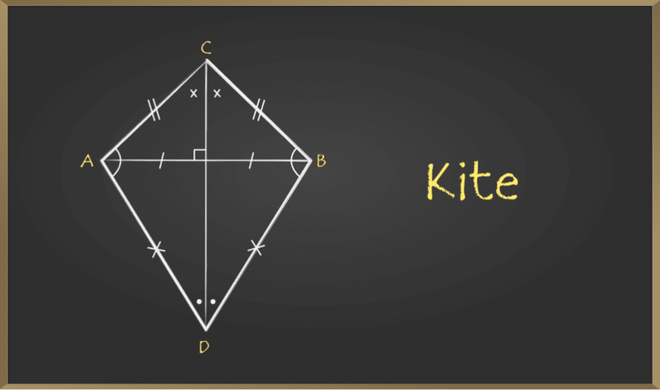
A quadrilateral is a closed figure and a type of polygon which has four sides or edges, four angles, and four corners or vertices. The word quadrilateral is derived from the Latin words "quad", a variant of four, and "latus", meaning side. It is also called a tetragon, derived from the Greek word "tetra", meaning four, and "gon" meaning corner or angle.
In this article, we will learn about Quadrilateral Definition, various Quadrilateral Formulas, related examples and others in detail.
It is not necessary that all four sides of a quadrilateral are equal in length. Thus, we can have different types of quadrilaterals based on their sides and angles.
Here, ABCD is a quadrilateral, with four sides namely AB, BC, CD, DA, four angles ∠A, ∠B, ∠C, ∠D, and the lines joining A to C and B to D are two diagonals of the quadrilateral.
Types of Quadrilateral
Based on their properties, quadrilaterals are divided into two major types:
Convex Quadrilaterals: Quadrilaterals that have one interior angle greater than 180° and one diagonal lies outside the quadrilateral are called concave quadrilaterals.
Concave Quadrilaterals: Quadrilaterals that have all four interior angles less than 180° are called concave quadrilaterals.
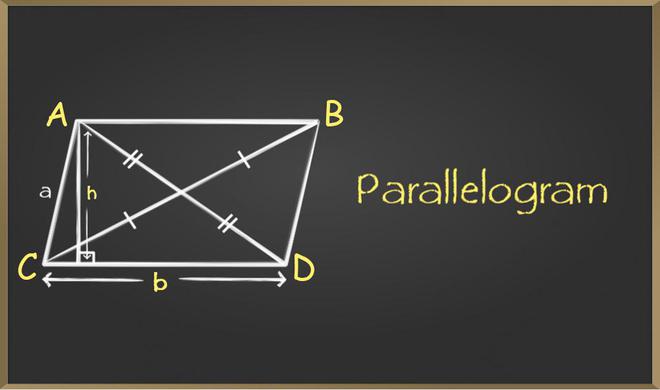
A parallelogram is a quadrilateral with two pairs of parallel sides. The opposite sides of a parallelogram are of equal length and the opposite angles of a parallelogram are also equal. The image for the same is added below:
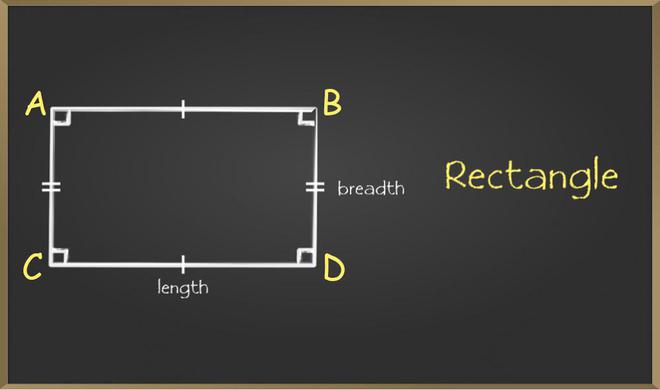
A Rectangle is a type of quadrilateral that has its parallel sides equal to each other and all four angles 90°. Hence, it is also called an equiangular quadrilateral. The image for the same is added below:
In geometry, the area can be defined as the space occupied by a flat shape or the surface of an object. The area of a figure is the number of unit squares that cover the surface of a closed figure. The area is measured in square units such as square centimeters, square feet, square inches, etc.
In geometry, the perimeter can be defined as the path or the boundary that surrounds a shape. It can also be defined as the length of the outline of a shape.
Since we know that quadrilateral has four sides, therefore, the perimeter of any quadrilateral say, ABCD, is given by
Problem 1: If 20cm and 10cm are diagonal lengths of a kite, then find the area of the kite.
Solution:
Given:
Length of diagonal1 = 20cm
Length of diagonal2 = 10cm
Area of Kite =1/2 × diagonal1 × diagonal2
Area =1/2 ×20 ×10 = 100cm2
Problem 2: How can we find the perimeter of an irregular Quadrilateral?
Solution:
To determine the perimeter of an irregular quadrilateral we can simply add the length of the outer sides of the quadrilateral. Because perimeter is nothing but the total length of the periphery of any shape.
Problem 3: Find the area of the trapezium whose length of parallel sides is 7cm and 18cm respectively and the height of the trapezium is 10cm.
Solution:
Given,
Length of parallel sides of Trapezium,
Length 1 = 7cm
Length 2 = 18cm
Height of Trapezium = 10cm
we know that, Area of Trapezium = 1/2 × Height × (Length1 + Length2)
Therefore,
Area = 1/2 × 10 ×(7 +18)
=125cm2
Hence, Area of the given trapezium is 125cm2
Problem 4: The perimeter of a quadrilateral is 90cm and the length of the three sides are AD = 23cm, AB = 28cm and BC = 18cm. Find the length of the fourth side i.e, CD.
Problem 5: If the area of a rhombus is 70cm2 and the base is 15cm, then find out the height of the given rhombus.
Solution:
Area = 70cm2
Base = 15cm
Since Area of Rhombus = Height × Base
This implies,
70 = Height × 15
Height = 70/15
Height = 4.67cm
Problem 6: Write down the formula to calculate the length of the diagonal of a rectangle.
Solution:
Diagonal of a rectangle is a line segment drawn to connect any two non-adjacent vertices of a rectangle. A rectangle can have a maximum of two diagonals of equal length.
A diagonal rectangle divides the rectangle into two right-angle triangles. Therefore we can easily calculate the length of diagonals using the Pythagoras Theorem, where the diagonals are considered as the hypotenuse of the right triangle.