|
VOOZH | about |
|
VOOZH | about |
The L'Hopital rule uses derivatives of each function to solve the limit, which helps us evaluate the limits that result in an indeterminate form.
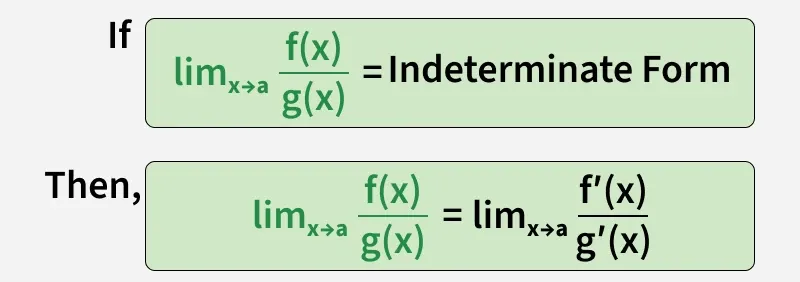
L'Hopital rule states that when the limit is applied to a fraction of two functions resulting in an indeterminate form then it is equal to the limit of the fraction formed by the individual derivatives of functions.
The indeterminate forms are the forms with two functions whose limits cannot be determined by putting the limits in the function. The indeterminate form is the form that is undefined mathematically.
The forms whose value cannot be evaluated by directly applying the limits are called indeterminate forms. Indeterminate form includes 0/0, ±∞/±∞, 0×∞, ∞-∞, 00, 1∞ etc. The 0/0, and ±∞/±∞ are the most common indeterminate forms in which the L'Hopital rule is applied.
For two continuous and differentiable functions f(x) and g(x), if the limits x tends to result in an indeterminate form, then the L'Hopital rule is applied, and it states,
If the limit results in an indeterminate form of , and
if the derivatives f′(x) and g′(x) exist and
are continuous near c, and g′(x)≠0 for x near c, then:
Where,
The L Hopital rule is used when the limits of two differentiable functions after applying the limit gives an indeterminate form. Commonly, for the indeterminate forms 0/0, ±∞/±∞ we apply the L'Hopital rule directly to evaluate the limit.
Some necessary conditions for applying the L'Hopital rule
= Some Finite Number
The L'Hopital rule is applied when limits result in indeterminate form 0/0, ±∞/±∞. We can prove the L'Hopital rule by using Cauchy's Mean Value Theorem.
Let f(x) and g(x) be two continuous functions on the interval [a, b] and differentiable on the interval (a, b) and we know for any function f(x), its derivative at x = c is given as
Assume that g(x) = 0 on (a, b), then there exists c in (a, b) such that
=
Let the functions f and g be differentiable at x = c satisfying where c belongs to the interval in which functions are defined. Let f(c) = g(c) = 0.
By Cauchy's Mean Value Theorem,
= lim x→c[f(x) -f(c)]/[g(x) - g(c)]
⇒ = [as f(c) = g(c) = 0]
⇒ =
⇒ =
⇒ =
Which is the required result.
L'Hopital rule is applied when we get an indeterminate form after applying the limits. For applying the L'Hopital Rule these are the following steps:
Example: Find limx→1 [(x10 - 1) / (x2 - 1)]
Solution:
First apply the limit
limx→1 [(x10 - 1) / (x2 - 1)] = [110 -1] / [12 -1] = 0 / 0
After applying the limit, we get 0 / 0 form so, we apply L'Hopital rule
f(x) = x10 - 1
⇒ f'(x) = 10x9
g(x) = x2 - 1
⇒ g'(x) = 2x
limx→1 [(x10 - 1) / (x2 - 1)] = (10x9) / 2x
Now, put limit x = 1, we get
⇒ limx→1 [(x10 - 1) / (x2 - 1)] = [(10×19 )-1] / [2×1] = 10 / 2
⇒ limx→1 [(x10 - 1) / (x2 - 1)] = 5
When the L'Hopital rule is applied once and also after applying the limit we get an indeterminate form then after simplifying the fraction, we can again apply L'Hopital Rule. We can apply the rule multiple times until we get an indeterminate form. Before each application of the L'Hopital rule, we should simplify the fractions.
Example: Find limx→0 [(sinx - x) / x2]
Solution:
First apply the limit
limx→0 [(sinx - x) / x2] = (sin0 - 0) / 02 = 0/0
After applying the limit, we get 0 / 0 form so, we apply L'Hopital rule
f(x) = sin x - x
⇒ f'(x) = cos x -1
g(x) = x2
⇒ g'(x) = 2x0
limx→0 [(sinx - x) / x2] = (cos x -1) / 2x
Now, put limit x = 0, we get
limx→0 [(sinx - x) / x2] = (cos 0 -1) / 2×0 = 0 / 0
Again we get 0 / 0 form so, we again apply L'Hopital rule
f(x) = cos x - 1
⇒ f'(x) = -sinx
g(x) = 2x
⇒ g'(x) = 2
limx→0 [(sinx - x) / x2] = (-sin x) / 2
Now, put limit x = 0, we get
limx→0 [(sinx - x) / x2] = (- sin 0) / 2 = 0
⇒ limx→0 [(sinx - x) / x2] = 0
When the variable is in power, we equate the limit with a variable and take the logarithm on both sides and then apply the L'Hopital rule.
Example: Evaluate: limx→∞ x1/x
Solution:
The given limit gives ∞0
In this question we have variable in the exponent, so we take ln
y = x1/x
Taking ln both sides in the above equation.
ln y = ln x1/x
⇒ ln y = (1 / x) ln x
Applying limit
limx→∞ ln y = limx→∞ (1 / x) × ln x
⇒ limx→∞ ln y = limx→∞ (ln x) / x
Applying L'Hopital rule
limx→∞ ln y = limx→∞ (1 / x) / 1
⇒ limx→∞ ln y = limx→∞ (1 / x)
putting limit
limx→∞ ln y = 1 / ∞ = 0
⇒ ln [limx→∞ y] = 0
⇒ limx→∞ y = e0
⇒ limx→∞ y = 1
⇒ limx→∞ x1/x= 1
Some of the key points which we need to remember related to L'Hopital's rule are:
Example 1. Find limx→-2 [(x + 2) / (x2 + 3x + 2)]
Solution:
First apply the limit
limx→-2 [(x + 2) / (x2 + 3x + 2)] = limx→-2 [(- 2 + 2) / ((-2)2 + 3×(-2) + 2)] = 0 / 0
After applying the limit, we get 0 / 0 form so, we apply L'Hopital rule
f(x) = x + 2
⇒ f'(x) = 1
g(x) = x2 + 3x + 2
⇒ g'(x) = 2x + 3
limx→-2 [(x + 2) / (x2 + 3x + 2)] = 1 / (2x + 3)
Now, put limit x = -2, we get
limx→-2 [(x + 2) / (x2 + 3x + 2)] = 1 / [2×(-2) + 3] = 1 / (-4 + 3)
⇒ limx→-2 [(x + 2) / (x2 + 3x + 2)] = -1
Example 2. Find limx→0 [sin 3x / x]
Solution:
First apply the limit
limx→0 [sin 3x / x] = sin 3(0) / 0 = 0 / 0
After applying the limit, we get 0 / 0 form so, we apply L'Hopital rule
f(x) = sin3x
⇒ f'(x) = 3cos3x
g(x) = x
⇒ g'(x) = 1
limx→0 [sin 3x / x] = 3cos 3x / 1
Now, put limit x = 0, we get
limx→0 [sin 3x / x] = [3cos 3(0)] / 1 = 3 / 1
⇒ limx→0 [sin 3x / x] = 3
Example 3. Find limx→∞ [x2 / ex]
Solution:
First apply the limit
limx→∞ [x2 / ex] = ∞2 / e ∞ = ∞ / ∞
After applying the limit, we get ∞ / ∞ form so, we apply L'Hopital rule
f(x) = x2
⇒ f'(x) = 2x
g(x) = ex
⇒ g'(x) = ex
⇒ limx→∞ [x2 / ex] = 2x / ex
Now, put limit x = ∞, we get
limx→∞ [x2 / ex] = (2 × ∞)/ e∞ = ∞ / ∞
Again we get ∞ / ∞ form so, we again apply L'Hopital rule
f(x) = 2x
⇒ f'(x) = x
g(x) = ex
⇒ g'(x) = ex
limx→∞ [x2 / ex] = 2 / ex
Now, put limit x = ∞, we get
limx→∞ [x2 / ex] = 2 / ex = 2 / e∞ = 2 / ∞
⇒ limx→∞ [x2 / ex] = 0
Example 4. Evaluate: limx→∞ xx
Solution:
The given limit gives ∞∞
In this question we have variable in the exponent, so we take ln
y = xx
Taking ln
ln y = ln xˣ
⇒ ln y = x ln x
Applying Limit
limₓ→∞ ln y = limₓ→∞ x ln x
⇒ limₓ→∞ ln y = limₓ→∞ [ ln x / (1 / x) ]
Applying L'Hopital rule
limₓ→∞ ln y = limₓ→∞ [ (1 / x) / ( −1 / x² ) ]
⇒ limₓ→∞ ln y = limₓ→∞ [ −(1 / x) / (1 / x)² ]
⇒ limₓ→∞ ln y = limₓ→∞ [ −1 / (1 / x) ]
⇒ limₓ→∞ ln y = limₓ→∞ ( −x )
Since for large x,
x > 0 and ln x > 0,
therefore x ln x is positive and increases without bound.Hence,
limₓ→∞ ln y = +∞
⇒ ln ( limₓ→∞ y ) = +∞
⇒ limₓ→∞ y = e⁺∞
⇒ limₓ→∞ y = ∞
⇒ limₓ→∞ xˣ = ∞
Find the following limits using L' Hopital Rule
Problem: 1
Problem: 2
Problem: 3
Problem: 4
Problem: 5
Problem: 6
Problem: 7
Problem: 8