|
VOOZH | about |
|
VOOZH | about |
Zeroes of a function are those real, complex or imaginary values when put in the function the value of the function becomes zero. There are multiple methods to find zeroes of function according to the function type. Zeroes of a function are very important while describing that function or while plotting the graph of that function.
In this article, we will see different Methods to find zeros of functions.
Table of Content
For a function f(x),
x = a is a zero/root of the function if f(a) 0.
Thus all such values of a (either real, complex, or imaginary ) for which f(x) = 0 are called zeroes of a function. For example, consider f(x) = x2 - 3x + 2 being a quadratic function. Now put x = 2 in the function
f(x) = 22-3×2 +2 = 0
Again put x =1 in the function then
f(x) = 12-3×1 +2 =0
So a = 1, 2 are zeroes of the function.
There are various methods to find zeroes of a function and that includes:
Now let's learn about each in detail.
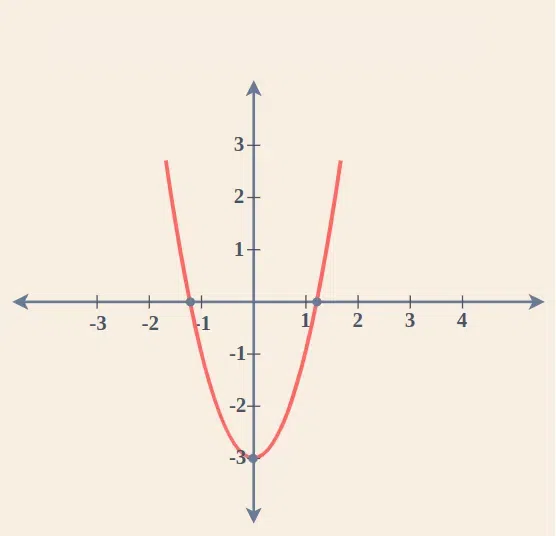
Zeroes of a function can be found by drawing the graph of the function. We know that for any Zero / root of the function, the value of f(x) is zero. So the x coordinate of all the points where the graph of function intersects the x axis represents the zeroes of function.
For example the graph of the function f(x) = x2 - 25/16 intersects the x-axis at two points x = 5/4 and x = -5/4 which are the zeroes of the given function f(x).
It is important to note that the graphical method can only find the real roots/zeroes of the function.
Similarly, we can use the Graphical Methods for finding the roots of any function e.g. logarithmic function, polynomial function, exponential Functions.
Read More aboutGraph of Polynomial Function
Factorization Method is highly useful method when the function can be factored into simpler components. For finding zeroes of the function using factorization method simply convert the function into simple factors, then equate each factor equal to zero and solve. The Idea behind equating both the factors equal to zero is that when the product of expression is zero than one or both factor must be zero. For example the zeroes of the function f(x) = x2-5x +6 can be found by factorization method as :
f(x) = x2-5x+6
f(x) = (x-3)(x-2)
put, x-3 =0 and x-2 =0
So x=3/2
Which are the required roots of the given Quadratic Function.
Read more about Factorization of polynomial function
One of the best Algebraic method to find the roots of a function is using Quadratic Formula. This method is useful for finding the roots of a Quadratic function. To find the roots of Quadratic function using this method simply put the value of a, b, c in the Quadratic formula, where a, b,c represents the coefficients of x2, x and constant term respectively.
root = (-b + √b2-4ac ) / 2a
or
root = (-b -√b2-4ac ) / 2a
This method can be used to find:
Newton Raphson Method is one of the most commonly used method for finding the roots of real valued function. It is named after Sir Isaac Newton and Joseph Raphson. Newton Raphson Method works by assuming the first iteration x0 and then approximating the next iteration (x1) which is close to the root. Here is how Newton Raphson Method works :
Let x1 = x0 + h be the root of function, where x0 is the approximate root of the equation
then
f(x1) =0 or f(x0+ h ) =0,
Expand the above equation using Taylor's theorem
f(x0) + hf1(x0) +..... =0
So,
h = -f(x0) / f'(x0) or we can say
x1 = x0 - f(x0) / f'(x0)
Similarly we can find Further approximation for x2, x3, x4.....
or
Xn+1 = Xn - f(xn) / f' (xn)
This is called Newton Raphson Formula.
Bisection Method is used to find the root of polynomial function in a given interval. This method works by dividing the interval into smaller subinterval until we find the correct answer. This Method works for functions continuous in a given interval. It is very similar to binary search due to which it is also known as binary search method or interval halving method. Here is how Bisection method works :
If f(m) < 0 choose interval from m to y, Since x < m < y.
If f(m) > 0 choose interval from x to m, Since x < m < y.
4. Keep Repeating Step 1 to 3 Until we find the correct Answer.
Read:Difference Between Newton Raphson and Bisection Method
Q1. Find zeroes of the following function f(x) = 7x2 - 9x + 2.
Solution:
Given Function f(x) = 7x2 - 9x + 2,
Factorize the given function
f(x) = 7x2 - 7x -2x + 2
f(x) = 7x(x-1) -2 (x-1)
f(x) = (x-1)(7x-2)
For Finding zeros put f(x) =0,
or (x-1)(7x-2) =0
or (x-1) =0 or ( 7x -2 ) = 0
or x=1 or x = 2/7
So Zeroes of the function are {1,2/7}.
Q2. Find zeroes of the function f(x) = tan2x -2tanx - 3, in the interval [0, π/2].
Solution:
Given f(x) = tan2x - 2tanx - 3,
or let tanx = p
So f(x) becomes
= p2 -2p - 3
Which is Quadratic Equation in one variable and can be solved using the quadratic formula
p = (2 +√22 + 4×3 ) / 2 or p = (2 -√22 + 4×3 ) / 2
p = ( 2 + √16) /2 or p = (2 -√16 ) / 2
p = 6/2 or p = -2/2
p = 3 or -1
So tanx = 3 or tanx =-1
Hence tan-1(3) is the Zero of function in the interval [0, π/2] as tan-1(-1) lies out of the interval [0, π/2].
Q3. Find the roots of the function f(x) = x2 - 4 in the interval x ∈ [ 0,8] Using Bisection Method.
Solution:
Given f(x) = x2 - 4,
Let a = 0 and b = 0
1st iteration:
Mid point of and b is m = a+b /2 = 0+8 / 2 = 4
and f(m) = (4)2 - 4 = 12 ≠ 0
So 4 is not a Zero of the function
2nd Iteration:
Since f(m) > 0 so we take the interval [0, 4]
Where
a = 0, b =4 and mid point of a and b is = (0 + 4) / 2 = 2
And
f(m) = (2)2 -4 = 0
So 2 is zero of the given function f(x) = x2 -4
Q4. Find the zeroes of the function f(x) = x3 -5x2 + 11x - 6.
Solution:
Given f(x) = x3 -5x2 + 11x - 6
f(x) = (x-1) (x2 -5x + 6 )
f(x) = (x-1 ) (x-2) (x-3)
put f(x)=0
either x=1, 2, 3 for f(x)=0
So x =1, 2, 3 are the required zeros of the given function