|
VOOZH | about |
|
VOOZH | about |
Chapter 10 of the Class 10 NCERT Mathematics textbook, "Circles," focuses on the properties and theorems related to circles. It covers topics such as the definition of a circle, chords, tangents, and the relationships between different parts of a circle. Students learn how to apply these properties to solve various geometric problems involving circles.
This section provides detailed solutions for Chapter 10 of the Class 10 NCERT Mathematics textbook. The exercise problems include working with chords, tangents, and angles related to circles. Solutions are presented step-by-step to help students understand and apply the geometric properties and theorems of circles effectively.
NCERT Solutions for Class 10 Maths Chapter 10 – Circles is curated by GeeksforGeeks experts to get help in solving all the problems related to this topic. With the help of this resource, students would not waste their precious time stuck in a single problem.
Chapter 10 Circles of the NCERT Solutions for Class 10 Maths covers major tangents of circles. Brief introductions to the circle, tangents to circles, and the number of tangents that can be drawn from a given point on a circle are covered in this topic.
Class 10 Maths NCERT Solutions Chapter 10 Exercises |
|---|
|
|
Solution:
A circle can have an infinite number of tangents because it has a infinite number of points on its circumference and each point can have its individual tangent.
Solution:
(i) one
(ii) secant
(iii) two
(iv) Point of contact
Solution:
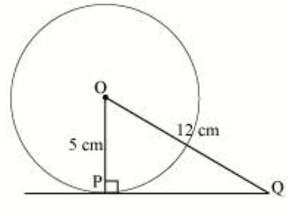
As we know that the line drawn from the centre of the circle to the tangent is perpendicular to the tangent at the point of contact.
Here OP is perpendicular to PQ.
Hence, the triangle OPQ is a Right angled Triangle, and we can apply Pythagoras Theorem in it.
PQ = √(OQ2−OP2)
PQ = √(122 - 52)cm
PQ = √119 cm
Hence, Option D is the correct answer.
Solution:
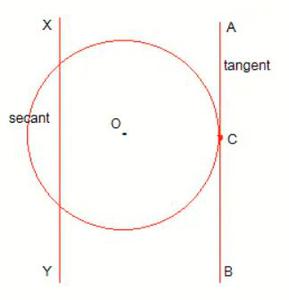
Here AB is the tangent to the circle at point C and XY is the secant to the circle. Also, both lines are parallel.
Theorem 10.1(NCERT) : The tangent at any point of a circle is perpendicular to the radius through the point of contact.
Theorem 10.2 (NCERT) : The lengths of tangents drawn from an external point to a circle are equal.
(A) 7 cm
(B) 12 cm
(C) 15 cm
(D) 24.5 cm
Solution:
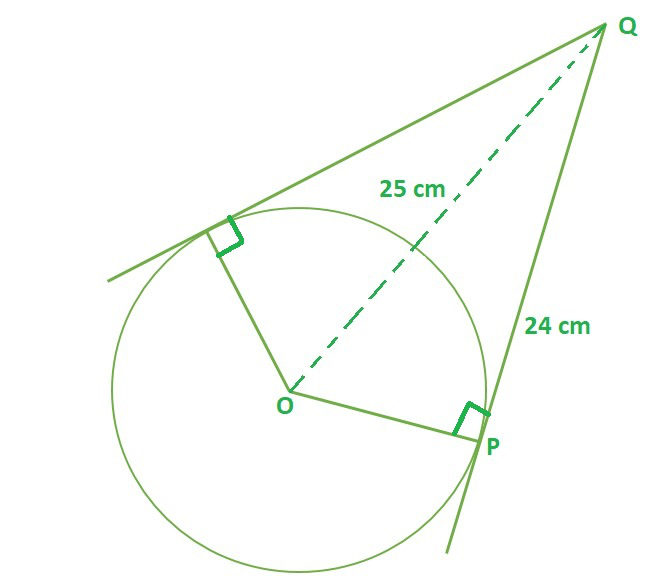
According to theorem 10.1, OP⊥ PQ then ∆OPQ is a right-angled triangle
OQ2 = PQ2 + OP2 (Pythagoras Theorem)
252 = 242 + OP2
OP2 = 252 - 242
OP2 = (25+24) (25-24) (using identity a2 - b2 = (a+b)(a-b))
OP = √49
OP = 7 cm
Hence, option A is correct.
(A) 60°
(B) 70°
(C) 80°
(D) 90°
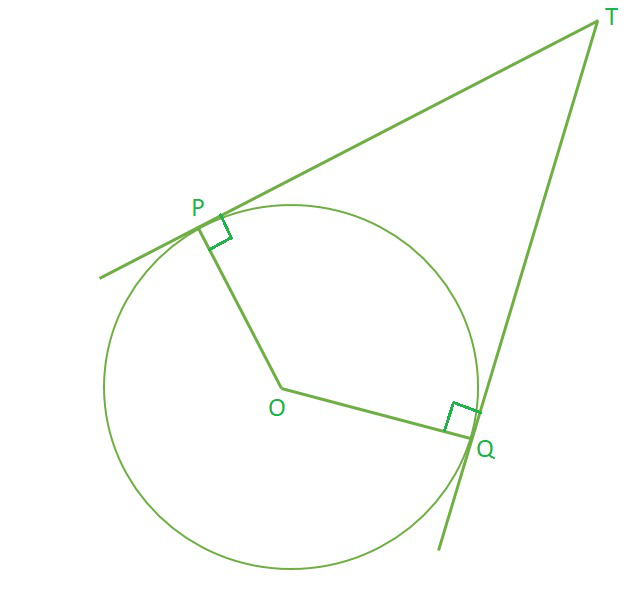
Solution:
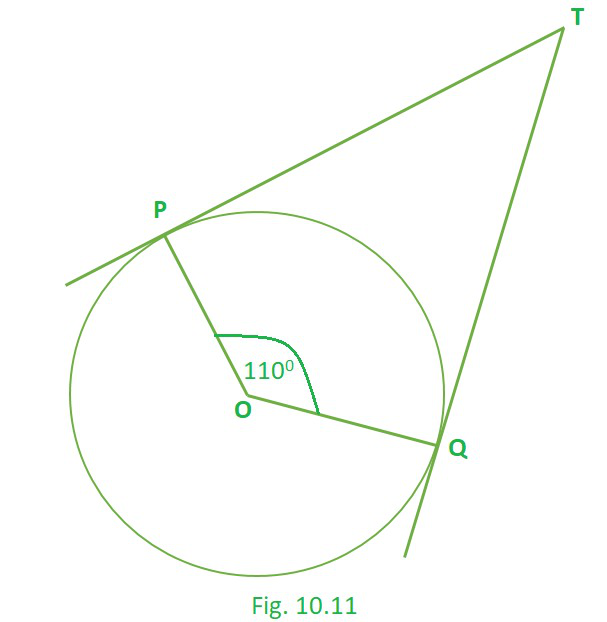
In the quadrilateral OPTQ,
∠P = 90°, ∠Q = 90° (Theorem 10.1)
∠O = 110°
The sum of the angles of a quadrilateral is 360° (Angle sum property of quadrilateral), Hence
∠P + ∠Q + ∠T + ∠O = 360°
90° + 90° + ∠T + 110° = 360°
∠T = 180 - 110° = 70°
Hence, option B is correct.
(A) 50°
(B) 60°
(C) 70°
(D) 80°
Solution:
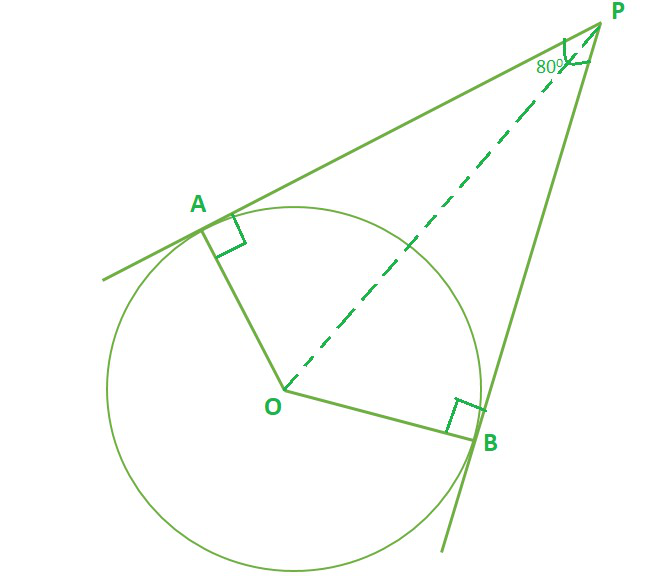
In the quadrilateral OAPB,
∠A = 90°, ∠B = 90° (Theorem 10.1)
∠P = 80°
The sum of the angles of a quadrilateral is 360° (Angle sum property of quadrilateral), Hence
∠A + ∠B + ∠P + ∠O = 360°
90° + 90° + 80° + ∠O = 360°
∠O = 180° - 80° = 100° .......................(1)
Considering, ∆OAP and ∆OBP
OA = OB ..............(radius of circle)
AP = BP ...............(Theorem 10.2)
∠OAP = ∠OBP .......(Theorem 10.1)
∴ ∆OAP ≅ ∆OBP [By SAS congruency]
So, ∠AOP = ∠BOP [By C.P.C.T.]..............(2)
From (1) and (2), we conclude that,
∠AOP + ∠BOP = 100°
∠AOP = 50°
Hence, option A is correct.
Solution:
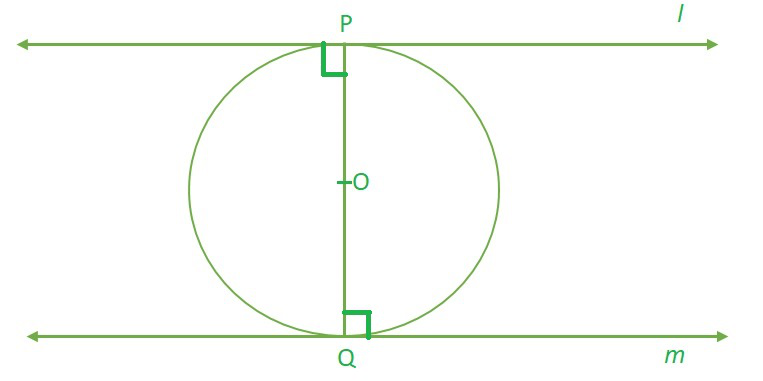
P and Q are point of contacts of Tangent lines l and m respectively.
O is the centre of circle.
OP⊥ l , OQ⊥ m and PQ is diameter (theorem 10.1)
∠PQm + ∠QPl = 90° + 90° = 180°
As, sum of adjacent angles is supplementary (180°), hence opposite sides are parallel.
Solution:
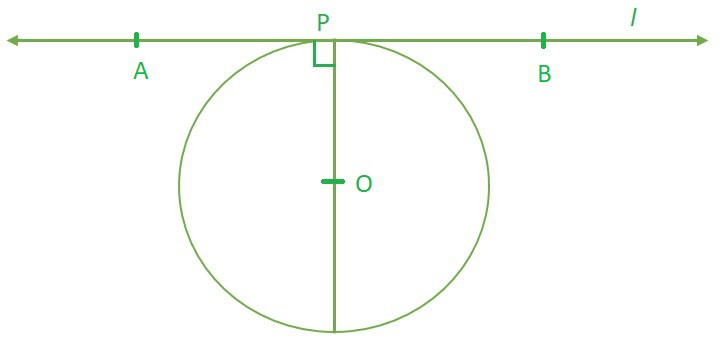
P is the point of contact of tangent line l.
Let, OP⊥ l at Point of contact P and it passes through point O.
As, The tangent at any point of a circle is perpendicular to the radius through the point of contact. (theorem 10.1)
According to the theorem 10.1 line OP has to pass through centre of circle for sure.
Solution:
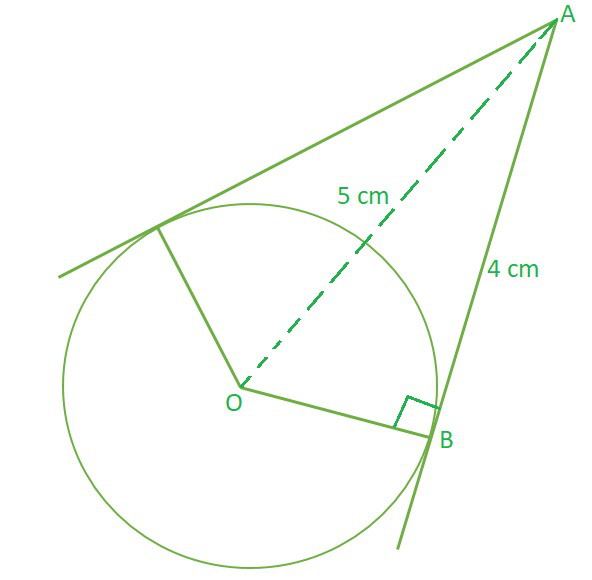
According to theorem 10.1, OB⊥ AB then ∆OAB is a right-angled triangle
OA2 = AB2 + OB2 (Pythagoras Theorem)
52 = 42 + OB2
OB2 = 52 - 42
OB2 = (5+4) (5-4) (using identity a2 - b2 = (a+b)(a-b))
OB = √9
OB = 3 cm
Hence, Radius of circle = 3 cm
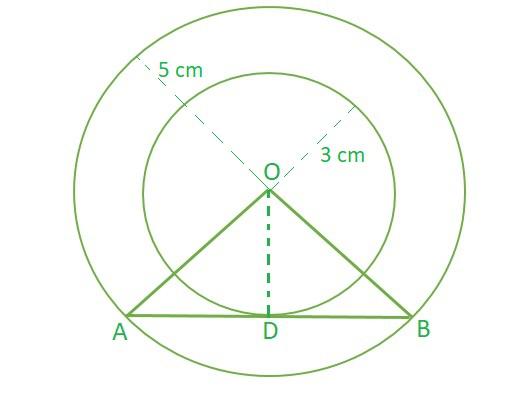
Solution:
Considering, ∆OAD and ∆OBD
OA = OB ..............(radius of large circle)
OD = OD ...............(common side)
∠ADO = ∠BDO .......(each 90°).......(Theorem 10.1)
∴ ∆OAD ≅ ∆OBD [By SAS congruency]
So, AD = BD [By C.P.C.T.]................(1)
Taking ∆OAD, which 90° at ∠D
OA = OB = 5 cm (radius of large circle)
OD = 3 cm (radius of smaller circle)
OA2 = AD2 + OD2 (Pythagoras Theorem)
52 = AD2 + 32
AD2 = 52 - 32
AD2 = (5+3) (5-3)
AD = √16
AD = 4 cm
AB = 2 × AD (from 1)
AB = 2 × 4
AB = 8 cm
Hence, length of the chord of the larger circle which touches the smaller circle = 8 cm
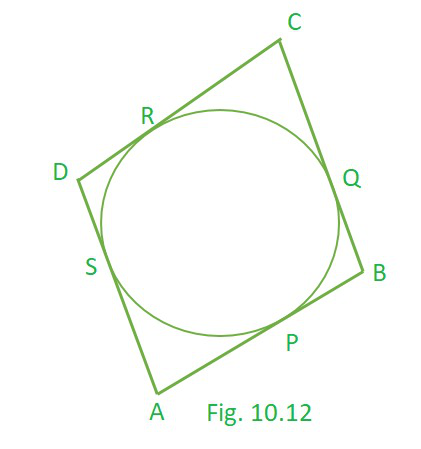
Solution:
Let the P, Q, R and S be point of contacts for tangent AB, BC, CD and DA respectively .
AP = AS (theorem 10.2)........(1)
BP = BQ (theorem 10.2)........(2)
CR = CQ (theorem 10.2)........(3)
DR = DS (theorem 10.2)........(4)
By, adding (1), (2), (3) and (4) RHS = LHS, we get
AP + BP + CR + DR = AS + BQ + CQ + DS
(AP + BP) + (CR + DR) = (AS + DS) + (BQ + CQ) (by Rearranging)
AB + CD = AD + BC
Hence, proved !!
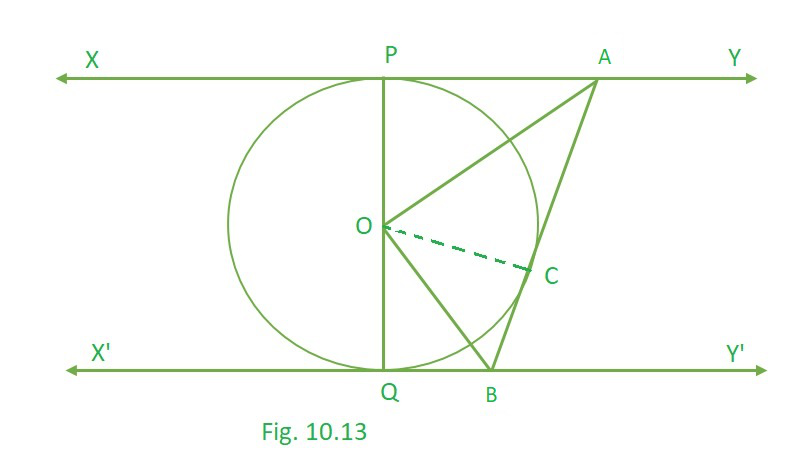
Solution:
As we can observe here,
AP and AC are tangent at same external point A.
and, QB and BC are tangent at same external point B.
Taking, ∆OAP and ∆OAC in consideration
OP = OC ..............(radius of circle)
OA = OA ...............(common side)
∠OPA = ∠OCA .......(each 90°).......(Theorem 10.1)
∴ ∆OAP ≅ ∆OAC [By SAS congruency]
So, ∠POA = ∠COA [By C.P.C.T.]
we can conclude that, ∠COP = 2 ∠COA....................(1)
Similarly, ∠COQ = 2 ∠COB .............(2)
Adding (1) and (2), RHS = LHS we get,
2 ∠COA + 2 ∠COB = ∠COQ + ∠COP
2 (∠COA + ∠COB) = 180° (Angle made by a straight line = 180°)
2 (∠AOB) = 180°
∠AOB = 90°.
Hence, proved !!
Solution:
In the quadrilateral OPTQ,
∠P = 90°, ∠Q = 90° (Theorem 10.1)
The sum of the angles of a quadrilateral is 360° (Angle sum property of quadrilateral), Hence
∠P + ∠Q + ∠T + ∠O = 360°
90° + 90° + ∠T + ∠O = 360°
∠T + ∠O = 180°
Hence, Proved, the angle between the two tangents drawn from an external point to a circle is supplementary to the angle subtended by the line segment joining the points of contact at the Centre.
Solution:
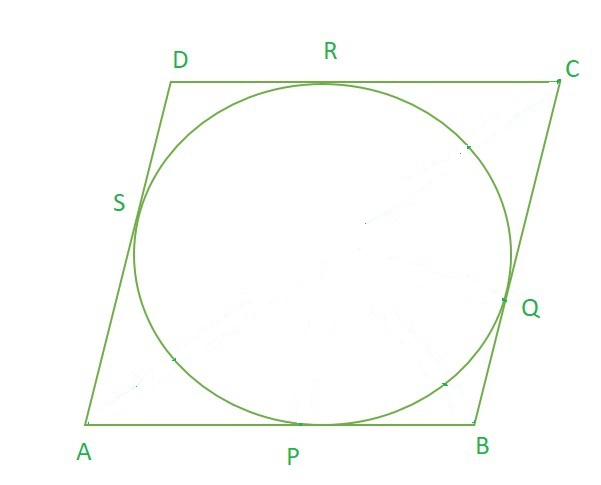
ABCD is a parallelogram and let P, Q, R and S be the point of contact of circle and parallelogram.
AP = AS (theorem 10.2)........(1)
BP = BQ (theorem 10.2)........(2)
CR = CQ (theorem 10.2)........(3)
DR = DS (theorem 10.2)........(4)
By, adding (1), (2), (3) and (4) RHS = LHS, we get
AP + BP + CR + DR = AS + BQ + CQ + DS
(AP + BP) + (CR + DR) = (AS + DS) + (BQ + CQ) (by Rearranging)
AB + CD = AD + BC
As ABCD is a parallelogram, AB = CD and AD = BC (Opposite sides of parallelogram are equal)
Hence, 2 AB = 2 BC
AB = BC
If adjacent side of parallelogram are equal, then it is a rhombus.
Hence, ABCD is a rhombus!!
Solution:
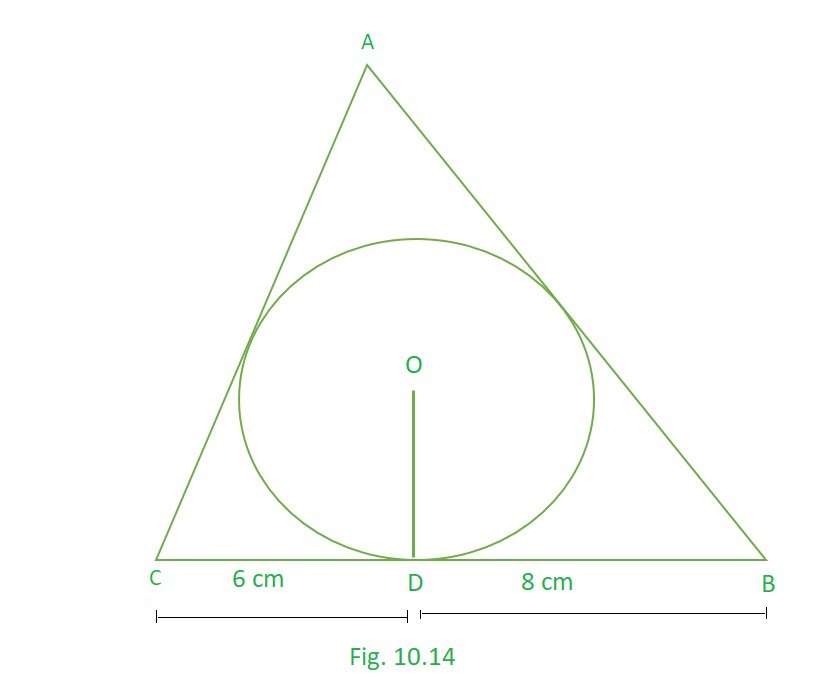
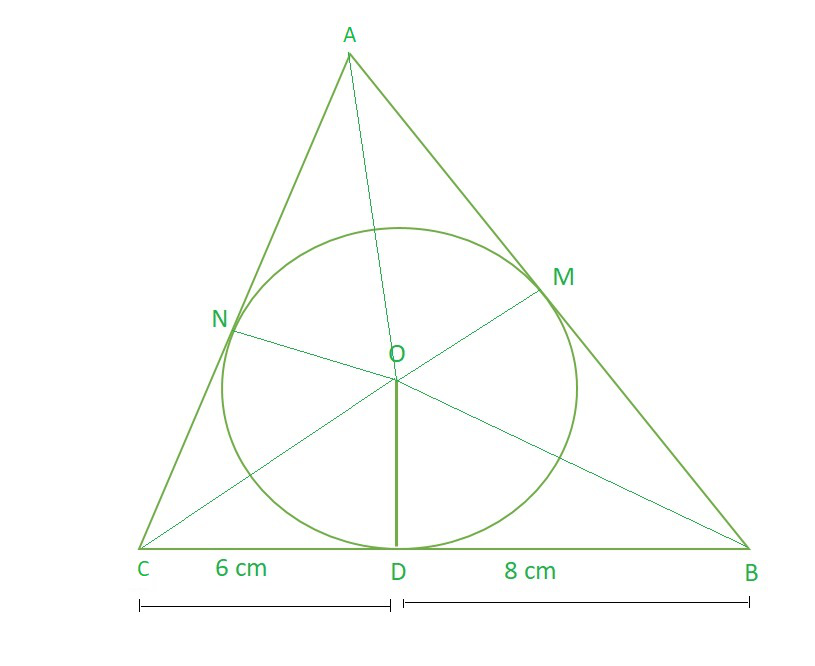
ABC is a Triangle and let M, D and N be the point of contact of circle and Triangle.
BD = BM = 8 cm (theorem 10.2)........(1)
CN = CD = 6 cm (theorem 10.2)........(2)
AN = AM = p cm (theorem 10.2)........(3)
AB = p+8 cm
BC = 6+8 = 14 cm
AC = p+6 cm
As we can observe here that,
Area of ∆ABC = Area of ∆AOC + Area of ∆COB + Area of ∆BOA
So, Area of ∆ABC = ar(∆ABC)
√(s (s-AB) (s-AC) (s-BC)) ............(Heron's formula) where s = (sum of sides) / 2
s = (AB+BC+AC)/2
s = (p+8+14+p+6)/2
s = (2p+28)/2
s = p+14
ar(∆ABC) = √((p+14) (p+14-(p+8)) (p+14-(p+6)) (p+14-14))
= √((p+14) (6) (8) (p))
= √48p (p+14) cm2...................................................(1)
Area of ∆AOC + Area of ∆COB + Area of ∆BOA = (½ × ON × AC) + (½ × OD × BC) + (½ × OM × AB)
= (½ × 4 × (p+6)) + (½ × 4 × 14) + (½ × 4 × (p+8))
= ½ × 4 (p+6+14+p+8)
= ½ × 4 × (2p+28)
= 4 × (p+14) cm2 ......................................................(2)
(1) = (2)
√48p (p+14) = 4 × (p+14)
Squaring both sides, we get
48 × p × (p+14) = (4 × (p+14))2
48 × p (
p+14) = 16 × (p+14)2(cancelling (p+14) from both sides)48 × p = 16 (p+14)
48p = 16p+ 224
32 × p = 224
p = 7 cm
Hence, AB = p+8 = 7+8 = 15 cm
AC = p+6 = 7+6 = 13 cm
Solution:
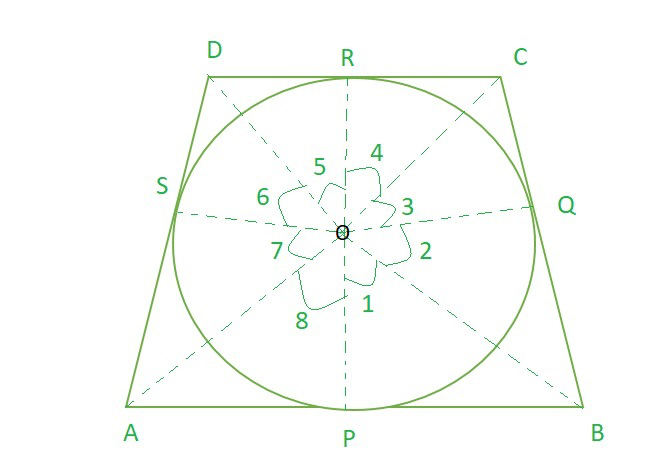
In the quadrilateral OPBQ,
∠OPB = 90° , ∠OQB = 90° (Theorem 10.1)
Considering, ∆OPB and ∆OQB
OP = OQ ..............(radius of circle)
OB = OB ...............(Common)
∠OPB = ∠OQB .......(each 90°)........(Theorem 10.1)
∴ ∆OPB ≅ ∆OQB [By SAS congruency]
So, ∠POB = ∠QOB [By C.P.C.T.]
Hence, ∠1 = ∠2 .................(1)
Similarly, ∠3 = ∠4 .................(2)
∠5 = ∠6 .................(3)
∠7 = ∠8 .................(4)
By making complete revolution,
∠1 + ∠2 + ∠3 + ∠4 + ∠5 + ∠6 + ∠7 + ∠8 = 360° (A complete revolution makes 360°)
∠1 + ∠1 + ∠4 + ∠4 + ∠5 + ∠5 + ∠8 + ∠8 = 360°
2 (∠1 + ∠4 + ∠5 + ∠8) = 360°
2 ((∠1 + ∠8) + (∠4 + ∠5) ) = 360°
∠AOB + ∠COD = 360° / 2 = 180°
Hence, proved, that opposite sides of a quadrilateral circumscribing a circle subtend supplementary angles at the Centre of the circle.
Chapter 10 of the Class 10 NCERT Mathematics textbook, "Circles," explores the fundamental properties and theorems related to circles. Key topics include the definition of a circle, chords, tangents, and the relationships between angles and arcs. The chapter teaches how to apply geometric properties to solve problems involving circles, such as finding angles and lengths. Solutions for exercises in this chapter help students practice these concepts and understand their applications in various geometric scenarios.