|
VOOZH | about |
|
VOOZH | about |
NCERT Solutions for Class 10 Maths Chapter 2 Polynomials- This article is an important resource created by the GFG team of experts to help students solve problems in the NCERT Textbook in an easy manner. It contains free NCERT Solutions for Class 10 Maths Chapter 2 Polynomials, as per the latest CBSE syllabus 2023-2024 and guidelines.
Class 10 Maths NCERT Solutions Chapter 2 Polynomials Exercises |
|---|
|
|
|
|
Chapter 2 Polynomials of NCERT Class 10 Maths deal majorly in topics such as fundamental aspects of polynomials. Students learn about the basic definitions, terms, coefficients, and degrees of polynomials. They study several polynomial varieties and comprehend polynomial operations including addition, subtraction, multiplication, and division. Factorization methods for quadratic polynomials are introduced, along with concepts like the factor theorem and remainder theorem. The chapter also delves into finding zeros of polynomials.
All the solutions to NCERT Class 10 Maths Chapter 2 Polynomials exercises have been covered in NCERT Solutions for Class 10 Maths.
👁 NCERT Solutions for Class 10 Maths Chapter 2 Polynomials
Solution:
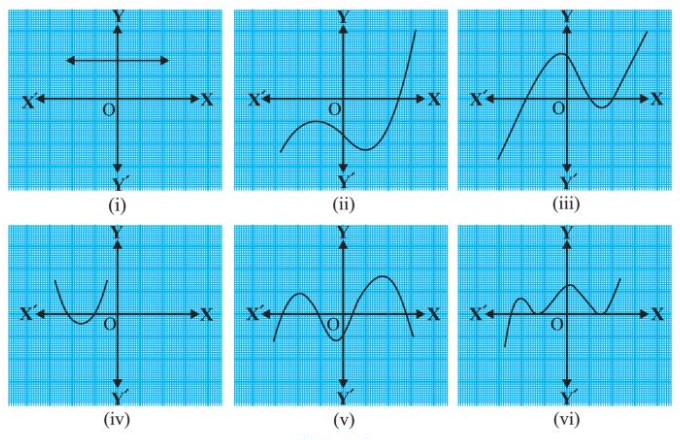
So, we have equation y = p(x). When p(x) = 0, y = 0.
That means we only need to find the number of times we get y = 0 in the graph.
In other words, the number of times the graph intersects the x-axis is the answer.
(i) 0. Because the graph doesn't intersect the x-axis.
(ii)1. Because the graph intersects the x-axis only at one point.
(iii) 3. Because the graph intersects the x-axis at three points.
(iv)2. Because the graph intersects the x-axis at two points.
(v)4. Because the graph intersects the x-axis at four points.
(vi) 3. Because the graph intersects the x-axis at three points.
(i) x2 – 2x – 8
x2 – 2x – 8 = x2 – 4x + 2x – 8
= x (x – 4) + 2(x – 4)
= (x - 4) (x + 2)
Therefore, zeroes of equation x2 – 2x – 8 are (4, -2)
Sum of zeroes is equal to [4 – 2]= 2 = -(-2)/1
i.e. = -(Coefficient of x) / (Coefficient of x2)
Product of zeroes is equal to 4 × (-2) = -8 =-(8)/1
i.e.= (Constant term) / (Coefficient of x2)
(ii) 4s2 – 4s + 1
4s2 – 4s + 1 = 4s2 – 2s – 2s +1
= 2s(2s – 1) – 1(2s - 1)
= (2s – 1) (2s – 1)
Therefore, zeroes of equation 4s2 – 4s +1 are (1/2, 1/2)
Sum of zeroes is equal to [(1/2) + (1/2)] = 1 = -4/4
i.e.= -(Coefficient of s) / (Coefficient of s2)
Product of zeros is equal to [(1/2) × (1/2)] = 1/4
i.e.= (Constant term) / (Coefficient of s2 )
(iii) 6x2 – 3 – 7x
6x2 – 3 – 7x = 6x2 – 7x – 3
= 6x2 – 9x + 2x – 3
= 3x(2x – 3) + 1(2x – 3)
= (3x + 1) (2x - 3)
Therefore, zeroes of equation 6x2 – 3 – 7x are (-1/3, 3/2)
Sum of zeroes is equal to -(1/3) + (3/2) = (7/6)
i.e.= -(Coefficient of x) / (Coefficient of x2)
Product of zeroes is equal to -(1/3) × (3/2) = -(3/6)
i.e.= (Constant term) / (Coefficient of x2 )
(iv) 4u2 + 8u
4u2 + 8u = 4u(u + 2)
Therefore, zeroes of equation 4u2 + 8u are (0, -2).
Sum of zeroes is equal to [0 + (-2)] = -2 = -(8/4)
i.e. = -(Coefficient of u) / (Coefficient of u2)
Product of zeroes is equal to 0 × -2 = 0 = 0/4
i.e. = (Constant term) / (Coefficient of u2 )
(v) t2 – 15
t2 – 15
⇒ t2 = 15 or t = ±√15
Therefore, zeroes of equation t2 – 15 are (√15, -√15)
Sum of zeroes is equal to [√15 + (-√15)] = 0 = -(0/1)
i.e.= -(Coefficient of t) / (Coefficient of t2)
Product of zeroes is equal to √15 × (-√15) = -15 = -15/1
i.e. = (Constant term) / (Coefficient of t2 )
(vi) 3x2 – x – 4
3x2 – x – 4 = 3x2 – 4x + 3x – 4
= x(3x - 4) + 1(3x - 4)
= (3x – 4) (x + 1)
Therefore, zeroes of equation 3x2 – x – 4 are (4/3, -1)
Sum of zeroes is equal to (4/3) + (-1) = (1/3) = -(-1/3)
i.e. = -(Coefficient of x) / (Coefficient of x2)
Product of zeroes is equal to (4/3) × (-1) = (-4/3)
i.e. = (Constant term) / (Coefficient of x2)
(i) 1/4, -1
Let two zeroes be α, β
∴ Sum of zeroes = α + β
∴ Product of zeroes = αβ
Given, Sum of zeroes = α + β = 1/4
Product of zeroes = α β = -1
∴ If α and β are zeroes of any quadratic polynomial, then the quadratic polynomial equation can be written directly as:-
x2 – (α + β)x + αβ = 0
x2 – (1/4)x +(-1) = 0
4x2 – x - 4 = 0
∴ 4x2 – x – 4 is the quadratic polynomial.
(ii) √2, 1/3
Let two zeroes be α, β
∴ Sum of zeroes = α + β
∴ Product of zeroes = αβ
Given Sum of zeroes = α + β =√2
Product of zeroes = αβ = 1/3
∴ If α and β are zeroes of any quadratic polynomial, then the quadratic polynomial equation can be written directly as:
x2 – (α + β)x + αβ = 0
x2 – (√2)x + (1/3) = 0
3x2 - 3√2x + 1 = 0
∴ 3x2 - 3√2x + 1 is the quadratic polynomial.
(iii) 0, √5
Let two zeroes be α, β
∴ Sum of zeroes = α + β
∴ Product of zeroes = αβ
Given, Sum of zeroes = α + β = 0
Product of zeroes = αβ = √5
∴ If α and β are zeroes of any quadratic polynomial, then the quadratic polynomial equation can be written directly as:-
x2 – (α + β)x + αβ = 0
x2 – (0)x + √5 = 0
∴ x2 + √5 is the quadratic polynomial.
(iv) 1, 1
Let two zeroes be α, β
∴ Sum of zeroes = α + β
∴ Product of zeroes = αβ
Given, Sum of zeroes = α + β = 1
Product of zeroes = αβ = 1
∴ If α and β are zeroes of any quadratic polynomial, then the quadratic polynomial equation can be written directly as:-
x2 – (α + β)x + αβ = 0
x2 – x + 1 = 0
∴ x2 – x + 1 is the quadratic polynomial.
(v) -1/4, 1/4
Let two zeroes be α, β
∴ Sum of zeroes = α + β
∴ Product of zeroes = αβ
Given, Sum of zeroes = α + β = -1/4
Product of zeroes = α β = 1/4
∴ If α and β are zeroes of any quadratic polynomial, then the quadratic polynomial equation can be written directly as:-
x2 – (α + β)x + αβ = 0
x2 – (-1/4)x + (1/4) = 0
4x2 + x + 1 = 0
∴ 4x2 + x + 1 is the quadratic polynomial.
(vi) 4, 1
Let two zeroes be α, β
∴ Sum of zeroes = α + β
∴ Product of zeroes = αβ
Given, Sum of zeroes = α + β = 4
Product of zeroes = αβ = 1
∴ If α and β are zeroes of any quadratic polynomial, then the quadratic polynomial equation can be written directly as:
x2 – (α + β)x + αβ = 0
x2 – 4x + 1 = 0
∴ x2 – 4x + 1 is the quadratic polynomial.
(i) p(x) = x3 – 3x2 + 5x – 3, g(x) = x2 – 2
(ii) p(x) = x4 – 3x2 + 4x + 5, g(x) = x2 + 1 – x
(iii) p(x) = x4– 5x + 6, g(x) = 2 – x2
Solution:
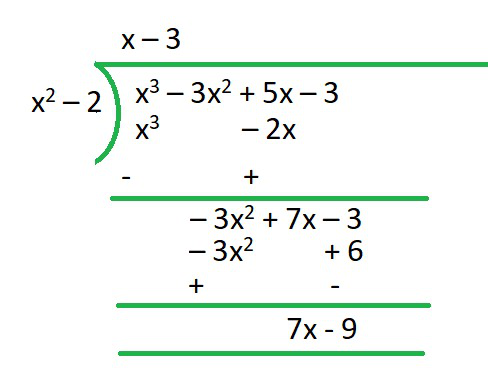
i)p(x) = x3 – 3x2 + 5x – 3, g(x) = x2 – 2
👁 NCERT Solutions for Class 10 Maths Chapter 2 Polynomials
R = 7x-9
Q = x-3
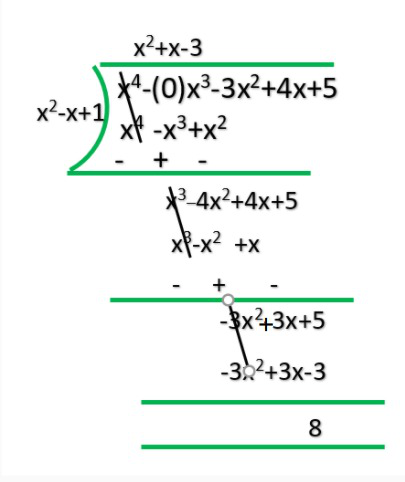
ii) p(x) = x4 – 3x2 + 4x + 5, g(x) = x2 + 1 – x
👁 NCERT Solutions for Class 10 Maths Chapter 2 Polynomials
R = 8
Q = x2+x-3
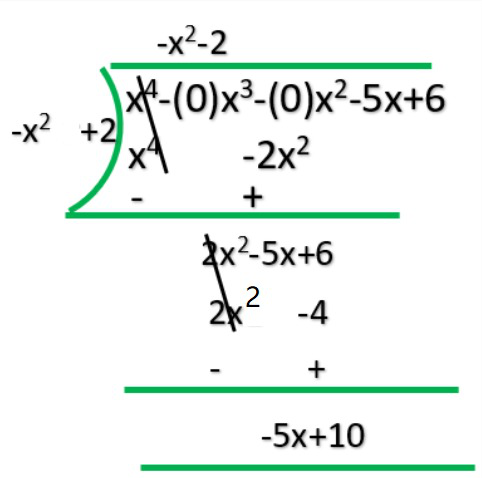
iii) p(x) = x4– 5x + 6, g(x) = 2 – x2
👁 NCERT Solutions for Class 10 Maths Chapter 2 Polynomials
Q = -x2-2
R = -5x+10
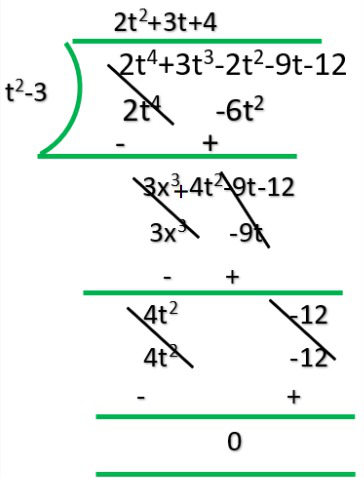
(i) t2 – 3, 2t4 + 3t3 – 2t2– 9t – 12
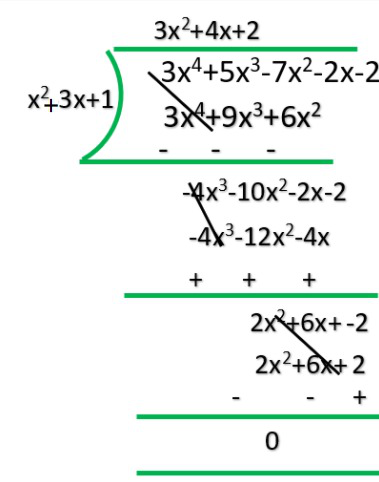
(ii) x2 + 3x + 1, 3x4 + 5x3 – 7x2 + 2x + 2
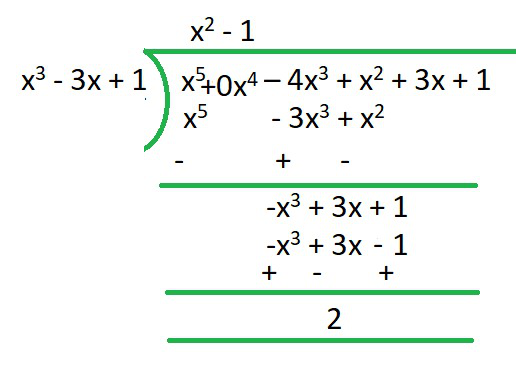
(iii) x3 - 3x + 1, x5 – 4x3 + x2 + 3x + 1
Solution:
i) t2 – 3, 2t4 + 3t3 – 2t2– 9t – 12
👁 NCERT Solutions for Class 10 Maths Chapter 2 Polynomials
Q = 2t3+3t+4
R = 0
Yes 1st polynomial is factor of 2nd polynomial.
ii) x2 + 3x + 1, 3x4 + 5x3 – 7x2 + 2x + 2
👁 NCERT Solutions for Class 10 Maths Chapter 2 Polynomials
R = 0
Q = 3x2-4x+2
iii) x3 - 3x + 1, x5 – 4x3 + x2 + 3x + 1
👁 NCERT Solutions for Class 10 Maths Chapter 2 Polynomials
R = x2-1
Q = 2
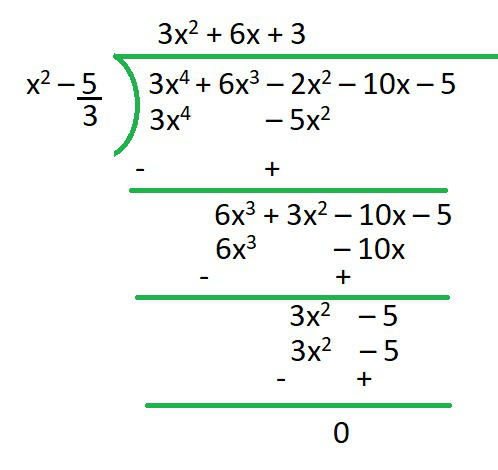
Solution:
👁 NCERT Solutions for Class 10 Maths Chapter 2 Polynomials
R = 0
Q = 3x2+6x+3
∴ we are factorizing
3x2+6x+3
x2+2x+1
(x+1)2
(x+1) (x+1) = 0
∴ x = -1 and x = -1
Solution:
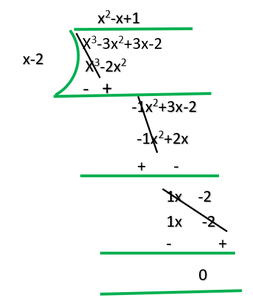
Dividend = Divisor * Quotient + Remainder
x3-3x2+3x-2/x-2
👁 NCERT Solutions for Class 10 Maths Chapter 2 Polynomials
R = 0
Q = x2 -x +1
Answer: g(x)=x2-x+1
(i) deg p(x) = deg q(x)
(ii) deg q(x) = deg r(x)
(iii) deg r(x) = 0
Solution:
i)deg p(x) = deg q(x)
p(x)=2x2-2x+14, g(x)=2
p(x)/g(x)=2x2-2x+14/2=(x2-x+7)
=x2-x+7=q(x)
=q(x)=x2-x+7
r(x)=0
ii) deg q(x)=deg r(x)
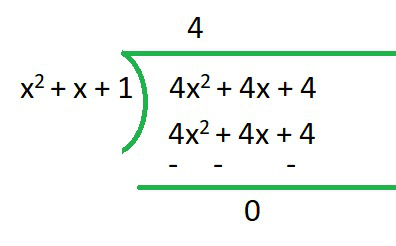
p(x)=4x2+4x+4, g(x)=x2+x+1
👁 NCERT Solutions for Class 10 Maths Chapter 2 Polynomials
q(x) = 4
r(x) = 0
∴Here deg q(x)=deg r(x)
iii) deg r(x)=0
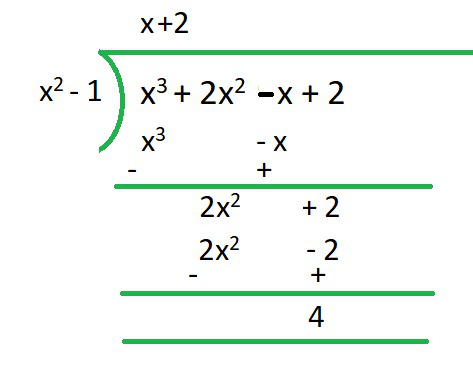
p(x)=x3+2x2-x+2 ,g(x)=x2-1
👁 NCERT Solutions for Class 10 Maths Chapter 2 Polynomials
q(x) = x+2
r(x) = 4
deg of r(x) = 0
Solution:
p(x) = 2x3+x2-5x+2
p(1/2) = 2(1/2)3+(1/2)2-5(1/2)+2
= (1/4)+(1/4)-(5/2)+2
= 0
p(1) = 2(1)3+(1)2-5(1)+2 = 0
p(-2) = 2(-2)3+(-2)2-5(-2)+2 = 0
Therefore, 1/2, 1, -2 are the zeroes of 2x3+x2-5x+2.
Now, comparing the given polynomial with general expression
ax3+bx2+cx+d = 2x3+x2-5x+2
a=2, b=1, c= -5 and d = 2
α, β, γ are the zeroes of the cubic polynomial ax3+bx2+cx+d
α +β+γ = –b/a
αβ+βγ+γα = c/a
α βγ = – d/a.
α+β+γ = ½+1+(-2)
= -1/2 = –b/a
αβ+βγ+γα = (1/2×1)+(1 ×-2)+(-2×1/2)
= -5/2 = c/a
α β γ = ½×1×(-2)
= -2/2 = -d/a
Hence, the relationship between the zeroes and the coefficients are satisfied.
Solution:
p(x) = x3-4x2+5x-2
Zeroes are 2,1,1.
p(2)= 23-4(2)2+5(2)-2
= 0
p(1) = 13-(4)(12 )+(5)(1)-2 = 0
Therefore, proved, 2, 1, 1 are the zeroes of x3-4x2+5x-2
On comparing the given polynomial with general expression
ax3+bx2+cx+d = x3-4x2+5x-2
a = 1, b = -4, c = 5 and d = -2
Therefore,
α + β + γ = –b/a
= 2+1+1
= 4
–b/a = -(-4)/1
αβ + βγ + γα = c/a
= 2×1+1×1+1×2
= 5
c/a = 5/1
α β γ = – d/a.
= 2×1×1
= 2
-d/a = -(-2)/1
Hence, the relationship between the zeroes and the coefficients is satisfied.
Solution:
Let us consider the cubic polynomial as ax3+bx2+cx+d and zeroes of the polynomials be α, β, γ.
α+β+γ = -b/a = 2/1
αβ +βγ+γα = c/a = -7/1
α βγ = -d/a = -14/1
On comparing
a = 1, b = -2, c = -7, d = 14
Therefore, the cubic polynomial is x3-2x2-7x+14
Solution:
p(x) = x3-3x2+x+1
Zeroes are given as a – b, a, a + b
px3+qx2+rx+s = x3-3x2+x+1
On comparing
p = 1, q = -3, r = 1 and s = 1
Sum of zeroes = a – b + a + a + b
-q/p = 3a
Putting the values q and p.
-(-3)/1 = 3a
a=1
Therefore, zeroes are 1-b, 1, 1+b.
Product of zeroes = 1(1-b)(1+b)
-s/p = 1-b2
-1/1 = 1-b2
b2 = 1+1 = 2
b = √2
Therefore,1-√2, 1,1+√2 are the zeroes of x3-3x2+x+1.
Solution:
Degree of polynomial is 4
Therefore, it has four roots
f(x) = x4-6x3-26x2+138x-35
As 2 +√3 and 2-√3 are zeroes of given polynomial f(x).
Therefore, [x−(2+√3)] [x−(2-√3)] = 0
(x−2−√3)(x−2+√3) = 0
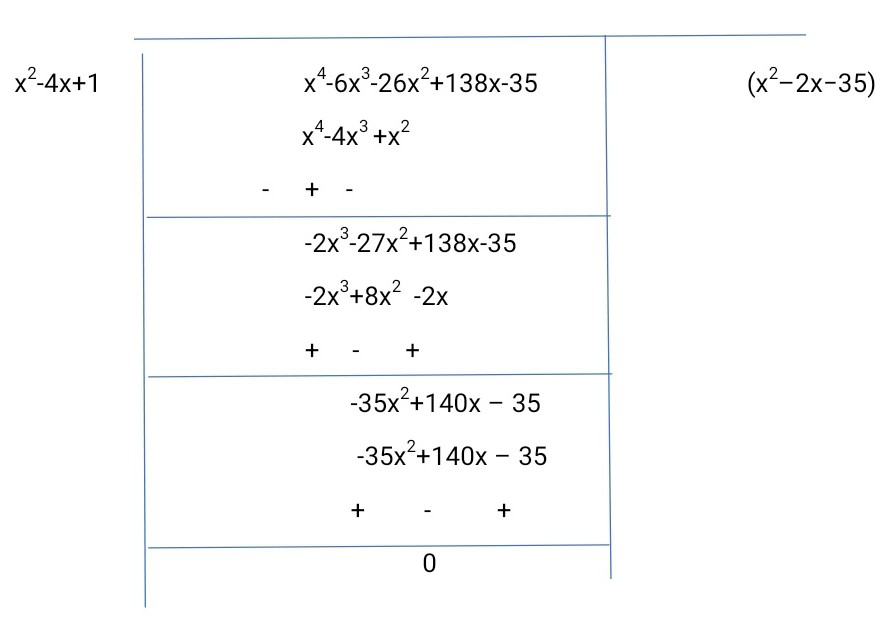
Therefore, x2-4x+1 is a factor of polynomial f(x).
Let it be g(x) = x2-4x+1
By dividing f(x) by g(x) we get another factor of f(x)
👁 NCERT Solutions for Class 10 Maths Chapter 2 Polynomials
x4-6x3-26x2+138x-35 = (x2-4x+1)(x2 –2x−35)
On factorizing (x2–2x−35) by splitting the middle term
x2–(7−5)x −35 = x2– 7x+5x-35
=x(x −7)+5(x−7)
(x+5)(x−7) = 0
x= −5 and x = 7.
Therefore, all four zeroes of given polynomial equation are: 2+√3, 2-√3, −5 and 7.
Also Check: