|
VOOZH | about |
|
VOOZH | about |
NCERT Solutions Class 9 Maths Chapter 2 Polynomials is curated by a team of professionals at GFG to help students in their academic journey. In this article, we have provided the answers to all the questions in the NCERT textbook. All of the problems in this chapter's exercise from the NCERT textbook for Class 9 are covered in the NCERT Solutions for Class 9 Maths.
The topics covered in the Polynomials chapter in Class 9 are Polynomials, Types of polynomials, Operations on polynomials, Degree of a polynomial, Factorization of polynomials, Factor Theorem, Remainder theorem, Algebraic identities and Application problems are the important Chapters in Class 9 Maths.
Table of Content
Class 9 Maths NCERT Solutions Chapter 2 Exercises |
|---|
|
|
|
|
These important NCERT Solutions for Class 9 Maths hold a significant weightage of 12 marks in the Class 9 Maths CBSE examination. It covers essential topics including:
To excel in this chapter, students can utilize NCERT Solutions for Class 9. These resources are invaluable for mastering concepts and preparing effectively for their Class 9 Maths exams.
(i) 4x2 - 3x + 7
(ii) y2 + √2
(iii) 3√t + t√2
(iv) y + 2/y
(v) x10 + y3 + t50
Solution:
(i) The algebraic expression 4x2 - 3x + 7 can be written as 4x2 - 3x + 7x0
As we can see, all exponents of x are whole numbers,
So, the given expression 4x2 - 3x + 7 is polynomial in one variable.
(ii) The algebraic expression y2 + √2 can be written as y2 + √2y0
As we can see, all exponents of y are whole numbers,
So, the given expression y2 + √2 is polynomial in one variable.
(iii) The algebraic expression 3 √t + t√2 can be written as 3 t1/2 + √2.t
As we can see, one exponent of t is 1/2, which is not a whole number,
So, the given expression 3 √t + t√2 is not a polynomial in one variable.
(iv) The algebraic expression y + 2/y can be written as y + 2.y-1
As we can see, one exponent of y is -1, which is not a whole number,
So, the given expression y+ 2/y is not a polynomial in one variable.
(v) The given algebraic expression is x10+ y3+ t50
As we can see, the expression contains three variables i.e x, y, and t,
So, the given expression x10 + y3 + t50 is not a polynomial in one variable.
(i) 2 + x2 + x
(ii) 2 - x2 + x3
(iii) pi/2 x2 + x
(iv) √2x - 1
Solution:
(i) The given algebraic expression is 2 + x2 + x
As we can clearly see, the coefficient of x2 is 1.
(ii) The given algebraic expression is 2 - x2 + x3
As we can clearly see, the coefficient of x2 is -1.
(iii) The given algebraic expression is pi/2 x2 + x
As we can clearly see, the coefficient of x2 is pi/2.
(iv) The given algebraic expression is √2 x — 1
As we can clearly see, the coefficient of x2 is 0.
Solution:
A Binomial having degree 35 is 4x35 + 50
A Monomial having degree 100 is 3t100pi
(i) 5x3 + 4x2 + 7x
(ii) 4 - y2
(iii) 5t - √7
(iv) 3
Solution:
The highest power of a variable in the given expression is known as the Degree of the polynomial
(i) The given expression is 5x3 + 4x2 + 7x
As we can clearly see, the highest power of variable x is 3,
So, the degree of given polynomial 5x3+4x2 + 7x is 3.
(ii) The given expression is 4 - y2
As we can clearly see, the highest power of variable y is 2,
So, the degree of given polynomial 4 - y2 is 2.
(iii) The given expression is 5t - √7
As we can clearly see, the highest power of variable t is 1,
So, the degree of given polynomial 5t - √7 is 1.
(iv) The given expression 3 can be written as 3x0
As we can clearly see, the highest power of variable x is 0,
So, the degree of given polynomial 3 is 0.
(i) x2 + x
(ii) x - x3
(iii) y + y2 + 4
(iv) 1 + x
(v) 3t
(vi) r2
(vii) 7x3
Solution:
(i) Since the degree of given polynomial x2 + x is 2,
So, it is a Quadratic Polynomial.
(ii) Since the degree of given polynomial x - x3 is 3,
So, it is a Cubic Polynomial.
(iii) Since the degree of given polynomial y + y2 + 4 is 2,
So, it is a Quadratic Polynomial.
(iv) Since the degree of given polynomial 1 + x is 1,
So, it is a Linear Polynomial.
(v) Since the degree of given polynomial 3t is 1,
So, it is a Linear Polynomial.
(vi) Since the degree of given polynomial r2 is 2,
So, it is a Quadratic Polynomial.
(vii) Since the degree of given polynomial 7x3 is 3,
So, it is a Cubic Polynomial.
(i) x = 0
(ii) x = –1
(iii) x = 2
Solution:
Given equation: 5x − 4x2 + 3
Therefore, let f(x) = 5x - 4x2 + 3
(i) When x = 0
f(0) = 5(0)-4(0)2+3
= 3
(ii) When x = -1
f(x) = 5x−4x2+3
f(−1) = 5(−1)−4(−1)2+3
= −5–4+3
= −6
(iii) When x = 2
f(x) = 5x−4x2+3
f(2) = 5(2)−4(2)2+3
= 10–16+3
= −3
(i) p(y) = y2−y+1
(ii) p(t) = 2+t+2t2−t3
(iii) p(x) = x3
(iv) P(x) = (x−1)(x+1)
Solution:
(i) p(y) = y2 – y + 1
Given equation: p(y) = y2–y+1
Therefore, p(0) = (0)2−(0)+1 = 1
p(1) = (1)2–(1)+1 = 1
p(2) = (2)2–(2)+1 = 3
Hence, p(0) = 1, p(1) = 1, p(2) = 3, for the equation p(y) = y2–y+1
(ii) p(t) = 2 + t + 2t2 − t3
Given equation: p(t) = 2+t+2t2−t3
Therefore, p(0) = 2+0+2(0)2–(0)3 = 2
p(1) = 2+1+2(1)2–(1)3 = 2+1+2–1 = 4
p(2) = 2+2+2(2)2–(2)3 = 2+2+8–8 = 4
Hence, p(0) = 2,p(1) =4 , p(2) = 4, for the equation p(t)=2+t+2t2−t3
(iii) p(x) = x3
Given equation: p(x) = x3
Therefore, p(0) = (0)3 = 0
p(1) = (1)3 = 1
p(2) = (2)3 = 8
Hence, p(0) = 0,p(1) = 1, p(2) = 8, for the equation p(x)=x3
(iv) p(x) = (x−1)(x+1)
Given equation: p(x) = (x–1)(x+1)
Therefore, p(0) = (0–1)(0+1) = (−1)(1) = –1
p(1) = (1–1)(1+1) = 0(2) = 0
p(2) = (2–1)(2+1) = 1(3) = 3
Hence, p(0)= 1, p(1) = 0, p(2) = 3, for the equation p(x) = (x−1)(x+1)
(i) p(x) = 3x+1, x=−1/3
(ii) p(x) = 5x–π, x = 4/5
(iii) p(x) = x2−1, x=1, −1
(iv) p(x) = (x+1)(x–2), x =−1, 2
(v) p(x) = x2, x = 0
(vi) p(x) = lx+m, x = −m/l
(vii) p(x) = 3x2−1, x = -1/√3 , 2/√3
(viii) p(x) = 2x+1, x = 1/2
Solution:
(i) p(x)=3x+1, x=−1/3
Given: p(x)=3x+1 and x=−1/3
Therefore, substituting the value of x in equation p(x), we get.
For, x = -1/3
p(−1/3) = 3(-1/3)+1
= −1+1
= 0
Hence, p(x) of -1/3 = 0
(ii) p(x)=5x–π, x = 4/5
Given: p(x)=5x–π and x = 4/5
Therefore, substituting the value of x in equation p(x), we get.
For, x = 4/5
p(4/5) = 5(4/5)–π
= 4–π
Hence, p(x) of 4/5 ≠ 0
(iii) p(x)=x2−1, x=1, −1
Given: p(x)=x2−1 and x=1, −1
Therefore, substituting the value of x in equation p(x), we get.
For x = 1
p(1) = 12−1
=1−1
= 0
For, x = -1
p(−1) = (-1)2−1
= 1−1
= 0
Hence, p(x) of 1 and -1 = 0
(iv) p(x) = (x+1)(x–2), x =−1, 2
Given: p(x) = (x+1)(x–2) and x =−1, 2
Therefore, substituting the value of x in equation p(x), we get.
For, x = −1
p(−1) = (−1+1)(−1–2)
= (0)(−3)
= 0
For, x = 2
p(2) = (2+1)(2–2)
= (3)(0)
= 0
Hence, p(x) of −1, 2 = 0
(v) p(x) = x2, x = 0
Given: p(x) = x2 and x = 0
Therefore, substituting the value of x in equation p(x), we get.
For, x = 0
p(0) = 02 = 0
Hence, p(x) of 0 = 0
(vi) p(x) = lx+m, x = −m/l
Given: p(x) = lx+m and x = −m/l
Therefore, substituting the value of x in equation p(x), we get.
For, x = −m/l
p(-m/l)= l(-m/l)+m
= −m+m
= 0
Hence, p(x) of -m/l = 0
(vii) p(x) = 3x2−1, x = -1/√3 , 2/√3
Given: p(x) = 3x2−1 and x = -1/√3 , 2/√3
Therefore, substituting the value of x in equation p(x), we get.
For, x = -1/√3
p(-1/√3) = 3(-1/√3)2 -1
= 3(1/3)-1
= 1-1
= 0
For, x = 2/√3
p(2/√3) = 3(2/√3)2 -1
= 3(4/3)-1
= 4−1
=3 ≠ 0
Hence, p(x) of -1/√3 = 0
but, p(x) of 2/√3 ≠ 0
(viii) p(x) =2x+1, x = 1/2
Given: p(x) =2x+1 and x = 1/2
Therefore, substituting the value of x in equation p(x), we get.
For, x = 1/2
p(1/2) = 2(1/2)+1
= 1+1
= 2≠0
Hence, p(x) of 1/2 ≠ 0
(i) p(x) = x+5
(ii) p(x) = x–5
(iii) p(x) = 2x+5
(iv) p(x) = 3x–2
(vii) p(x) = cx+d, c ≠ 0, c, d are real numbers.
Solution:
(i) p(x) = x+5
Given: p(x) = x+5
To find the zero, let p(x) = 0
p(x) = x+5
0 = x+5
x = −5
Therefore, the zero of the polynomial p(x) = x+5 is when x = -5
(ii) p(x) = x–5
Given: p(x) = x–5
p(x) = x−5
x−5 = 0
x = 5
Therefore, the zero of the polynomial p(x) = x–5 is when x = 5
(iii) p(x) = 2x+5
Given: p(x) = 2x+5
p(x) = 2x+5
2x+5 = 0
2x = −5
x = -5/2
Therefore, the zero of the polynomial p(x) = 2x+5 is when x = -5/2
(iv) p(x) = 3x–2
Given: p(x) = 3x–2
p(x) = 3x–2
3x−2 = 0
3x = 2
x = 2/3
Therefore, the zero of the polynomial p(x) = 3x–2 is when x = 2/3
(v) p(x) = 3x
Given: p(x) = 3x
p(x) = 3x
3x = 0
x = 0
Therefore, the zero of the polynomial p(x) = 3x is when x = 0
(vi) p(x) = ax, a0
Given: p(x) = ax, a≠ 0
p(x) = ax
ax = 0
x = 0
Therefore, the zero of the polynomial p(x) = ax is when x = 0
(vii) p(x) = cx+d, c ≠ 0, c, d are real numbers.
Given: p(x) = cx+d
p(x) = cx + d
cx+d =0
x = -d/c
Therefore, the zero of the polynomial p(x) = cx+d is when x = -d/c
(i) x + 1
Solution:
x + 1 = 0
x = −1
Therefore remainder will be f(x):
f(−1) = (−1)3 + 3(−1)2 + 3(−1) + 1
= −1 + 3 − 3 + 1
= 0
(ii) x – 1/2
Solution:
x - 1/2 = 0
x = 1/2
Therefore remainder will be f(x):
f(1/2) = (1/2)3 + 3(1/2)2 + 3(1/2) + 1
= (1/8) + (3/4) + (3/2) + 1
= 27/8
(iii) x
Solution:
x = 0
Therefore remainder will be f(x):
f(0) = (0)3 + 3(0)2 + 3(0) + 1
= 1
(iv) x + pi
Solution:
x + pi = 0
x = −pi
Therefore remainder will be f(x):
f(−pi) = (−pi)3 + 3(−pi)2 + 3(−pi) + 1
= −pi3 + 3pi2 − 3pi + 1
(v) 5 + 2x
Solution:
5 + 2x = 0
2x = −5
x = -5/2
Therefore remainder will be f(x) :
f(-5/2) = (-5/2)3 + 3(-5/2)2 + 3(-5/2) + 1
= (-125/8) + (75/4) - (15/2) + 1
= -27/8
Solution:
Let f(x) = x3 − ax2 + 6x − a
x − a = 0
∴ x = a
Therefore remainder will be f(x):
f(a) = (a)3 − a(a2) + 6(a) − a
= a3 − a3 + 6a − a
= 5a
Solution:
7 + 3x = 0
3x = −7
x = -7/3
Therefore remainder will be f(x):
f(-7/3) = 3(-7/3)3 + 7(-7/3)
= - (343/9) + (-49/3)
= (-343- (49) * 3)/9
= (-343 - 147)/9
= - 490/9 ≠ 0
∴ 7 + 3x is not a factor of 3x3 + 7x
(i) x3+x2+x+1
Solution:
p(x) = x3 + x2 + x + 1
Let x+1 be the factor of p(x)
Then x = -1 will be the zero of p(x)
value of p(-1) should be 0
Checking,
=> p(-1) = (-1)3 + (-1)2 + (-1) + 1
=> -1 + 1 -1 + 1
=> 0
As p(-1)=0 so (x + 1) is a factor of p(x).
(ii) x4+x3+x2+x+1
Solution:
p(x) = x4+x3+x2+x+1
Let x+1 be the factor of p(x)
Then x = -1 will be the zero of p(x)
value of p(-1) should be 0
Checking,
=> p(-1) = (-1)4 + (-1)3 + (-1)2 + (-1) + 1
=> - 1 + 1 - 1 + 1 -1
=> -1
=> -1 ≠ 0
As p(-1) ≠ 0 so (x + 1) is not a factor of p(x).
(iii) x4+3x3+3x2+x+1
Solution:
p(x) = x4+3x3+3x2+x+1
Let x+1 be the factor of p(x)
Then x = -1 will be the zero of p(x)
value of p(-1) should be 0
Checking,
=> p(-1) = (-1)4 + 3(-1)3 + 3(-1)2 + (-1) + 1
=> 1 - 3 + 3 - 1 + 1
=> -1
=> -1 ≠ 0
As p(-1) ≠ 0 so (x + 1) is not a factor of p(x).
(iv) x3 – x2– (2+√2)x +√2
Solution:
p(x) = x3 – x2– (2+√2)x +√2
Let x+1 be the factor of p(x)
Then x = -1 will be the zero of p(x)
value of p(-1) should be 0
Checking,
=> p(-1) = (-1)3 – (-1)2– (2+√2)(-1) +√2
=> -1 - 1 + 2 + √2 + √2
=> 2√2
=> 2√2 ≠ 0
As p(-1) ≠ 0 so (x + 1) is not a factor of p(x).
(i) p(x) = 2x3+x2–2x–1, g(x) = x+1
Solution:
p(x) = 2x3+x2– 2x–1
g(x) = x + 1
By Factor Theorem we know that if x + 1 is a factor of p(x)
Then value of p(-1) should be 0
Checking,
=> p(-1) = 2(-1)3 + (-1)2 - 2(-1) -1
=> -2 + 1 + 2 - 1
=> 0
As p(-1) = 0 therefore (x + 1) is a factor of 2x3 + x2 - 2x - 1
(ii) p(x) = x3+3x2+3x+1, g(x) = x+2
Solution:
p(x) = x3+3x2+3x+1
g(x) = x + 2
By Factor Theorem we know that if x + 2 is a factor of p(x)
Then value of p(-2) should be 0
Checking,
=> p(-2) = (-2)3 + 3(-2)2 + 3(-2) +1
=> -8 + 12 - 6 + 1
=> -1
=> -1 ≠ 0
As p(-2) ≠ 0 therefore (x + 2) is not a factor of x3 + 3x2 +3x + 1
(iii) p(x)=x3– 4x2+x+6, g(x) = x – 3
Solution:
p(x) = x3– 4x2+x+6
g(x) = x - 3
By Factor Theorem we know that if x - 3 is a factor of p(x)
Then value of p(3) should be 0
Checking,
=> p(3) = (3)3 - 4(3)2 + 3 + 6
=> 27 - 36 + 3 + 6
=> 0
As p(3)=0 so (x - 3) is a factor of p(x).
(i) p(x) = x2+x+k
Solution:
p(x) = x2 + x + k
By Factor Theorem,
As x-1 is a factor of p(x)
then x = 1 is the zero of p(x)
Therefore p(1) = 0
=> p(1) = (1)2 + 1 + k
=> 1 + 1 + k = 0
=> 2 + k = 0
=> k = -2
(ii) p(x) = 2x2+kx+√2
Solution:
p(x) = 2x2 + kx + √2
By Factor Theorem,
As x-1 is a factor of p(x)
then x = 1 is the zero of p(x)
Therefore p(1) = 0
=> p(1) = 2(1)2 + k(1) + √2
=> 2 + k + √2 = 0
=> 2 + √2 + k = 0
=> k = - (2 + √2)
(iii) p(x) = kx2–√2x+1
Solution:
p(x) = kx2 - √2x + 1
By Factor Theorem,
As x-1 is a factor of p(x)
then x = 1 is the zero of p(x)
Therefore p(1) = 0
=> p(1) = k(1)2 - √2(1) + 1
=> k - √2 + 1 = 0
=> k = √2 - 1
(iv) p(x) = kx2–3x+k
Solution:
p(x) = kx2 -3x + k
By Factor Theorem,
As x-1 is a factor of p(x)
Then x = 1 is the zero of p(x)
Therefore, p(1) = 0
=> p(1) = k(1)2 - 3(1) + k
=> k - 3 + k = 0
=> 2k - 3 = 0
=> k = 3/2
(i) 12x2–7x+1
Solution:
p(x) = 12x2 - 7x + 1
Using splitting the middle term method,
We need to find a pair of numbers whose sum is -7x
and product is 12x2
-7x can be written as the sum of -3x and -4x
12x2 can be written as the product of -3x and -4x
=> 12x2 - 7x + 1
=> 12x2 -3x -4x +1
=> 3x(4x -1) -1(4x -1)
=> (3x - 1)(4x - 1) are the factors of 12x2 - 7x + 1
(ii) 2x2+7x+3
Solution:
p(x) = 2x2 + 7x + 3
Using splitting the middle term method,
We need to find a pair of numbers whose sum is 7x
and product is 6x2
7x can be written as the sum of 1x and 6x
6x2 can be written as the product of 1x and 6x
=> 2x2 + 7x + 3
=> 2x2 + 1x + 6x + 3
=> 2x(x + 3) + 1(x + 3)
=> (2x + 1)(x + 3) are the factors of 2x2 + 7x + 3
(iii) 6x2+5x-6
Solution:
p(x) = 6x2 + 5x - 6
Using splitting the middle term method,
We need to find a pair of numbers whose sum is 5x
and product is -36x2
5x can be written as the sum of 9x and -4x
-36x2 can be written as the product of 9x and -4x
=> 6x2 + 5x - 6
=> 6x2 + 9x - 4x - 6
=> 3x(2x + 3) - 2(2x + 3)
=> (3x - 2)(2x + 3) are the factors of 6x2 + 5x - 6
(iv) 3x2–x–4
Solution:
p(x) = 3x2 - x - 4
Using splitting the middle term method,
We need to find a pair of numbers whose sum is -x
and product is -12x2
-x can be written as the sum of -4x and 3x
-12x2 can be written as the product of -4x and 3x
=> 3x2 - x - 4
=> 3x2 - 4x + 3x - 4
=> 3x(x + 1) - 4(x + 1)
=> (3x - 4)(x + 1) are the factors of 3x2 - x - 4
(i) x3–2x2–x+2
Solution:
p(x) = x3– 2x2– x + 2
Factors of 2 are ±1 and ± 2
Using Hit and Trial Method
p(1) = (1)3 - 2(1)2 - (1) + 2
p(1) = 1 - 2 - 1 + 2
p(1) = 0
Therefore, (x - 1) is a factor of x3 - 2x2 - x + 2
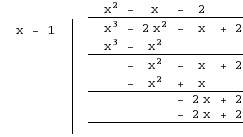
Performing Long Division :
Dividend = Divisor × Quotient + Remainder
=>p(x) = (x - 1)(x2 - x - 2)
=> solving (x2 - x -2)
=> using Splitting the middle term method
=> x2 - 2x + x - 2
=> x(x - 2) + 1(x - 2)
=> (x + 1)(x - 2)
=>(x - 1)(x + 1)(x - 2) are the factors of p(x)
(ii) x3–3x2–9x–5
Solution:
p(x) = x3–3x2–9x–5
Factors of -5 are ±1 and ± 5
Using Hit and Trial Method
let x = 1
p(1) = (1)3 - 3(1)2 - 9(1) - 5
p(1) = 1 - 3 - 9 -5
p(1) = -16
p(1) ≠ 0
let x = -1
p(-1) = (-1)3 - 3(-1)2 - 9(-1) - 5
p(-1) = -1 - 3 + 9 - 5
p(-1) = -9 + 9
p(-1) = 0
Therefore, (x + 1) is a factor of p(x)
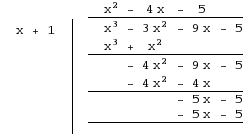
Performing Long Division :
Dividend = Divisor × Quotient + Remainder
=>p(x) = (x + 1)(x2 - 4x - 5)
=> solving (x2 - 4x - 5)
=> using splitting the middle term method
=> x2 -5x + x - 5
=> x(x - 5) + 1(x - 5)
=> (x + 1)(x - 5)
=>(x + 1)(x + 1)(x - 5) are the factors of p(x)
(iii) x3+13x2+32x+20
Solution:
p(x) = x3+13x2+32x+20
=> Factors of 20 are ±1, ±2, ±4, ±5, ±10 and ±20
Using Hit and Trial Method
let x = 1
p(1) = (1)3 + 13(1)2 + 32(1) + 20
p(1) = 1 + 13 + 32 + 20
p(1) = 66
p(1) ≠ 0
let x = -1
p(-1) = (-1)3 + 13(-1)2 + 32(-1) + 20
p(-1) = -1 + 13 - 32 + 20
p(-1) = -33 + 33
p(-1) = 0
Therefore, (x + 1) is a factor of p(x)
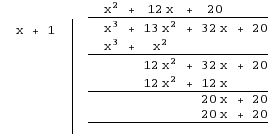
Performing Long Division :
Dividend = Divisor × Quotient + Remainder
=> p(x) = (x + 1)(x2 + 12x + 20)
=> solving x2 + 12x + 20
=> using Splitting the middle term method
=> x2 + 10x + 2x + 20
=> x(x + 10) + 2(x + 10)
=> (x + 2)(x + 10) are the factors of x2 + 12x + 20
=> (x + 1)(x + 2)(x + 10) are the factors of p(x)
(iv) 2y3+y2–2y–1
Solution:
p(y) = 2y3+y2–2y–1
=> Factors of -1 are ±1
Using Hit and Trial Method
let x = 1
p(1) = 2(1)3 + (1)2 - 2(1) - 1
p(1) = 2 + 1 -2 - 1
p(1) = 0
Therefore, (y - 1) is a factor of p(y)
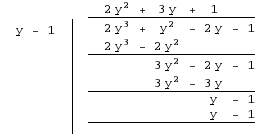
Performing Long Division :
Dividend = Divisor × Quotient + Remainder
=> p(y) = (y - 1)(2y2 + 3y + 1)
=> solving 2y2 + 3y +1
=> using splitting the middle term method
=> 2y2 + 2y +y +1
=> 2y(y + 1)+1(2y + 1)
=>(2y + 1)(2y + 1) are the factors of 2y2 + 3y + 1
=> (y - 1)(2y + 1)(2y + 1) are the factors of p(y)
(i) (x + 4) (x + 10)
Solution:
Using formula, (x + a) (x + b) = x2 + (a + b)x + ab
[So, a = 4 and b = 10]
(x + 4) (x + 10) = x2 + (4 + 10)x + (4 × 10)
= x2 + 14x + 40
(ii) (x + 8) (x - 10)
Solution:
Using formula, (x + a) (x + b) = x2 + (a + b)x + ab
[So, a = 8 and b = −10]
(x + 8) (x - 10) = x2 + (8 + (-10) )x + (8 × (-10))
= x2 + (8 - 10) x - 80
= x2 − 2x - 80
(iii) (3x + 4) (3x - 5)
Solution:
Using formula, (y + a) (y + b) = y2 + (a + b)y + ab
[So, y = 3x, a = 4 and b = −5]
(3x + 4) (3x − 5) = (3x)2 + [4 + (-5)]3x + 4 × (-5)
= 9x2 + 3x (4 - 5) - 20
= 9x2 – 3x – 20
(iv) (y2 + ) (y2 - )
Solution:
Using formula, (a + b) (a – b) = a2 – b2
[So, a = y2 and b = ]
(y 2 + ) (y2 – ) = (y2)2 – ()^2
= y 4 –
(i) 103 × 107
Solution:
103 × 107 = (100 + 3) × (100 + 7)
Using formula, (x + a) (x + b) = x2 + (a + b)x + ab
Then,
x = 100
a = 3
b = 7
So, 103 × 107 = (100 + 3) × (100 + 7)
= (100)2 + (3 + 7)100 + (3 × 7)
= 10000 + 1000 + 21
= 11021
(ii) 95 × 96
Solution:
95 × 96 = (100 - 5) × (100 - 4)
Using formula, (x - a) (x - b) = x2 - (a + b)x + ab
Then, According to the identity
x = 100
a = 5
b = 4
So, 95 × 96 = (100 - 5) × (100 - 4)
= (100)2 - 100 (5+4) + (5 × 4)
= 10000 - 900 + 20
= 9120
(iii) 104 × 96
Solution:
104 × 96 = (100 + 4) × (100 – 4)
Using formula, (a + b) (a - b) = a2 - b2
Then,
a = 100
b = 4
So, 104 × 96 = (100 + 4) × (100 – 4)
= (100)2 – (4)2
= 10000 – 16
= 9984
(i) 9x2 + 6xy + y2
Solution:
9x2 + 6xy + y2 = (3x)2 + (2 × 3x × y) + y2
Using formula, a2 + 2ab + b2 = (a + b)2
Then,
a = 3x
b = y
9x2 + 6xy + y2 = (3x)2 + (2 × 3x × y) + y2
= (3x + y)2
= (3x + y) (3x + y)
(ii) 4y2 − 4y + 1
Solution:
4y2 − 4y + 1 = (2y)2 – (2 × 2y × 1) + 1
Using formula, a2 - 2ab + b2 = (a - b)2
Then,
a = 2y
b = 1
= (2y – 1)2
= (2y – 1) (2y – 1)
(iii) x2 -
Solution:
x2 – = x2 –
Using formula, a2 - b2 = (a - b) (a + b)
Then,
a = x
b =
= (x – ) (x + )
(i) (x + 2y + 4z)2
Solution:
Using formula, (x + y + z)2 = x2 + y2 + z2 + 2xy + 2yz + 2zx
Then,
x = x
y = 2y
z = 4z
(x + 2y + 4z)2 = x2 + (2y)2 + (4z)2 + (2 × x × 2y) + (2 × 2y × 4z) + (2 × 4z × x)
= x2 + 4y2 + 16z2 + 4xy + 16yz + 8xz
(ii) (2x − y + z)2
Solution:
Using formula, (x + y + z)2 = x2 + y2 + z2 + 2xy + 2yz + 2zx
Then,
x = 2x
y = −y
z = z
(2x − y + z)2 = (2x)2 + (−y)2 + z2 + (2 × 2x × −y) + (2 × −y × z) + (2 × z × 2x)
= 4x2 + y2 + z2 – 4xy – 2yz + 4xz
(iii) (−2x + 3y + 2z)2
Solution:
Using formula, (x + y + z)2 = x2 + y2 + z2 + 2xy + 2yz + 2zx
Then,
x = −2x
y = 3y
z = 2z
(−2x + 3y + 2z)2 = (−2x)2 + (3y)2 + (2z)2 + (2 ×−2x × 3y) + (2 ×3y × 2z) + (2 ×2z × −2x)
= 4x2 + 9y2 + 4z2 – 12xy + 12yz– 8xz
(iv) (3a – 7b – c)2
Solution:
Using formula, (x + y + z)2 = x2 + y2 + z2 + 2xy + 2yz + 2zx
Then,
x = 3a
y = – 7b
z = – c
(3a – 7b – c)2 = (3a)2 + (– 7b)2 + (– c)2 + (2 × 3a × – 7b) + (2 × –7b × –c) + (2 × –c × 3a)
= 9a2 + 49b2 + c2 – 42ab + 14bc – 6ca
(v) (–2x + 5y – 3z)2
Solution:
Using formula, (x + y + z)2 = x2 + y2 + z2 + 2xy + 2yz + 2zx
Then,
x = –2x
y = 5y
z = – 3z
(–2x + 5y – 3z)2 = (–2x)2 + (5y)2 + (–3z)2 + (2 × –2x × 5y) + (2 × 5y × – 3z) + (2 × –3z × –2x)
= 4x2 + 25y2 + 9z2 – 20xy – 30yz + 12zx
(vi) (a - b + 1)2
Solution:
Using formula, (x + y + z)2 = x2 + y2 + z2 + 2xy + 2yz + 2zx
Then,
x = a
y = b
z = 1
(a - ()b + 1)2 = [a]2 + [b]2 + 12 + [2 x }a x b] + [2 xb x 1] + [2 x 1 x a]
= a2 + b2 + 1 - ab - b + a
(i) 4x2 + 9y2 + 16z2 + 12xy – 24yz – 16xz
Solution:
Using formula, (x + y + z)2 = x2 + y2 + z2 + 2xy + 2yz + 2zx
Then, x2 + y2 + z2 + 2xy + 2yz + 2zx = (x + y + z)2
4x2 + 9y2 + 16z2 + 12xy – 24yz – 16xz = (2x)2 + (3y)2 + (−4z)2 + (2 × 2x × 3y) + (2 × 3y × −4z) + (2 × −4z × 2x)
= (2x + 3y – 4z)2
= (2x + 3y – 4z) (2x + 3y – 4z)
(ii) 2x2 + y2 + 8z2 – 2√2xy + 4√2yz – 8xz
Solution:
Using formula, (x + y + z)2 = x2 + y2 + z2 + 2xy + 2yz + 2zx
Then, x2 + y2 + z2 + 2xy + 2yz + 2zx = (x + y + z)2
2x2 + y2 + 8z2 – 2√2xy + 4√2yz – 8xz
= (-√2x)2 + (y)2 + (2√2z)2 + (2 × -√2x × y) + (2 × y × 2√2z) + (2 × 2√2 × −√2x)
= (−√2x + y + 2√2z)2
= (−√2x + y + 2√2z) (−√2x + y + 2√2z)
(i) (2x + 1)3
Solution:
Using formula,(x + y)3 = x3 + y3 + 3xy(x + y)
(2x + 1)3= (2x)3 + 13 + (3 × 2x ×1) (2x + 1)
= 8x3 + 1 + 6x(2x + 1)
= 8x3 + 12x2 + 6x + 1
(ii) (2a − 3b)3
Solution:
Using formula, (x – y)3 = x3 – y3 – 3xy(x – y)
(2a − 3b)3 = (2a)3 − (3b)3 – (3 × 2a × 3b) (2a – 3b)
= 8a3 – 27b3 – 18ab(2a – 3b)
= 8a3 – 27b3 – 36a2b + 54ab2
(iii) (x + 1)3
Solution:
Using formula, (x + y)3 = x3 + y3 + 3xy(x + y)
(x+ 1)3 = (x)3 + 13 + (3 × x × 1) (x + 1)
= x3 + 1 + x2 + x
=
(iv) (x − y)3
Solution:
Using formula, (x – y)3 = x3 – y3 – 3xy(x – y)
(x − y)3 = x3 − [y]3 - 3(x) y[x − y]
= x3 -y3 - 2x2y + xy2
(i) (99)3
Solution:
99 = 100 – 1
Using formula, (x – y)3 = x3 – y3 – 3xy(x – y)
(99)3 = (100 – 1)3
= (100)3 – 13 – (3 × 100 × 1) (100 – 1)
= 1000000 – 1 – 300(100 – 1)
= 1000000 – 1 – 30000 + 300
= 970299
(ii) (102)3
Solution:
102 = 100 + 2
Using formula, (x + y)3 = x3 + y3 + 3xy(x + y)
(100 + 2)3 = (100)3 + 23 + (3 × 100 × 2) (100 + 2)
= 1000000 + 8 + 600(100 + 2)
= 1000000 + 8 + 60000 + 1200
= 1061208
(iii) (998)3
Solution:
998 = 1000 – 2
Using formula, (x – y)3 = x3 – y3 – 3xy(x – y)
(998)3 = (1000 – 2)3
= (1000)3 – 23 – (3 × 1000 × 2) (1000 – 2)
= 1000000000 – 8 – 6000(1000 – 2)
= 1000000000 - 8 - 6000000 + 12000
= 994011992
(i) 8a3 + b3 + 12a2b + 6ab2
Solution:
8a3 + b3 +12a2b + 6ab2 can also be written as (2a)3 + b3 + 3(2a)2b + 3(2a)(b)2
8a3 + b3 + 12a2b + 6ab2 = (2a)3 + b3 + 3(2a)2b + 3(2a)(b)2
Formula used, (x + y)3 = x3 + y3 + 3xy(x + y)
= (2a + b)3
= (2a + b) (2a + b) (2a + b)
(ii) 8a3 – b3 – 12a2b + 6ab2
Solution:
8a3 – b3 − 12a2b + 6ab2 can also be written as (2a)3– b3 – 3(2a)2b + 3(2a)(b)2
8a3 – b3 − 12a2b + 6ab2 = (2a)3 – b3 – 3(2a)2b + 3(2a)(b)2
formula used, (x - y)3 = x3 - y3 - 3xy(x - y)
= (2a – b)3
= (2a – b) (2a – b) (2a – b)
(iii) 27 – 125a3 – 135a + 225a2
Solution:
27 – 125a3 – 135a +225a2 can be also written as 33 – (5a)3 – 3(3)2(5a) + 3(3)(5a)2
27 – 125a3 – 135a + 225a2 = 33 – (5a)3 – 3(3)2(5a) + 3(3)(5a)2
Formula used, (x - y)3 = x3 - y3 - 3xy(x - y)
= (3 – 5a)3
= (3 – 5a) (3 – 5a) (3 – 5a)
(iv) 64a3 – 27b3 – 144a2b + 108ab2
Solution:
64a3 – 27b3 – 144a2b + 108ab2 can also be written as (4a)3 – (3b)3 – 3(4a)2(3b) + 3(4a)(3b)2
64a3 – 27b3 – 144a2b + 108ab2 = (4a)3 – (3b)3 – 3(4a)2(3b) + 3(4a)(3b)2
Formula used, (x - y)3 = x3 - y3 - 3xy(x - y)
= (4a – 3b)3
= (4a – 3b) (4a – 3b) (4a – 3b)
(v) 7p3 – − p2 + p
Solution:
27p3 – − () p2 + ()p can also be written as (3p)3 – – 3(3p)2() + 3(3p)()2
27p3 – () − () p2 + ()p = (3p)3 – ()3 – 3(3p)2() + 3(3p)()2
Formula used, (x - y)3 = x3 - y3 - 3xy(x - y)
= (3p – )3
= (3p – ) (3p – ) (3p – )
(i) x3 + y3 = (x + y) (x2 - xy + y2)
Solution:
Formula (x + y)3 = x3 + y3 + 3xy(x + y)
x3 + y3 = (x + y)3 - 3xy(x + y)
x3 + y3 = (x + y) [(x + y)2 - 3xy]
x3 + y3 = (x + y) [(x2 + y2 + 2xy) - 3xy]
Therefore, x3 + y3 = (x + y) (x2 + y2 - xy)
(ii) x3 - y3 = (x - y) (x2 + xy + y2)
Solution:
Formula, (x - y)3 = x3 - y3 - 3xy(x - y)
x3 − y3 = (x - y)3 + 3xy(x - y)
x3− y3 = (x - y) [(x - y)2 + 3xy]
x3 − y3 = (x - y) [(x2 + y2 – 2xy) + 3xy]
Therefore, x3 + y3 = (x – y) (x2 + y2 + xy)
(i) 27y3 + 125z3
Solution:
27y3 + 125z3 can also be written as (3y)3 + (5z)3
27y3 + 125z3 = (3y)3 + (5z)3
Formula x3 + y3 = (x + y) (x2 – xy + y2)
27y3 + 125z3 = (3y)3 + (5z)3
= (3y + 5z) [(3y)2 – (3y)(5z) + (5z)2]
= (3y + 5z) (9y2 – 15yz + 25z2)
(ii) 64m3 - 343n3
Solution:
64m3 - 343n3 can also be written as (4m)3 - (7n)3
64m3 - 343n3 = (4m)3 - (7n)3
Formula x3 - y3 = (x - y) (x2 + xy + y2)
64m3 - 343n3 = (4m)3 - (7n)3
= (4m - 7n) [(4m)2 + (4m)(7n) + (7n)2]
Solution:
27x3 + y3 + z3 - 9xyz can also be written as (3x)3 + y3 + z3 - 3(3x)(y)(z)
27x3 + y3 + z3 – 9xyz = (3x)3 + y3 + z3 – 3(3x)(y)(z)
Formula, x3 + y3 + z3 – 3xyz = (x + y + z) (x2 + y2 + z2 – xy – yz – zx)
27x3 + y3 + z3 – 9xyz = (3x)3 + y3 + z3 – 3(3x)(y)(z)
= (3x + y + z) [(3x)2 + y2 + z2 – 3xy – yz – 3xz]
= (3x + y + z) (9x2 + y2 + z2 – 3xy – yz – 3xz)
Solution:
Formula, x3 + y3 + z3 − 3xyz = (x + y + z)(x2 + y2 + z2 – xy – yz – xz)
Multiplying by 2 and dividing by 2
= (1/2) (x + y + z) [2(x2 + y2 + z2 – xy – yz – xz)]
= (1/2) (x + y + z) (2x2 + 2y2 + 2z2 – 2xy – 2yz – 2xz)
= (1/2) (x + y + z) [(x2 + y2 − 2xy) + (y2 + z2 – 2yz) + (x2 + z2 – 2xz)]
= (1/2) (x + y + z) [(x – y)2 + (y – z)2 + (z – x)2]
Therefore, x3 + y3 + z3 – 3xyz = (1/2) (x + y + z) [(x – y)2 + (y – z)2 + (z – x)2]
Solution:
Formula, x3 + y3 + z3 - 3xyz = (x + y + z) (x2 + y2 + z2 – xy – yz – xz)
Given, (x + y + z) = 0,
Then, x3 + y3 + z3 - 3xyz = (0) (x2 + y2 + z2 – xy – yz – xz)
x3 + y3 + z3 – 3xyz = 0
Therefore, x3 + y3 + z3 = 3xyz
(i) (−12)3 + (7)3 + (5)3
Solution:
Let,
x = −12
y = 7
z = 5
We know that if x + y + z = 0, then x3 + y3 + z3 = 3xyz.
and we have −12 + 7 + 5 = 0
Therefore, (−12)3 + (7)3 + (5)3 = 3xyz
= 3 × -12 × 7 × 5
= -1260
(ii) (28)3 + (−15)3 + (−13)3
Solution:
Let,
x = 28
y = −15
z = −13
We know that if x + y + z = 0, then x3 + y3 + z3 = 3xyz.
and we have, x + y + z = 28 – 15 – 13 = 0
Therefore, (28)3 + (−15)3 + (−13)3 = 3xyz
= 3 (28) (−15) (−13)
= 16380
(i) Area : 25a2 – 35a + 12
Solution:
Using splitting the middle term method,
25a2 – 35a + 12
25a2 – 35a + 12 = 25a2 – 15a − 20a + 12
= 5a(5a – 3) – 4(5a – 3)
= (5a – 4) (5a – 3)
Possible expression for length & breadth is = (5a – 4) & (5a – 3)
(ii) Area : 35y2 + 13y – 12
Solution:
Using the splitting the middle term method,
35y2 + 13y – 12 = 35y2 – 15y + 28y – 12
= 5y(7y – 3) + 4(7y – 3)
= (5y + 4) (7y – 3)
Possible expression for length & breadth is = (5y + 4) & (7y – 3)
(i) Volume : 3x2 – 12x
Solution:
3x2 – 12x can also be written as 3x(x – 4)
= (3) (x) (x – 4)
Possible expression for length, breadth & height = 3, x & (x - 4)
(ii) Volume: 12ky2 + 8ky – 20k
Solution:
12ky2 + 8ky – 20k can also be written as 4k (3y2 + 2y – 5)
12ky2 + 8ky– 20k = 4k(3y2 + 2y – 5)
Using splitting the middle term method.
= 4k (3y2 + 5y – 3y – 5)
= 4k [y(3y + 5) – 1(3y + 5)]
= 4k (3y + 5) (y – 1)
Possible expression for length, breadth & height= 4k, (3y + 5) & (y - 1)
Also Check: