|
VOOZH | about |
|
VOOZH | about |
NCERT Solutions for Class 9 Maths Chapter 6 Lines and Angles is curated and compiled by the expert team of professionals at GFG to assist students in resolving questions related to lines and angles they may have as they go through problems from the NCERT textbook.
This chapter Lines and Angles mainly covers the characteristics of the angles created when two or more lines cross one another. Additionally, it gives a fundamental comprehension of the definitions of various terminology used in geometry. The many kinds of angles, pairs of angles, transversals, parallel lines, the angle sum property of triangles, and axioms related to these ideas are all taught to students.
Class 9 Maths NCERT Solutions Chapter 6 Exercises: |
|---|
| NCERT Maths Solutions Class 9 Exercise 6.1 – 6 Questions & Solutions (5 Short Answers, 1 Long Answer) |
| NCERT Maths Solutions Class 9 Exercise 6.2 – 3 Questions & Solutions (3 Short Answers, 3 Long Answers) |
| NCERT Maths Solutions Class 9 Exercise 6.3 – 6 Questions & Solutions (5 Short Answers, 1 Long Answer) |
Solution:
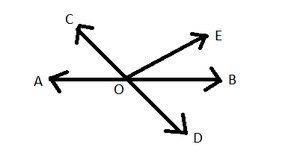
Given, AB and CD are straight lines.
∠AOC + ∠BOE = 70° ----eq(i)
∠BOD = 40° ----eq(ii)
Since, AB is a straight line, the sum of all angles made on it is 180°
⇒ ∠AOC + ∠COE + ∠BOE = 180° ---eq(iii)
We can rearrange this equation as,
⇒ ∠AOC + ∠BOE + ∠COE = 180°
⇒ 70° + ∠COE = 180° ---from eq(i)
⇒ ∠COE = 180° - 70° = 110°
⇒ ∠COE = 110° ---eq(iv)
Reflex ∠COE = 360° - ∠COE = 360° - 110° = 250°
Now, it is also given that CD is also a straight line, so the sum of all angles made on it is 180°
⇒ ∠COE + ∠BOE + ∠BOD = 180° ---eq(v)
We can rearrange this equation as,
⇒ ∠COE + ∠BOD + ∠BOE = 180°
⇒ 110° + 40° + ∠BOE = 180° ---from eq(ii) and eq(iv)
⇒ 150° + ∠BOE = 180°
⇒ ∠BOE = 180° - 150° = 30°
⇒ ∠BOE = 30°
Solution:
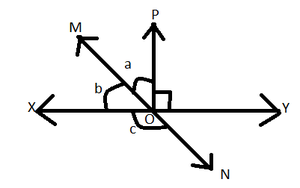
Given, XY and MN are straight lines.
∠POY = 90° --eq(i)
a : b = 2 : 3 --eq(ii)
∠POM = a
∠XOM = b
∠XON = c
Taking XY as a straight line, so the sum of all angles made on it is 180°
⇒ ∠XOM + ∠POM + ∠POY = 180° ---eq(iii)
⇒ b + a + 90° = 180°
⇒ 3x + 2x + 90° = 180° from eq(i) and eq(ii)
⇒ 5x + 90° = 180°
⇒ 5x = 180° - 90° = 90°
⇒ 5x = 90°
⇒ x = 18°
a : b = 2x : 3x = 2x18 : 3x18
a = 36°
b = 54°
Taking MN as a straight line so,the sum of all the angles made on it is 180°
⇒ ∠XOM + ∠XON = 180°
⇒ 54° + ∠XON = 180° from above finding value
⇒ ∠XON = 126° or c = 126°
Solution:
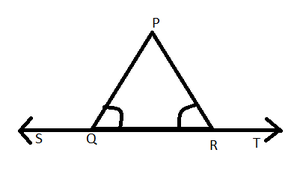
Given, ∠PQR = ∠PRQ
Taking ST is a straight line, so the sum of all angles made on it is 180°
⇒ ∠PQS + ∠PQR = 180° ----eq(i)
also, ∠PRQ + ∠PRT = 180° ---eq(ii)
By equating both the equations because RHS of both the equation is equal So, LHS will also be equal.
⇒ ∠PQS + ∠PQR = ∠PRQ + ∠PRT
⇒ ∠PQS + ∠PQR = ∠PQR + ∠PRT --[ Given in question ∠PQR = ∠PRQ ]
⇒ ∠PQS = ∠PRT
Solution:
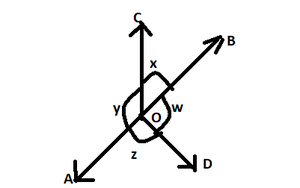
Given, x + y = w + z --eq(i)
We know that , sum of all angles made along a point is 360°
So, Taking O as a point ∠AOC + ∠BOC + ∠BOD + ∠AOD = 360°
⇒ y + x + w + z = 360° from the given figure
⇒ (x + y) + (x + y) = 360° from eq(i)
⇒ 2x + 2y = 360°
⇒ 2(x + y) = 360°
⇒ x + y=180°
From this statement it is proved that AOB is a straight line because the sum of angles made on the line is 180°. So, AOB is a straight line.
Solution:
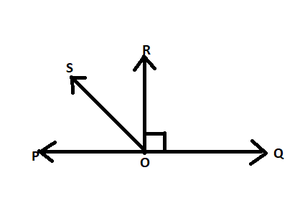
Given POQ is a straight line
So, the sum of all angles made on it is 180°
⇒ ∠POS + ∠ROS + ∠ROQ = 180°
⇒ ∠POS + ∠ROS + 90° = 180° [given ∠ROQ = 90°]
⇒ ∠POS + ∠ROS = 90°
⇒ ∠ROS = 90° - ∠POS --eq(i)
Now, ∠ROS + ∠ROQ = ∠QOS [from figure]
⇒ ∠ROS + 90° = ∠QOS
⇒ ∠ROS = ∠QOS - 90° --eq(ii)
Now Adding both the equations eq(i) + eq(ii)
⇒ ∠ROS + ∠ROS = 90° - ∠POS + ∠QOS - 90°
⇒ 2∠ROS =(∠QOS - ∠POS)
⇒ ∠ROS = (1/2) (∠QOS - ∠POS)
Hence Verified!!!
Solution:
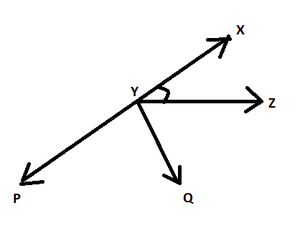
From the drawn figure, it is clearly shown that XYP is a straight line.
So, ∠XYZ + ∠ZYQ + ∠QYP = 180°
⇒ 64°+ ∠ZYQ + ∠QYP = 180° [ given ∠XYZ = 64°]
⇒ 64° + 2∠QYP = 180° [ YQ bisect ∠ZYP so, ∠QYP = ∠ZYQ]
⇒ 2∠QYP = 180° - 64° = 116°
⇒ ∠QYP = 58°
So, Reflex ∠QYP = 360° - 58° = 302°
Since ∠XYQ = ∠XYZ + ∠ZYQ
⇒ ∠XYQ = 64° + ∠QYP [ given ∠XYZ = 64° and ∠ZYQ = ∠QYP]
⇒ ∠XYQ =64° + 58° = 122°
Thus, ∠XYQ = 122° and Reflex ∠QYP = 302°
Solution:
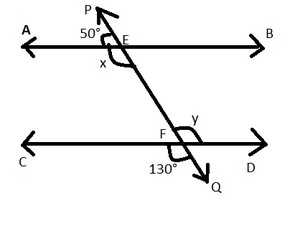
After given names to the remaining vertices we get,
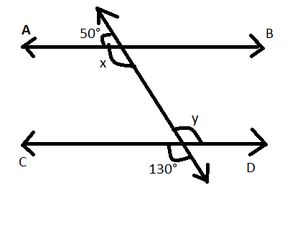
Now, Given ∠AEP = 50°, ∠CFQ = 130°
⇒ ∠EFD = ∠CFQ [vertically opposite angles are equal]
⇒ y = 130° [Given ∠CFQ = 130°]
⇒ y = 130° ---eq(i)
Now,PQ is taking as straight line so, sum of all angles made on it is 180°
⇒ ∠AEP + ∠AEQ = 180°
⇒ 50° + x = 180°
⇒ x = 180° - 50° = 130°
⇒ x = 130° --eq(ii)
Now, from eq(i) and eq(ii) We conclude that x = y
As they are pair of alternate interior angles
So, AB || CD
Hence proved!!!
Solution:
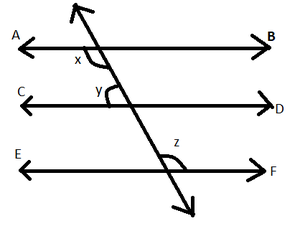
Given AB || CD and CD || EF y : z = 3 : 7
⇒ AB || CD || EF
⇒ AB || EF
So, x=z [alternate interior angles] --eq(i)
Again AB || CD
⇒ x + y = 180° [Co-interior angles]
⇒ z + y = 180° --eq(ii) [from eq(i)]
But given that y : z = 3 : 7
⇒ z = (7/3) y = (7/3)(180° - z) [from eq(ii)]
⇒ 10z = 7 * 180°
⇒ z = (7 * 180°)/10 =126°
⇒ z = 126° --eq(iii)
from eq(i) and eq(iii) we have
⇒ x = 126°
Solution:
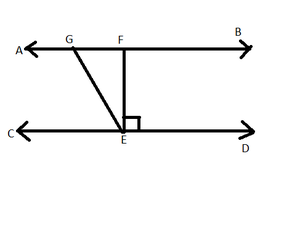
Given AB || CD, EF ⊥ CD, ∠GED = 126° and ∠FED =90°
⇒ ∠GED = ∠GEF + ∠FED
⇒ 126° = ∠GEF + 90° [Given]
⇒ ∠GEF = 36°
As, AB || CD and GE is a transversal
So, ∠FGE + ∠GED = 180° [ sum of Co- interior angles is 180 ]
⇒ ∠FGE + 126° = 180° [ Given ]
⇒ ∠FGE = 54°
As, AB || CD and GE is a transversal
So, ∠AGE = ∠GED [ alternate angles are equal ]
⇒ ∠AGE = 126°
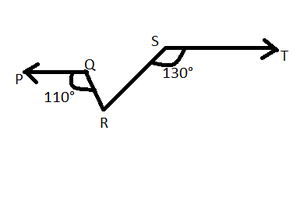
[Hint: Draw a line parallel to ST through point R.]
Solution:
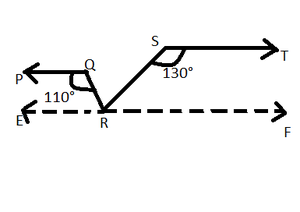
Firstly we have drawn a line EF parallel to ST (EF || ST)
Since, PQ || ST [Given] and EF || ST [ Construction ]
So, PQ || EF and QR is a transversal
⇒ ∠PQR = ∠QRF [ Alternate interior angles ]
⇒ ∠QRF = 110° [Given ∠PQR =110° ]
⇒ ∠QRF = ∠QRS + ∠SRF
⇒ ∠QRS + ∠SRF = 110° --eq(i)
Again ST || EF and RS is a transversal
⇒∠RST + ∠SRF = 180° [ sum of Co-interior angles is 180° ]
⇒130° + ∠SRF =180° [Given]
⇒∠SRF =50°
Now , from eq(i)
⇒ ∠QRS + ∠SRF = 110°
⇒ ∠QRS +50 = 110°
⇒ Thus, ∠QRS = 60°
Solution:
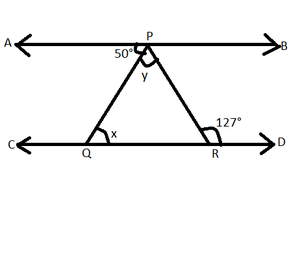
Given AB || CD and PQ is a transversal
⇒ ∠APQ = ∠PQR [ Alternate interior angles ]
⇒ x= 50° [ Given ∠APQ = 50° ]
⇒ x = 50°
Again, AB || CD and PR is a transversal
⇒∠APR = ∠PRD [ Alternate interior angles ]
⇒ ∠APR = 127° [ Given ∠PRD = 127° ]
⇒ 50° + y =127° [Given ∠APQ = 50° ]
⇒ y =127° - 50° = 77°
⇒ y = 77°
Thus, x = 50° and y = 77°
Solution:
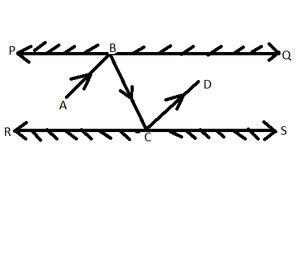
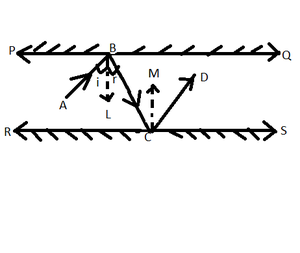
Draw ray BL ⊥ PQ and CM ⊥ RS
Since, PQ || RS ⇒ BL || CM
⇒[ So, BL || PQ and CM || RS ]
Now, BL || CM and BC is a transversal
⇒ ∠LBC = ∠MCB --eq(i) [ Alternate interior angles ]
Since, angle of incidence = angle of reflection
⇒ ∠ABL = ∠LBC and ∠MCB = ∠MCD
⇒ ∠ABL = ∠MCD --eq(ii) [By eq(i)]
⇒Adding eq(i) and eq(ii) we get
⇒ ∠LBC + ∠ABL = ∠MCB + ∠MCD
⇒ ∠ABC = ∠BCD
i.e, a pair of alternate angles are equal
Thus, AB || CD
Hence, Proved !!!
Solution:
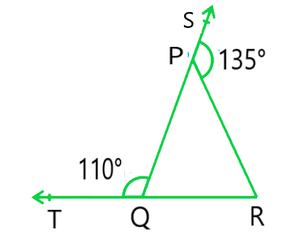
Given: ∠TQP = 110°, ∠SPR = 135°
TQR is a Straight line as we can see in the figure
As we have studied in this chapter, TQP and PQR will form a linear pair
⇒ ∠TQP + ∠PQR = 180° ----------(i)
Putting the value of ∠TQP = 110° in Equation (i) we get,
⇒ 110° + ∠PQR = 180°
⇒ ∠PQR = 70°
Consider the ΔPQR,
Here, the side QP is extended to S and so, SPR forms the exterior angle.
Thus, ∠SPR (∠SPR = 135°) is equal to the sum of interior opposite angles. (Triangle property)
Or, ∠PQR + ∠PRQ = 135° ---------(ii)
Now, putting the value of PQR = 70° in equation (ii) we get,
∠PRQ = 135° - 70°
Hence, ∠PRQ = 65°
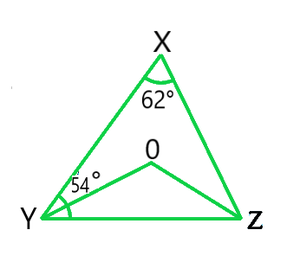
Solution:
Given: ∠X = 62°, ∠XYZ = 54°
As we have studied in this chapter,
We know that the sum of the interior angles of the triangle is 180°.
So, ∠X +∠XYZ +∠XZY = 180°
Putting the values as given in the question we get,
62°+54° + ∠XZY = 180°
Or, ∠XZY = 64°
Now, we know that ZO is the bisector so,
∠OZY = ½ XZY
∴ ∠OZY = 32°
Similarly, YO is a bisector and so,
∠OYZ = ½ XYZ
Or, ∠OYZ = 27° (As XYZ = 54°)
Now, as the sum of the interior angles of the triangle,
∠OZY +∠OYZ +O = 180°
Putting their respective values, we get,
∠O = 180°-32°-27°
Hence, ∠O = 121°
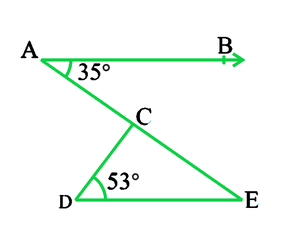
Solution:
Given: AB || DE, ∠BAC = 35° and ∠CDE = 53°
Since, we know that AE is a transversal of AB and DE
Here, BAC and AED are alternate interior angles.
Hence, ∠BAC = ∠AED
∠BAC = 35° (Given)
∠AED = 35°
Now consider the triangle CDE. We know that the sum of the interior angles of a triangle is 180°.
∴ ∠DCE + ∠CED + ∠CDE = 180°
Putting the values, we get
∠DCE + 35° + 53° = 180°
Hence, ∠DCE = 92°
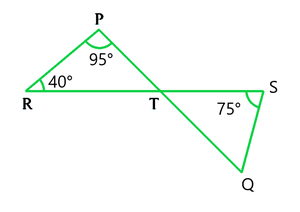
Solution:
Given: ∠PRT = 40°, ∠RPT = 95° and ∠TSQ = 75°
In △PRT.
∠PRT +∠RPT + ∠PTR = 180° (The Sum of all the angles of Triangle is 180°)
⇒ ∠PTR = 45°
Now ∠PTR will be equal to STQ as they are vertically opposite angles.
⇒ ∠PTR = ∠STQ = 45°
Again, in triangle STQ,
⇒ ∠TSQ +∠PTR + ∠SQT = 180° (The Sum of all the angles of Triangle is 180°)
Solving this we get,
⇒ ∠SQT = 60°
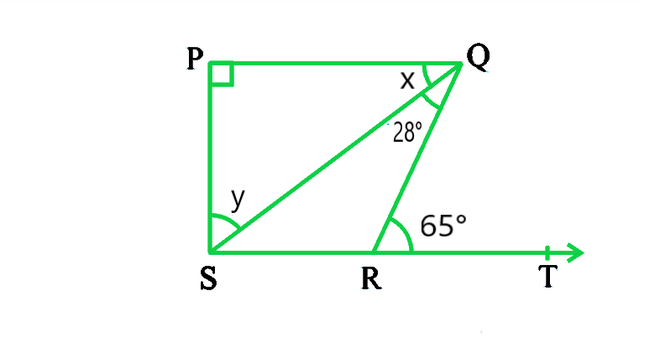
Solution:
Given: PQ ⊥ PS, PQ || SR, ∠SQR = 28° and ∠QRT = 65°
x + SQR = QRT (As they are alternate angles since QR is transversal)
Now, Putting the value of ∠SQR = 28° and ∠QRT = 65°
⇒ x + 28° = 65°
∴ x = 37°
It is also known that alternate interior angles are same and
⇒ QSR = x = 37°
Also,
⇒ QRS + QRT = 180° (As they form a Linear pair)
Putting the value of ∠QRT = 65° we get,
⇒ QRS + 65° = 180°
⇒ QRS = 115°
As we know that the sum of the angles in a quadrilateral is 360°.
⇒ P + Q + R + S = 360°
Putting their respective values, we get,
⇒ S = 360° - 90° - 65° - 115° = 900
In Δ SPQ
⇒ ∠SPQ + x + y = 1800
⇒ 900 + 370 + y = 1800
⇒ y = 1800 – 1270 = 530
Hence, y = 53°
Solution:
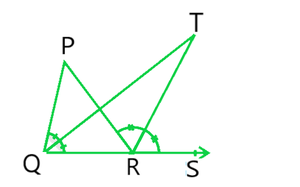
Given: T is the bisector of ∠PQR and ∠PRS,
To Prove: ∠QTR = ½ ∠QPR
Proof:
Consider the ΔPQR.
∠PRS is an exterior angle.
∠QPR and ∠PQR are interior angles.
⇒ ∠PRS = ∠QPR + ∠PQR (According to triangle property)
⇒ ∠PRS - ∠PQR = ∠QPR ------------(i)
Now, consider the ΔQRT,
∠TRS = ∠TQR + ∠QTR (Since exterior angle are equal)
⇒ ∠QTR = ∠TRS - ∠TQR
We know that QT and RT bisect ∠PQR and ∠PRS respectively.
So, ∠PRS = 2 ∠TRS and ∠PQR = 2∠TQR
Now,
⇒ ∠QTR = ½ ∠PRS – ½ ∠PQR
⇒ ∠QTR = ½ ∠(PRS - PQR)
From equation (i) we know that ∠PRS - ∠PQR = ∠QPR,
⇒ ∠QTR = ½ ∠QPR
Hence, Proved.