CBSE Class 10 Maths Notes Chapter 4 Polynomials are provided to support student's education. We believe that students' learning and development are of utmost importance, and that's why we have created these comprehensive notes to help them comprehend the complex subject of Polynomials better.
The NCERT Class 10 Maths textbook's Chapter 4 explores the realm of Polynomials and covers various concepts such as finding the polynomial degree, types of polynomials, zeros of polynomials, and more. Our notes aim to provide students with a complete summary of the entire chapter, including all essential topics, formulae, and concepts necessary to succeed in their exams.
What is Polynomials?
An algebraic expression in the form of a0+a1x1+a2x2+….+anxn where a0, a1, a2, ..., an represents the real numbers, n represents the positive integers and x represents the variable.
A polynomial is a mathematical expression that contains variables and coefficients and is formed by using addition, subtraction, and multiplication operations. The variables in a polynomial are raised to whole-number exponents, and the coefficients can be any real number.
Some examples of Polynomials:
2x − 1 is a polynomial in variable x.
2x2 + 2x + 1 is a polynomial in variable y.
Note: Expressions like 3x2+2√x+4, 1 / (x2+2x+1), and 3x3+2/x+4 are not polynomials because negative exponents, fractional exponents, radicals, and division by a variable are all prohibited in polynomials.
Degree of Polynomials
The highest exponent of the variable in the algebraic expression is called Degree of a Polynomial.
Some examples of the degree of polynomials:
2x2 + 3x +1 is a polynomials of degree 2 in the variable x.
3y3 + 2y2 + 4y + 1 is a polynomials of degree 3 in the variable y.
Types of Polynomials
Various types of Polynomials based on the number of terms that the polynomial has been,
Types
Definition
Representation
Example
Constant Polynomials
A polynomial of degree Zero
f(x) = k
f(x) = 2
Linear Polynomials
A polynomial of degree One
g(x) = ax + b, a ≠ 0
g(x) = 2x + 1
Quadratic Polynomials
A polynomial of degree Two
h(x) = ax2 + bx + c, a ≠ 0
h(x) = 2x2 − 2x + 4
Cubic Polynomials
A polynomial of degree Three
p(x) = ax3 + bx2 + cx + d, a ≠ 0
p(x) = 3x3 + 4x2 + 5x + 2
Bi-Quadratic Polynomials
A polynomial of degree Four
q(x) = ax4 + bx3 + cx2 + dx + e, a ≠ 0
q(x) = 5x4 + 3x3 + 2x2 + 4x + 1
Value of a Polynomials
If p(x) is a polynomial in x, and if k is any real number, then the value obtained by replacing x by k in p(x), is called the value of p(x) at x = k, and is denoted by p(k).
Example: What is the value of p(x) = 2x2 − 3x + 1 at x = 2?
Substitute 2 for x in p(x)
p(2) = 2(2)2 − 3(2) + 1
= 8 − 6 + 1
= 3
Therefore, the value of p(x) at x = 2 is 3.
Zeros of a Polynomial
We say that x = a is the zero of the polynomial if P(x) = 0 at that point. The process of finding zero is basically the process of finding out the solutions of any polynomial equation.
Example:Find the zeros of the quadratic polynomial f(x) = x2 + 7x + 12.
In general, for a linear polynomial ax + b, a ≠ 0, the graph of y = ax + b is a straight line that intersects the x-axis at exactly one point, namely, (−b / a, 0)
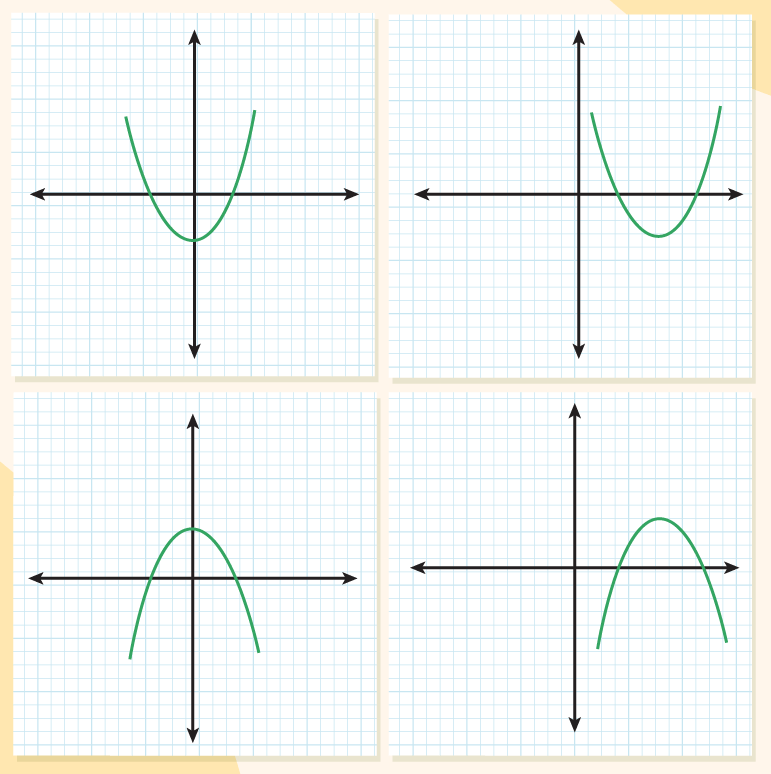
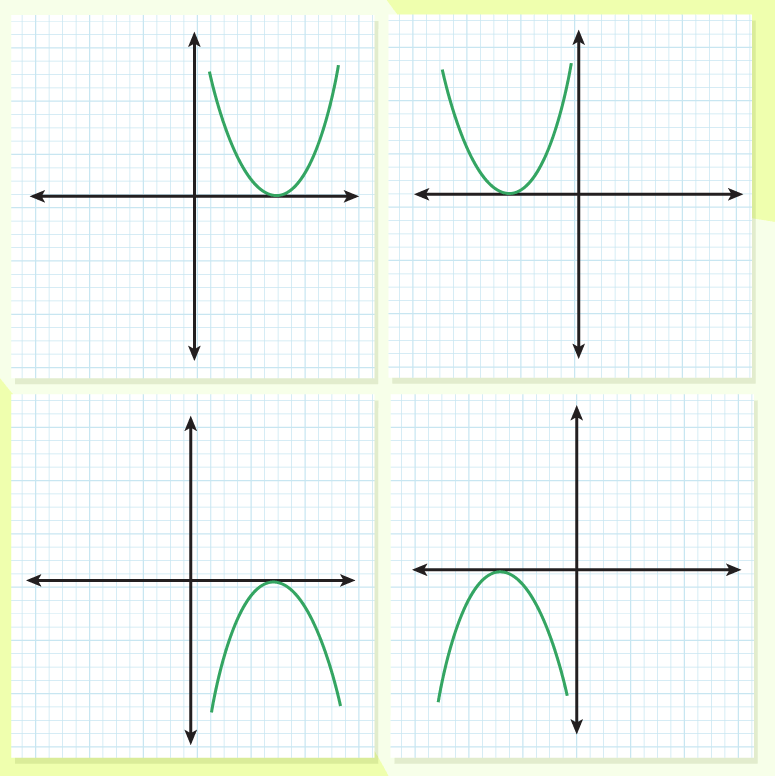
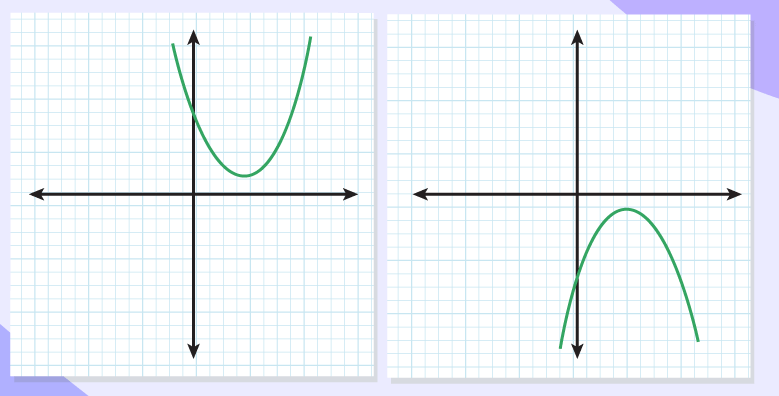
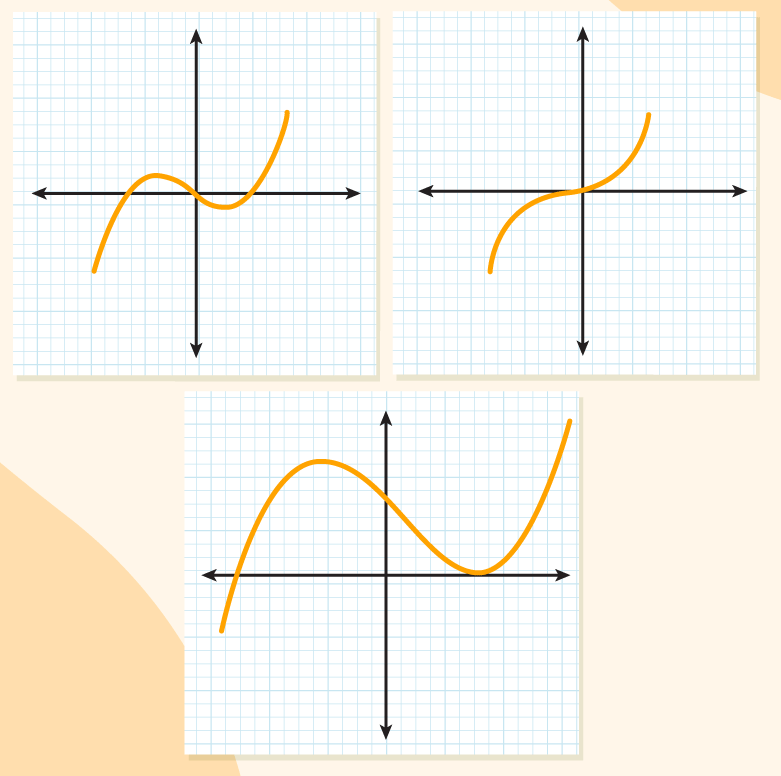
Geometrically that a quadratic polynomial can have either two distinct zeroes or two equal zeroes (i.e., one zero), or no zero. This also means that a polynomial of degree 2 has at most two zeroes.
Possibilities of Quadratic Polynomial
Graphically Representation
Quadratic polynomial is factorizable into two distinct linear factors
Example 1:If α and β are the zeros of the polynomials 2x2 − 4x + 5, then find the value of α2 + β2.
Solution:
Sum of zeros (α + β) = −(−4) / 2
= 2
Product of zeros (αβ) = 5 / 2
Use the algebraic identity,
(a + b)2 = a2 + b2 +2ab
(α + β)2 = α2 + β2 + 2αβ
Substitute 2 for α + β and 5 / 2 for αβ in the above equation.
22 = α2 + β2 + 2 × (5 / 2)
4 = α2 + β2 + 5
α2 + β2 = −1
Therefore, the value of α2 + β2 is −1.
Example 2:If α, β, and γ are the zeros of the polynomials 6x3 + 3x3 + −5x + 1, then find the value of α-1 + β-1 + γ-1.
Solution:
Product of Zeros (αβγ) = −1 / 6
Sum of Product of Zeros taken 2 at a time (αβ + βγ + αγ) = −5 / 6
Division Algorithm for Polynomial
The division algorithm for polynomials is a method for dividing one polynomial by another. It is similar to the long division algorithm for integers but with some key differences. We can perform the division of polynomials using various steps that are,
Step 1: The first step is to write the dividend and divisor in decreasing order of their degrees. The dividend is the polynomial that is being divided, and the divisor is the polynomial that is doing the dividing.
Step 2: Next, we need to find the first term of the quotient. This is done by dividing the leading term of the dividend by the leading term of the divisor. The result is the first term of the quotient, and it is placed above the bar.
Step 3: Now, we need to subtract the product of the first term of the quotient and the divisor from the dividend. This gives us a new polynomial, which is called the remainder.
Step 4: If the degree of the remainder is less than the degree of the divisor, then we are finished. The quotient is the polynomial with the first term that we found, and the remainder is the polynomial that we just subtracted.
Step 5: If the degree of the remainder is equal to the degree of the divisor, then we need to repeat the process. We find the next term of the quotient by dividing the leading term of the remainder by the leading term of the divisor. We then subtract the product of the new term of the quotient and the divisor from the remainder. We continue this process until the degree of the remainder is less than the degree of the divisor.
The division algorithm for polynomials can be used to solve a variety of problems, such as finding the roots of a polynomial and finding the inverse of a polynomial.
Example: Divide the polynomial f(x) = 3x2 − x3 − 3x + 5 by the polynomial g(x) = x − 1 − x2 and verify the division algorithm.


.png)