|
VOOZH | about |
|
VOOZH | about |
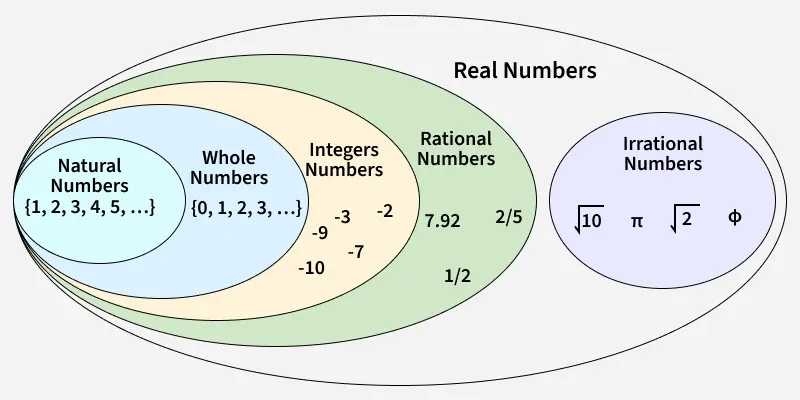
Rational and Irrational Numbers are types of real numbers with different properties.
In simpler terms, rational numbers are like fractions – they show the relationship between two whole numbers.
A Rational Numbers is any number that can be expressed as the ratio of two integers. In mathematical terms, a rational number is a number that can be written in the form, where p and q are integers, and q is not equal to zero.
This means that fractions, whole numbers, and terminating or repeating decimals are all examples of rational numbers.
Examples
Unlike rational numbers, irrational numbers cannot be written as a simple fraction. They are numbers whose decimal expansions are non-terminating and non-repeating. In other words, the decimal goes on forever without forming any recurring pattern. The most well-known irrational numbers are π (pi) and √2.
An Irrational Numbers is a type of real number that cannot be expressed as a simple fraction (ratio) of two integers. In other words, it's a number that cannot be written in the form a/b, where "a" and "b" are integers and "b" is not equal to zero.
Examples: √5, √11, √21, etc., are irrational