|
VOOZH | about |
|
VOOZH | about |
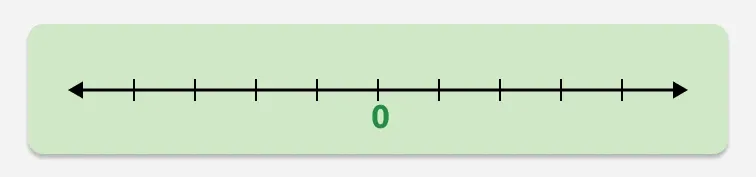
A rational number is any number that can be written in the form p/q, where p and q are integers and q ≠ 0. Rational numbers include positive numbers, negative numbers, and zero. To understand these numbers better, we often represent them on a number line. The number line helps us see their exact position, compare them, and understand which numbers are bigger or smaller.
A proper fraction is a fraction in which the numerator is smaller than the denominator. This means the value of the fraction is less than 1.
For Example: 2/5, 3/8, 7/10
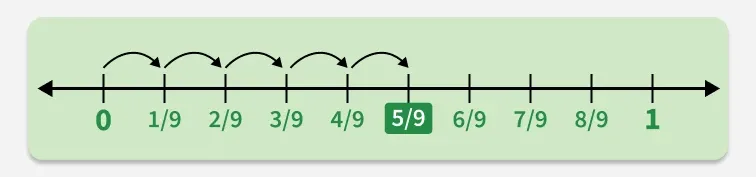
Example 1: Representation of 5/9 on the number line.
Solution:
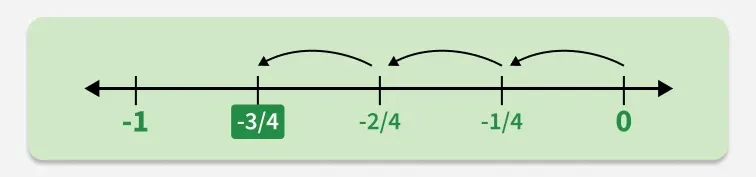
Example 2: Representation of -3/4 on the number line.
Solution:
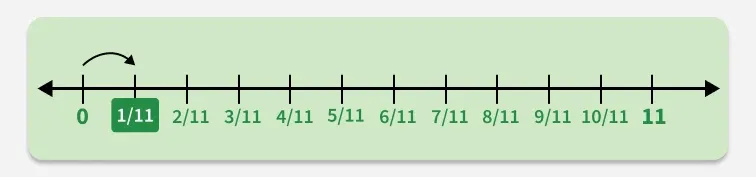
Example 3: Representation of 1/11 on the number line
Solution:
Given an improper fraction p/q, the numerator (p) > denomination (q), such that the ratio p/q>1. Improper fractions are first converted into mixed fractions, that is, 11/2 ⇢ 51/2, here 5 is whole number part, 1/2 is fraction part.
Example 1: Represent 95/4 on a number line.
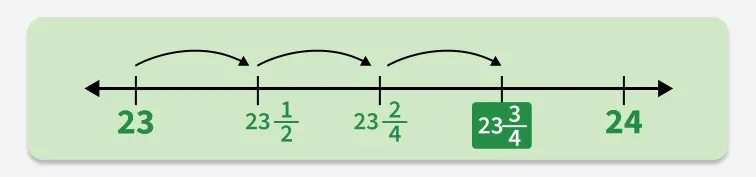
Solution:
Converting to a mixed fraction we get,
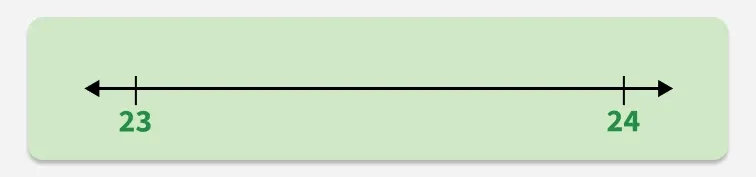
The mixed fraction is then plotted on the number line, which lies in the range of the whole number part and whole number part +1. This region is then divided into equal parts, corresponding to the denominator of the fraction part and marking the pth (that is, numerator) part.
95/4 =
Step 1:
Step 2:
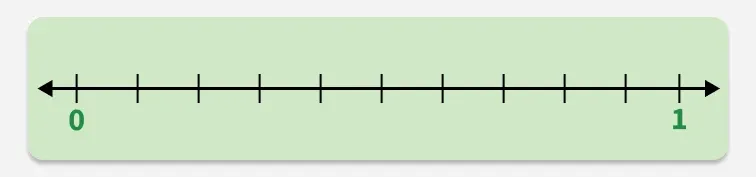
We can represent We can represent this decimal expansion on the number line through the process of successive magnification.
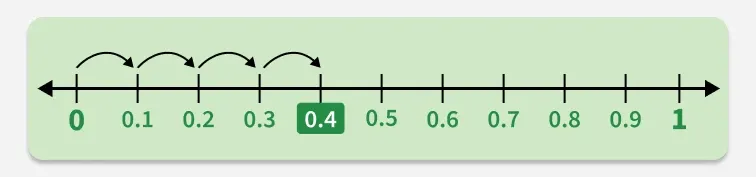
We know every rational number can be expressed as decimal expansions. Here,
2/5 = 0.4
Step 1 : 0.4 lies between: 0 and 1
Step 2:
Question 1: Represent 7/8 on the number line.
Question 2: Represent –5/6 on the number line.
Question 3: Represent 13/5 on the number line.
Question 4: Using successive magnification, represent 0.37 on the number line.
Question 5: Represent –9/4 on the number line.
Question 6: Convert 47/6 into mixed form and represent it on the number line.