|
VOOZH | about |
|
VOOZH | about |
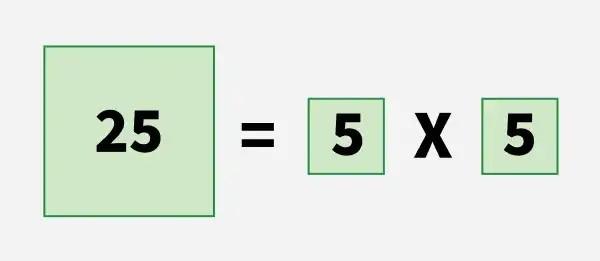
A square number is the product of a number multiplied by itself. It is commonly represented using exponent notation:
a2= a × a
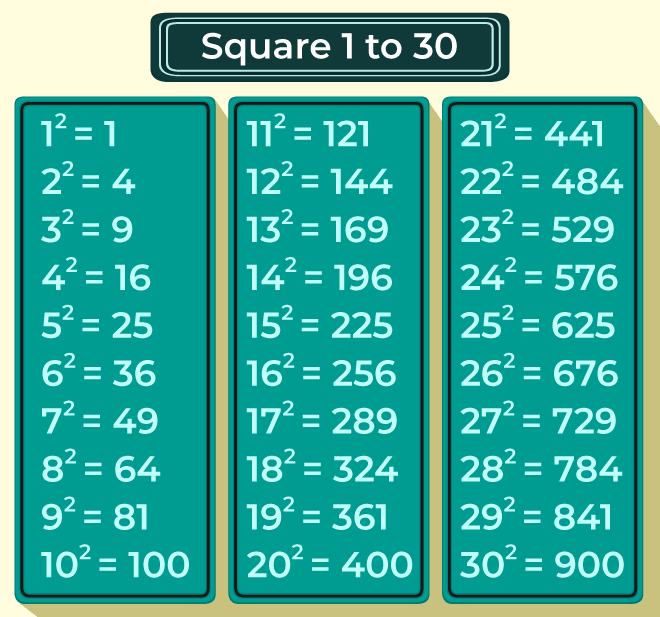
The squares of numbers from 1 to 30, i.e, the square of the first 30 natural numbers given in the image discussed below,
| Number | Square | Number | Square | Number | Square |
|---|---|---|---|---|---|
| (1)2 | 1 | (11)2 | 121 | (21)2 | 441 |
| (2)2 | 4 | (12)2 | 144 | (22)2 | 484 |
| (3)2 | 9 | (13)2 | 169 | (23)2 | 529 |
| (4)2 | 16 | (14)2 | 196 | (24)2 | 576 |
| (5)2 | 25 | (15)2 | 225 | (25)2 | 625 |
| (6)2 | 36 | (16)2 | 256 | (26)2 | 676 |
| (7)2 | 49 | (17)2 | 289 | (27)2 | 729 |
| (8)2 | 64 | (18)2 | 324 | (28)2 | 784 |
| (9)2 | 81 | (19)2 | 361 | (29)2 | 841 |
| (10)2 | 100 | (20)2 | 400 | (30)2 | 900 |
Also check: Squares 1 to 50
Even numbers from 1 to 30 are 2, 4, 6, 8, 10, 12, 14, 16, 18, 20, 22, 24, 26, 28, and 30. Learning the square of even numbers from 1 to 30 is very important. The following table contains the squares 1 to 30 for even numbers.
Even Numbers (1 to 30) | Squares of Even Numbers (1 to 30) |
|---|---|
2 | (2)2 = 4 |
4 | (4)2 = 16 |
6 | (6)2 = 36 |
8 | (8)2 = 64 |
10 | (10)2 = 100 |
12 | (12)2 = 144 |
14 | (14)2 = 196 |
16 | (16)2 = 256 |
18 | (18)2 = 324 |
20 | (20)2 = 400 |
22 | (22)2 = 484 |
24 | (24)2 = 576 |
26 | (26)2 = 676 |
28 | (28)2 = 784 |
30 | (30)2 = 900 |
Odd numbers from 1 to 30 are 1, 3, 5, 7, 9, 11, 13, 15, 17, 19, 21, 23, 25, 27, and 29. Learning the squares of odd numbers from 1 to 30 is very important. The following table shows the values of squares from 1 to 30 for odd numbers.
Odd Numbers (1 to 30) | Squares of Odd Numbers (1 to 30) |
|---|---|
1 | (1)2 = 1 |
3 | (3)2 = 9 |
5 | (5)2 = 25 |
7 | (7)2 = 49 |
9 | (9)2 = 81 |
11 | (11)2 = 121 |
13 | (13)2 = 169 |
15 | (15)2 = 225 |
17 | (17)2 = 289 |
19 | (19)2 = 361 |
21 | (21)2 = 441 |
23 | (23)2 = 529 |
25 | (25)2 = 625 |
27 | (27)2 = 729 |
29 | (29)2 = 841 |
The square of a negative number is always positive because multiplying two negative numbers results in a positive product.
The square of a negative number results in a positive value, as shown in the table below:
| Number | Square | Number | Square | Number | Square |
|---|---|---|---|---|---|
| (-1)2 | 1 | (-11)2 | 121 | (-21)2 | 441 |
| (-2)2 | 4 | (-12)2 | 144 | (-22)2 | 484 |
| (-3)2 | 9 | (-13)2 | 169 | (-23)2 | 529 |
| (-4)2 | 16 | (-14)2 | 196 | (-24)2 | 576 |
| (-5)2 | 25 | (-15)2 | 225 | (-25)2 | 625 |
| (-6)2 | 36 | (-16)2 | 256 | (-26)2 | 676 |
| (-7)2 | 49 | (-17)2 | 289 | (-27)2 | 729 |
| (-8)2 | 64 | (-18)2 | 324 | (-28)2 | 784 |
| (-9)2 | 81 | (-19)2 | 361 | (-29)2 | 841 |
| (-10)2 | 100 | (-20)2 | 400 | (-30)2 | 900 |
The squares 1 to 30 can easily be calculated using the two methods as discussed below:
Now, let's learn about these two methods in detail.
Multiplying by itself means to find the square of the number we multiply the number with itself, i.e. the square of any number a is (a)2 then it is calculated as (a)2 = a × a.
Square of some numbers between 1 to 30 using the multiplication by itself method is,
This method works best for smaller methods, but for finding the square of the larger numbers, we use other methods, i.e., using Algebraic Identities.
As the name suggests, using algebraic identities uses the basic identities of the square, i.e., it uses
Now the given number "n" is broken according to these identities as,
n = (a + b) or n = (a - b) according to the number n, and then the square is found using the identities discussed above. This can be understood by the example discussed below.
For example: To find the square of 28, we can express 28 in two ways,
Solution:
(20 + 8)
To find the square of 28 we use the algebraic identity,
(a + b)2 = a2 + b2 + 2ab
(20 + 8)2 = 202 + 82 + 2(20)(8)
= 400 + 64 + 320
= 784(30 - 2)
To find the square of 28 we use the algebraic identity,
(a - b)2 = a2 + b2 - 2ab
(30 - 2)2 = 302 + 22 - 2(30)(2)
= 900 + 4 - 120
= 784
This method is used to find the square of a large number very easily.
Here are some helpful tricks to assist you in memorizing square roots:
Read More,
Example 1: Find the area of the circular park whose radius is 21 m.
Solution:
Given,
Radius of Park = 21 m
Area of Circular Park(A) = πr2
A = π (21)2
Using the square of 21 from the square of 1 to 30 table
212 = 441
A = 22/7(441)
A = 1386 m2Thus, the area of the circular park is 1386 m2
Example 2: Find how much glass is required to cover the square window of side 25 cm.
Solution:
Given,
Side of Square Window(s) = 25 cm
Area of Square Window(A) = (s)2
A = (25)2
Using the square of 25 from the square of 1 to 30 table
252 = 625
A = 625 cm2Thus, the glass required to cover the square window is 625 cm2
Example 3: Simplify 112 - 52 + 212
Solution:
Using Square of 1 to 30 table we get,
- 112 = 121
- 52 = 25
- 212 = 441
Simplifying, 112 - 52 + 212
= 121 - 25 + 441
= 562 - 25
= 537
Example 4: Simplify 162 + 152 - 192
Solution:
Using Square of 1 to 30 table we get,
- 162 = 256
- 152 = 225
- 192 = 361
Simplifying, 162 + 152 - 192
= 256 + 225 - 361
= 481 - 361
= 120
Question 1: Find the area of a square window whose side length is 17 inches.
Solution:
Area of the Square window (A) = Side2
Using the squaretable 1 to 30, we get,
Area = 172 = 289
Therefore, the area of the window is 289 inches
Question 2: What is the square of 26?
Solution:
Using the value from square table 1 to 30 chart,
we can get the square of 26 which is 262 = 676
Question 3: Two square wooden planks have sides 5 m and 12 m,, respectively. Find the combined area of both wooden planks.
Solution:
Area of wooden plank = (side)2
Let us use the chart of square upto 30 to solve this questionArea of 1st wooden plank = 52 = 25
Area of 2nd wooden plank = 102 = 100Therefore, the combined area of wooden plank is 100 + 25 = 125 m2
Question 4: If a circular tabletop has a radius of 25 inches, what is the area of the tabletop in sq. inches?
Solution:
Area of circular tabletop = πr2 = π (25)2
Let us use the value from squares of 1 to 30 chart and we get
(25)2 = 625
Area = 625πTherefore, the area of tabletop = 1963.50 inches2
Question 1: Find the area of a square garden whose side length is 14 meters.
Question 2: What is the square of 19?
Question 3: Two square carpets have sides 8 m and 15 m, respectively. Find the combined area of both carpets.
Question 4: A circular garden has a radius of 12 feet, what is the area of the garden in square feet?
Answer Sheet
1) 196 meters2
2) 361
3) 289 merters2
4) 452.39 square feet