|
VOOZH | about |
|
VOOZH | about |
Complementary angles are a pair of angles whose sum is 90°. In simple terms, they “complete” each other to form a right angle.
∠x + ∠y = 90
In trigonometry, complementary angles show special relationships between the trigonometric ratios. These relationships allow one trigonometric function to be expressed in terms of another.
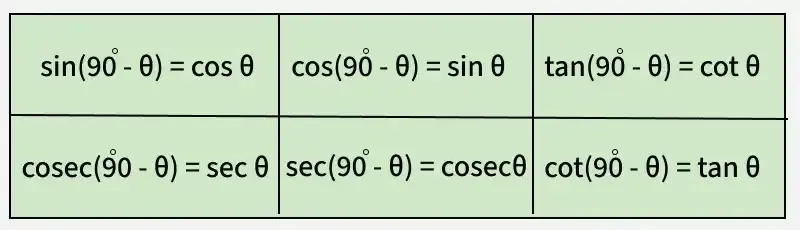
For an angle θ, the following identities hold:
In Simple Words
- Sine ↔ Cosine interchange
- Tangent ↔ Cotangent interchange
- Secant ↔ Cosecant interchange
Trigonometric ratios are essential mathematical functions that describe the relationships between the angles and sides of a right-angled triangle. These ratios are derived from the lengths of the sides of a triangle and the measurements of its angles, especially in the context of a right triangle, which has one angle measuring 90 degrees.
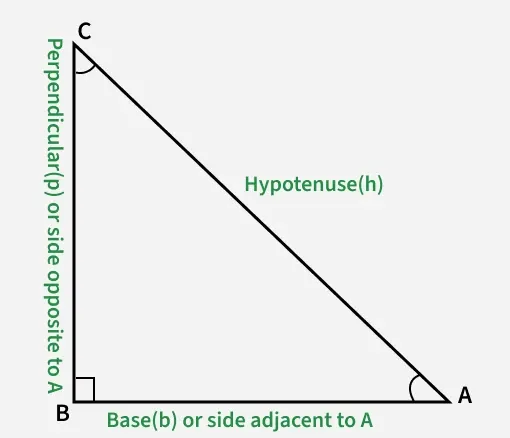
In the right triangle, there are three sides:
The relationships between these sides and angles form the basis of trigonometric ratios.
- sin A = BC/AC
- cos A = AB/AC
- tan A = BC/AB
- cosec A = 1/sin A = AC/BC
- sec A = 1/cos A = AC/AB
- cot A = 1/tan A = AB/BC
For instance, if one angle measures 30 degrees, its complementary angle would measure 60 degrees, as their sum equals 90 degrees.
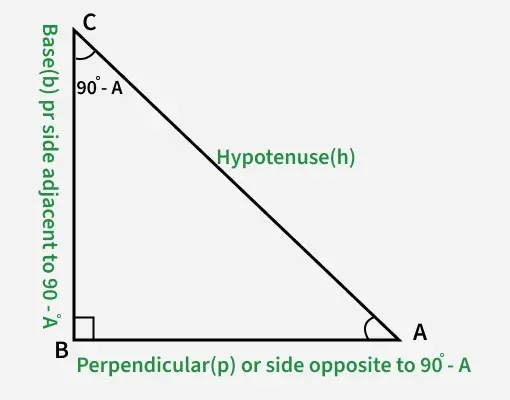
The trigonometric ratios of the complement of angle ∠A (90° - A) in the same triangle are:
These trigonometric ratios, when compared to the ratios of angle ∠A, exhibit some intriguing relationships:
These relations hold for all values of A lying between 0° and 90°.
| Trigonometric Ratio | Complementary Angle Formula |
| sin(90° - A) | cos(A) |
| cos(90° - A) | sin(A) |
| tan(90° - A) | cot(A) |
| cot(90° - A) | tan(A) |
| sec(90° - A) | cosec(A) |
| csc(90° - A) | sec(A) |
Example 1: Given, cos θ = 4/5 and θ is an acute angle. Find the value of sin (90° - θ).
Using trigonometric relation: sin2 θ + cos2 θ = 1
Given, cos θ = 4/5
sin2 θ = 1 - cos2 θ
⇒ sin2 θ = 1 - (4/5)2
⇒ sin2 θ = 1 - 16/25 = 9/25
⇒ sin θ = ±3/5 (as θ is acute, sin θ = 3/5)
Now, sin (90° - θ) = cos θ = 4/5
Therefore, sin (90° - θ) = 4/5.
Example 2: If cot A = 5/12, find sec (90° - A).
Given, cot A = 5/12
Since cot A = 1/tan A, we can find tan A = 12/5
Using the trigonometric identity: 1 + tan2 A = sec2 A
⇒ 1 + (12/5)2 = sec2 A
⇒ 1 + 144/25 = sec2 A
⇒ 169/25 = sec2 A
⇒ sec A = ±13/5
Now, sec (90° - A) = sec A = 13/5.
Example 3: If sin α = 7/25, find cos (90° - α).
Given, sin α = 7/25
Using the trigonometric identity: sin2 α + cos2 α = 1
cos2 α = 1 - sin2 α
⇒ cos2 α = 1 - (7/25)2
⇒ cos2 α = 1 - 49/625
⇒ cos2 α = 576/625
⇒ cos α = ±24/25
Now, cos (90° - α) = sin α = 7/25.
Example 4: If sec β = 29/21, find tan (90° - β).
Given, sec β = 29/21
Since sec β = 1/cos β, we can find cos β = 21/29
Using the trigonometric identity: tan2 β + 1 = sec2 β
⇒ tan2 β + 1 = (29/21)2
⇒ tan2 β = (29/21)2 - 1
⇒ tan2 β = 841/441 - 1
⇒ tan2 β = 2
⇒ tan β = √2
Now, tan (90° - β) = cot β = 1/√2.
Example 5: If tan θ = 3/4, find cosec (90° - θ).
Given, tan θ = 3/4
Since tan θ = 1/cot θ, we can find cot θ = 4/3
Using the trigonometric identity: cosec2 θ = 1 + cot2 θ
cosec2 θ = 1 + (4/3)2
= 1 + 16/9 = 25/9
cosec θ = ±5/3
Now, cosec (90° - θ) = cosec θ = 5/3.