|
VOOZH | about |
|
VOOZH | about |
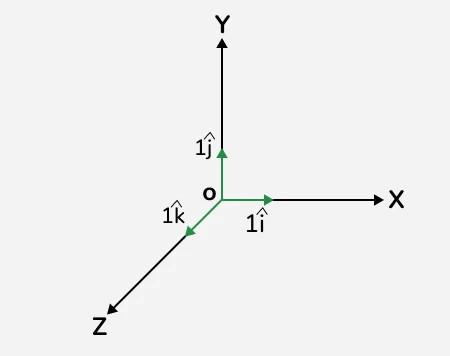
Unit vectors are the vectors that have a magnitude (length) of exactly 1.
We define a unit vector in each 3-D axis as,
Also, the magnitude of this vector is,
|i| = 1, |j| = 1, |k| = 1
The dot product of these unit vectors is represented as,
The formula to calculate the unit vector is,
Where denotes Vector ai + bj + ck and denotes the Magnitude of Vector
As we know that unit vectors along any vector are calculated by taking the ratio of the vector along with its magnitude. So it is very important to find the magnitude of the vector first. Any vector can be represented in two ways,
And now we can easily calculate the magnitude of this vector as,
|A| = √(a2 + b2 + c2)
Now finding the unit vector using the unit vector formula as
Unit Vector = Vector / Magnitude of Vector
We can easily calculate the unit vector of any given vector by following the steps discussed below:
Step 1: Write the given vector and note its component in x, y, and z directions respectively.
Step 2: Find the magnitude of the vector using the formula,
|A| = √(a2 + b2 + c2)
Step 3: Find the unit vector by using the formula,
Unit Vector = Vector / Magnitude of Vector
Step 4: Simplify to get the required unit vector.
Example: Find the unit vector of = 2i + j + 2k
Solution:
Step 1:
Given Vector,
= 2i + j + 2k
- x-component of the vector (a) = 2
- y-component of the vector (b) = 1
- z-component of the vector (c) = 2
Step 2:
Magnitude of Vector (a) = |a| = √(22 +12 +22) = √(9) = 3
Step 3:
= (2i + j + 2k)/3
= (2/3i + 1/3j + 2/3k)
This is the required unit vector.
For any vector given as,
= (x, y, z)
Its unit vector is calculated and represented as,
= (x, y, z)/(√x2 + y2 + z2)
= [x/(√x2 + y2 + z2), y/(√x2 + y2 + z2), z/(√x2 + y2 + z2)]
For any vector given as,
= xi + yj + zk
Its unit vector is calculated and represented as,
= (xi + yj + zk)/(√x2 + y2 + z2)
= [x/(√x2 + y2 + z2)i + y/(√x2 + y2 + z2)j + z/(√x2 + y2 + z2)k]
where i, j, and k represent the unit vector in the x, y, and z directions respectively.
To find a unit vector that is parallel to another vector v, you need to normalize v. This is done by dividing the vector by its magnitude. Mathematically, the unit vector v^ that is parallel to v can be calculated using:
Where ∣v∣ is the magnitude of v. This results in a vector v^ that has the same direction as v but a magnitude of 1.
To determine a unit vector that is perpendicular to another vector, you need to start with a vector that is orthogonal (perpendicular) to the original vector and then normalize it. In three dimensions.
For example, if you are given a vector v = (vx ,vy ,vz), a perpendicular vector can be obtained through a cross product with another non-parallel vector (commonly a standard basis vector). Once you have a perpendicular vector w, you can then normalize it to find the unit vector:
where ∣w∣ is the magnitude of w. The resulting vector w^ will be perpendicular to v and have a magnitude of 1.
Unit vectors have various applications. It is used in explaining various concepts of both Physics and Mathematics. Some of the common applications of unit vectors are,
Example 1: Find the unit vector of 2i + 4j + 5k.
Solution:
Given Vector,
v = 2i + 4j + 5k
Magnitude of Vector v
=
= 3√5
Unit Vector of v
= (2/3√5) i + (4/3√5) j + (√5/3)k
Example 2: Find the unit vector of 3i + 4j + 5k.
Solution:
Given Vector,
v = 3i + 4j + 5k
Magnitude of Vector v
=
= 5√2
Unit Vector of v
= (3/5√2) i + (4/5√2) j + (1/√2)k
Example 3: Find the unit vector of the resultant of vector i + 3j + 5k and -j - 3k.
Solution:
Given Vectors,
A = i + 3j + 5k
B = -j - 3k
Resultant Vector = R = A + B
= ( i + 3j + 5k) + (-j - 3k)
= (1+0)i + (3-1)j + (5-3)k
A + B = i + 2j + 2k
Magnitude of Vector R = |R|
= 3
= (1/3) i + (2/3) j + (2/3)k
1. Given the vector v = 3+ 4, find the unit vector in the direction of v.
2. Given the vector u = - 2 + 2, find the unit vector in the direction of u.
3. Determine whether the vector w = is a unit vector.
4. Find the unit vector in the direction of the vector a = .