|
VOOZH | about |
|
VOOZH | about |
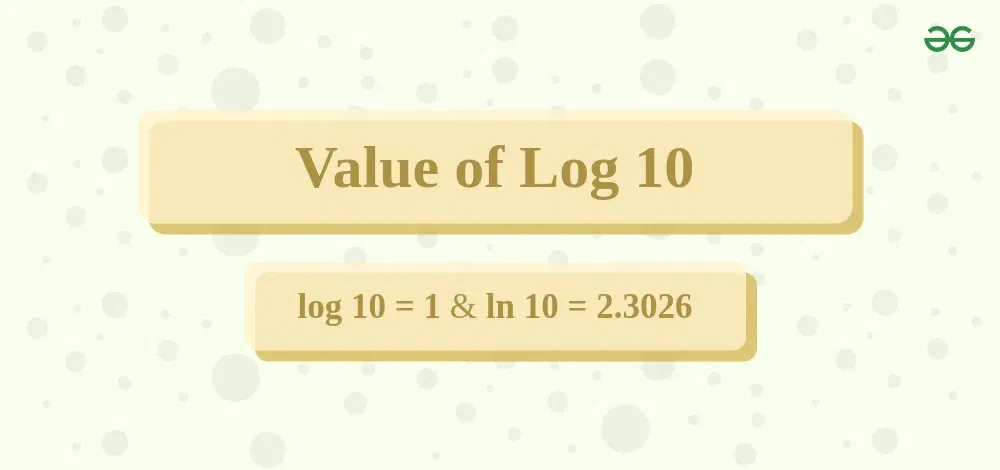
Value of log 10 is 1 whereas the value of ln 10 is approximately 2.3026. The logarithm base 10 is denoted as log and is called a common logarithm whereas a logarithm with base e is represented as ln and is called a natural logarithm. In this article, we are going to learn what is the value of log 10, how the value is derived, and many more things about log 10.
Value of log 10 in any base is the number which when raised to the base as power is equal to 10 i.e.,
logb 10 = x ⇒ bx = 10
For different bases value of log 10 is different, some of the most common value of log 10 are:
Let's discuss these values in detail as follows.
Vallue of loge 10 is approximately equal to 2.3026 or in the exponent form we can say that e2.3026 = 10. Mathematically it is written as
loge 10 = 2.3026
OR
ln 10 = 2.3026
Value of log 10 is 1 as the base of the common logarithm is 10 and loga a = 1. Also, as log is an inverse function of exponents we can also explain the same thing using the exponent i.e., as 101 = 10 thus the value of log10 10 is 1.
Values of Log 10 in different bases in given in the following table:
Base | LogBase 10 |
|---|---|
2 | 3.3219 |
e | 2.3026 |
3 | 2.0956 |
4 | 1.6021 |
5 | 1.4307 |
10 | 1 |
Try the following calculator tool to calculate the value of Log 10:
Let's see to calculate the value of Log 10 using base 10:
logba = logca / logcb
As we know, the logarithm base 10 of a number x is the exponent to which 10 must be raised to obtain x. So, In this case: Here x is also 10 and base is also 10.
Then: According to definition, (10)1 = 10.Hence the value of Log10 10 = 1.
Calculating the value of a whole number is straightforward with a log table.
Step 1: Refer to a Log Table with base 10. (Log Table PDF)
Step 2: Find the row for the mantissa (10).
Step 3: Identify the column for the characteristic (0).
Step 4: The intersection of both row and column in log table is the value log 10 i.e., 1.
Read More about Log Table.
The Taylor series expansion can be used to find the value of log 10. we can use the Taylor series expansion for ln x:
ln( 1 + x ) = x - x2/2 + x3/3 - x4/4 + ....
We can put x=9, to get the value of ln 10,
ln( 1 + 9 ) = 9 - 92/2 + 93/3 - 94/4 + . . .
After solving this series, we get the value of log 10 which is a approximate value.
Note: Higher the number of terms taken, the closest the value of expansion to log 10.
Read More about Taylor Series.
Read More,
Example 1: Find the Derivative of loge10?
Solution:
We know that log1010 = 1
Hence, d/dx(log1010) = d/dx(1) = 0
Example 2: What is the value of log10 100?
Solution:
log10100 = log10(10)2
Using Log Formula
log10(10)2 = 2×log10(10) = 2 × 1 = 2
Example 3: What is the value of q in log10 (q-2) = 1 ?
Solution:
log10(q-2) = 1
⇒ 101 = q-2
⇒ 10 = q-2
⇒ p = 10 + 2 = 12
Q1: If 10x = 100000, Find x.
Q2: Given that log10(z – 2) = 6, find z.
Q3: Find the value of √10.