|
VOOZH | about |
|
VOOZH | about |
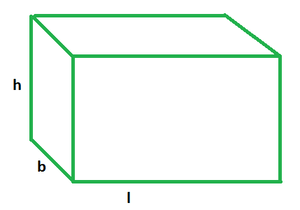
A rectangular prism is a three-dimensional geometric shape with two congruent and parallel rectangular bases and four rectangular faces connecting them. This type of prism is also known as a cuboid. It is a member of the polyhedron family and is characterized by its six rectangular faces, twelve edges, and eight vertices. Common examples include books, cereal boxes, containers, and rooms.
There are two main types of rectangular prisms:
The quantity of tri space contained in a surface is expressed as a scalar quantity called volume. For example, the amount of space occupied or contained by material or 3D objects. The SI-derived unit, the cubic meter, is frequently used to quantify volume numerically.
The entire space inside a rectangular prism is measured by the volume of the prism. Consider a water-filled rectangular container. In this situation, the box's capacity is equal to the entire amount of water it can store.
The formula for the volume of a rectangular prism is equal to the product of its base area and its height.
The volume of a Rectangular Prism (V) = Base Area × Height of the Prism
Formula
V = l × b × h
Where l, b, and h are the length, breadth, and height of the rectangular prism respectively.
Example 1: Find the volume of a rectangular prism whose length, breadth, and height are 12, 15, and 8 cm.
Solution:
Given: l = 12 cm
b = 15 cm
h = 8 cm
Volume = l × b × h
= 12 × 15 × 8
= 1440 cm3
Example 2: Find the base area of a rectangular prism whose volume is 40 cm3 and height is 4 cm.
Solution:
Given: V = 40 cm3
h = 4 cm
Since, V = l × b × h or,
V = Base Area × Height
40 cm3 = Base Area × 4 cm
⇒ Base Area = 40/4
= 10 cm2
Example 3: Find the volume of a rectangular prism if its base area is 50 cm2 and height is 12 cm.
Solution:
Given: Base area = l × b = 50 cm2
h = 12 cm
Volume = l × b × h
= 50 × 12
= 600 cm3
Example 4: Find the height of a rectangular prism given its volume is 600 cm3 and the base area is 50 cm2.
Solution:
Given: V = 600 cm3
Base area = l × b = 50 cm2
Volume = l × b × h
600 = 50 × h
h = 600/50
= 12 cm
Example 5: Determine the volume of a rectangular prism if its height is 15 inches and the length and breadth of its base are 11 inches and 6 inches, respectively.
Solution:
Given data,
l = 11 inches
b = 6 inches
h = 15 inches
We know that,
The volume of a Rectangular Prism = (l × b × h) cubic units
= 12 × 11 × 6 = 792 cubic inches
Hence, the volume of the given prism is 792 cu. in.
Example 6: Find the volume of a rectangular prism whose length, breadth, and height are 10, 9, and 8 cm.
Solution:
Given: l = 10 cm
b = 9 cm
h = 8 cm
Volume = l × b × h
= 10 × 9 × 8
= 720 cm3
Example 7: Determine the volume of a rectangular prism if its height is 10 cm and the length and breadth of its base are 8 cm and 5 cm, respectively.
Solution:
Given data,
l = 8 cm
b = 5 cm
h = 10 cm
We know that,
The volume of a Rectangular Prism = (l × b × h) cubic units
= 10 × 8 × 5 = 400 cu. cm
Hence, the volume of the given prism is 400 cu. cm.
A rectangular prism is a fundamental 3D shape in geometry characterized by its six rectangular faces, twelve edges, and eight vertices. Understanding the properties and volume calculations of rectangular prisms is essential in various practical applications, from packaging to architectural design. The volume formula V=l×b×h is crucial for determining the space contained within the prism, aiding in solving real-world problems.