|
VOOZH | about |
|
VOOZH | about |
Have you ever held your hand out of a speeding car or bus? The air pushes your hand in the direction opposite to the movement of the vehicle. An object falling down from say, a table slows down subsequently because a certain force slows down its fall by acting in the direction opposite to its motion. In both of these cases, a certain force is exerted by the atmosphere upon the objects, thereby slowing down their motion. The force and its formula are discussed below.
The force exerted by the air on things moving through it is known as air resistance. This force is commonly referred to by scientists as drag or drag force. Typically, this force is applied in the opposite direction as the object's motion, slowing it down.
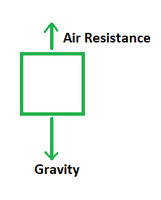
The frictional force of air resistance acts on the moving body. When a body moves, air resistance slows it down. The more the body's motion, the greater the air resistance imposed on it. Air resistance affects all moving objects, including bicycles, automobiles, trains, rockets, airplanes, and even living bodies. As is evident from the picture below, the air resistance acts upon freely falling bodies too, in the direction opposite to the force of gravity.
Formula
The formula for air resistance is given as follows:
Fair = cv2
where,
- Fair depicts the force of air resistance
- c refers to the force constant
- v depicts the object's velocity.
Question 1. Calculate the air resistance if an object moving at 50 ms-1 has a force constant of 0.05.
Solution:
Given: v = 50 ms-1 and c = 0.05
The formula for air resistance is Fair = cv2
Substitute the given values in the above formula. Then,
= (0.05)(50)2
Fair = 125 N
Question 2. Calculate the air resistance if an object moving at 40 ms-1 has a force constant of 0.08.
Solution:
Given: v = 40 ms-1 and c = 0.08
The formula for air resistance is Fair = cv2
Substitute the given values in the above formula. Then,
= (0.08)(40)2
Fair = 128 N
Question 3. Calculate the force constant if an object moving at 30 ms-1 experiences an air resistance of 20 N.
Solution:
Given: v = 30 ms-1 and Fair = 20 N
The formula for air resistance is Fair = cv2
Substitute the given values in the above formula. Then,
20 = c(30)2
c = 20/900
c = 0.023
Question 4. Calculate the force constant if an object moving at 20 ms-1 experiences an air resistance of 50 N.
Solution:
Given: v = 20 ms-1 and Fair = 50 N
The formula for air resistance is Fair = cv2
Substitute the given values in the above formula. Then,
50 = c(20)2
c = 50/400
c = 0.125
Question 5. Calculate the air resistance if an object moving at 30 ms-1 has a force constant of 0.02.
Solution:
Given: v = 30 ms-1 and c = 0.02
The formula for air resistance is Fair = cv2
Substitute the given values in the above formula. Then,
= (0.02)(30)2
Fair = 18 N
Question 6. Calculate the velocity of an object if its air resistance is 40 N and the force constant is 0.5.
Solution:
Given: Fair = 40 N and c = 0.5
The formula for air resistance is Fair = cv2
Substitute the given values in the above formula. Then,
v2 = Fair/c
v2 = 40/0.5
v2 = 80
v = 8.94 m/s
Question 7. Calculate the velocity of an object if its air resistance is 32 N and the force constant is 0.04.
Solution:
Given: Fair = 32 N and c = 0.04
The formula for air resistance is Fair = cv2
Substitute the given values in the above formula. Then,
v2 = Fair/c
v2 = 32/0.04
v2 = 800
v = 28.28 m/s
Also Check: