|
VOOZH | about |
|
VOOZH | about |
Gauss’s Law states that the total electric flux passing through any closed surface is equal to the net charge enclosed inside the surface divided by the permittivity of free space.
Applications mainly simplify the calculation of electric fields for systems with high symmetry. Instead of doing complex integrations using Coulomb's law, Gauss’s law provides a much easier method in many practical situations.
Consider an infinitely long straight wire with uniform linear charge density (). To find the electric field, a cylindrical Gaussian surface is chosen around the wire. The electric field is radial, so it is perpendicular to the curved surface and parallel to the flat ends. Therefore, the flux through the end faces is zero, and only the curved surface contributes to the flux. Due to cylindrical symmetry, the magnitude of the electric field remains constant at every point on the curved surface at a fixed distance from the wire.
👁 Electric Field due to Infinite Wire
The curved cylindrical surface has a surface area of 2πrl. The electric flux flowing through the curve is equal to E × (2πrl).
According to Gauss’s Law:
Hence, Electric Field due to Infinite Wire is given as
It's important to note that if the linear charge density is positive, the electric field is radially outward. If the linear charge density is negative, however, it will be radially inward.
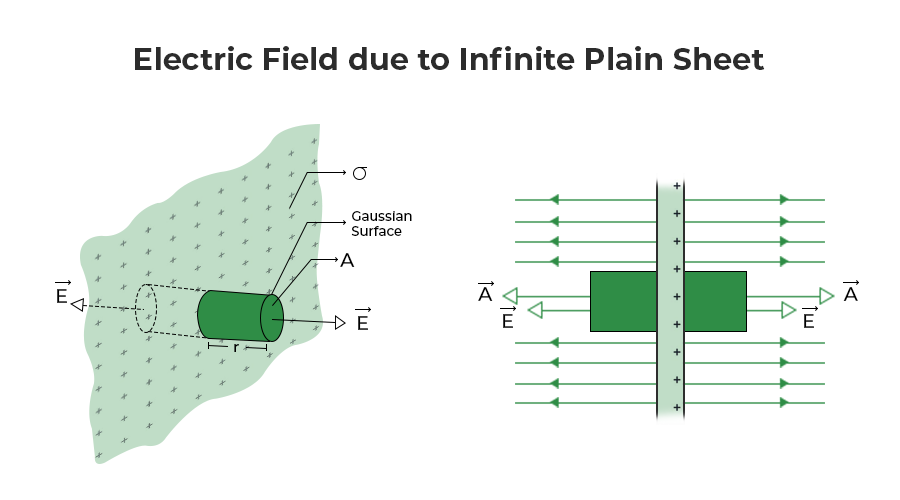
Consider an infinite plane sheet with a cross-sectional area A and a surface charge density σ. The infinite plane sheet is in the following position:
👁 Electric Field due to Infinite Plane Sheet
The electric field generated by an infinite charge sheet is perpendicular to the sheet's plane. Consider a cylindrical Gaussian surface whose axis is perpendicular to the sheet's plane. Gauss's Law allows us to calculate the electric field E as follows:
Here, the enclosed charge q = σA. Only the two flat ends of the cylinder contribute to the flux, as the curved surface is perpendicular to the field, giving zero flux. Therefore, the net flux is:
Applying Gauss’s Law
Hence, the electric field due to an infinite plane sheet is:
This shows that the electric field is independent of the area of the sheet.
Consider a thin spherical shell with a radius “R”, charge q, and a surface charge density of σ (such that σ = q / 4 π r2). The shell possesses spherical symmetry. The electric field owing to the spherical shell can be calculated in two ways:
a. Outside the Spherical Shell
Take a point P outside the spherical shell at a distance r from the center of the spherical shell to get the electric field. We use a Gaussian spherical surface with a radius of r and center 'O'. Because all points are equally spaced “r” from the sphere's center, the Gaussian surface will pass through P and experience a constant electric field E all around. So, Therefore, the total electric flux:
b.Charge contained inside the surface, q = σ × 4 π R2
Simplifying gives the electric field,
Electric field can also be written in the form of charge as (σ = q / 4 π r2)
Hence, Electric Field Outside Spherical shell is given as
It's important to keep in mind that if the surface charge density σ is negative, the electric field will be radially inward.
Let's look at point P inside the spherical shell to see how the electric field there is. We may use symmetry to create a spherical Gaussian surface that passes through P, is centered at O, and has a radius of r. Now, based on Gauss's Law,
Since surface charge density is spread outside the surface, there is no charge contained inside the shell. Therefore, the electric field inside shellfrom the above formula is also zero, i.e.,
E = 0 (since q = 0)
Example 1: A hemispherical bowl of radius r is placed in a region of space with a uniform electric field E. Find out the electric flux through the bowl.
Solution:
The surface area of the given bowl, dA = 2 π r2
The field lines are parallel the axis of the plane of the bowl, i.e., θ = 0°
The electric flux, ϕ = E (dA) cosθ
= E (2 π r2) cos0°
= E (2 π r2)
Hence, the electric flux through the bowl is E (2 π r2).
Question 2: An infinite plane sheet has a uniform surface charge density σ = 4 × 10⁻⁶ C/m2 . Find the electric field near the sheet. Take ε0 = 8.85 × 10⁻¹² C2/N⋅m2.
Solution: Electric field due to an infinite plane sheet
Question 3: A hemispherical bowl of radius r = 0.3 m is placed in a uniform electric field E = 5×10³ N/C, parallel to the axis of the bowl. Find the electric flux through the bowl.
Solution: Surface area of the hemispherical bowl
Electric flux
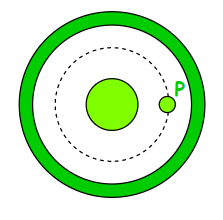
Example 4: A charge of 2×10⁻⁸ C is distributed uniformly on the surface of a sphere of radius 2 cm. It is covered by a concentric, hollow conducting sphere of radius 5 cm. Find the electric field at a point 3 cm away from the center.
Solution: Let us consider the below figure.
👁 Application of Gauss law Example 4
At point P, a concentric spherical surface is considered. By symmetry, the electric field is equal in magnitude and radial at all points on this surface.
The flux through this surface = ∮ E dS
= E ∮ dS
= E (4 π r2)
where r = 3 cm = 3 × 10⁻² m
This flux is equal to the charge q contained within the surface divided by ε0 according to Gauss' law.
Thus,
E (4 π r2) = q/ε0
E = q ⁄ 4 π ε0 r2
= ( 9 × 10⁹) × [(2 × 10⁻⁸)/(9 × 10-4)]
= 2 × 10⁵ N ⁄ C
The electric field at a point 3 cm away from the centre is 2 × 10⁵ N ⁄ C.
Question 1: A uniform surface charge density σ = 6 × 10⁻⁶ C/m2 is spread on an infinite plane. Find the electric field near the plane.
Question 2: A long straight wire has a linear charge density λ = 5 × 10⁻⁸ C/m. Calculate the electric field at a distance of 0.2 m from the wire.
Question 3: A spherical shell of radius 0.5 m carries a total charge of 4×10⁻⁸ C uniformly distributed on its surface. Find the electric field at a point 0.3 m and 0.7 m from the centre.
Question 4: An infinite cylindrical shell of radius 4 cm has a linear charge density of 2 × 10⁻⁷ C/m. Find the electric field at a point 6 cm from the axis of the cylinder.
Question 5: A hemispherical shell of radius 0.2 m is placed in a uniform electric field E = 3×10³ N/C, with the field parallel to the axis of the hemisphere. Find the electric flux through the hemispherical surface.