|
VOOZH | about |
|
VOOZH | about |
Electric charges are fundamental to the universe and play a significant role not only in science but also in our daily lives. For example, when dry hair is rubbed with a plastic ruler, some hair strands stand up. This simple phenomenon occurs because electric charges are present in everything around us.
Electric charges are of two types,
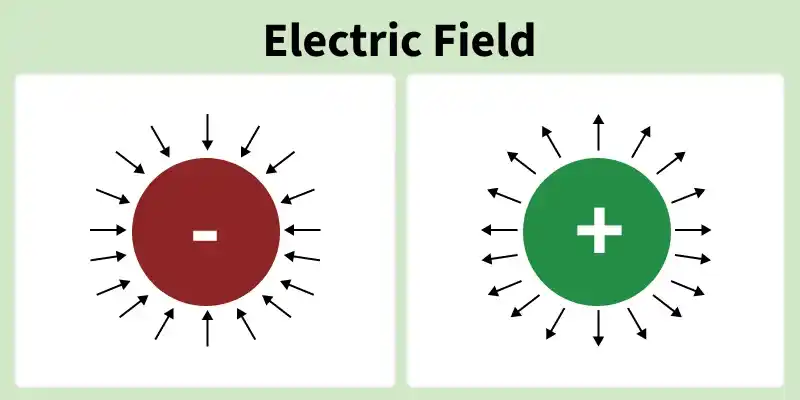
1. Positive charges, or protons, have a charge of +1.6 × 10⁻¹⁹ coulomb. A positive charge has its field lines emerging from within and going up to infinity.
2. Negative charges, or electrons, have a charge of -1.6 × 10⁻¹⁹ coulomb. A Negative charge has its field lines coming from infinity.
The above example, where hair strands start to attract the ruler, is due to electric charges. Similarly, rubbing a balloon on hair attracts hair to the balloon. If two balloons are simultaneously rubbed, they will start to repel each other, but they will attract the hair strands.
The rate of change of electric charge is known as Electric current.
Electric charges, when they are considered as point charges, are scalar in nature. With that, it is important to note that charges can be point charges, but they are still positive and negative charges. The additive property of electric charges says that if there are n charges present inside, the total charge present will be the algebraic sum of the individual charges.
Q = q1+ q2+ q3+..... qn
The Conservation of charges says that the charges are neither created nor destroyed. They can be transferred from one body to another, but they cannot be created or destroyed. In an Isolated system, the charges are always conserved.
According to the quantization of electric charge, Electric charges are defined as the Integral multiple of the charge present on them; hence, in any system, the charges will be,
q = ne
Where,
- n = Integer numbers
- e = value of the charge (1.6× 10⁻¹⁹ C)
Question 1: A polythene is rubbed against a woolen cloth, the charge developed on the woolen cloth is 7× 10⁻⁹C. What is the amount of charges transferred?
Solution: The Total charge present = 7 × 10⁻⁹ C.
q = 1.6 10-19 C.
Q = ne
7× 10-9= n × 1.6 × 10⁻¹⁹
n = 4.375 × 10¹⁰ C.
Question 2: How many electrons are present in one Coulomb?
Solution: Charge on 1 Electron = 1.6× 10⁻¹⁹C
Number of electrons present in 1 Coulomb = 1/(1.6× 10-19)
= 6.25 × 10¹⁸ Electrons.
Question 3: 5 different types of charges are present in an isolated system, the values of the charges are- +5nC, -6nC, +3nC, +4nC, +1nC. What is the total charge present in the system?
Solution: The additivity property of electric charges is,
Q = q1+ q2+ q3+ q4+ q5
Q = (+5 – 6+ 3+ 4+ 1)nC
Q = 7nC
Question 4: If a system has 0 charge overall. Is it true that there are no charges present in the system?
Solution: No, it is not true that the system would always have no charges present inside if the overall charge present inside is 0. There is a possibility that all positive charge cancels out all the negative charges, and the overall system has 0 charge.
Question 1: A rubber rod is rubbed with a piece of fur and gains a charge of 4×10⁻⁸ C. Calculate the number of electrons transferred to the rod. (Given: charge of one electron e = 1.6 × 10⁻¹⁹ C)
Question 2: How many electrons are required to produce a charge of −2.56 × 10⁻⁶ C on a body?
Question 3: Three charges, +3 nC, −2 nC, +4 nC, are placed in an isolated system. Find the total charge of the system.
Question 4: A neutral metal sphere is touched by a positively charged rod of 6 × 10⁻⁶ C. If the sphere acquires one-third of the rod’s charge, find the charge on the sphere.
Question 5: Two isolated spheres, one with a charge of +7 C and the other with −5 C, are connected by a conducting wire. Find the final charge on each sphere after they are separated.