 |
VOOZH | about |
|
VOOZH | about |
Think of a battery as a small city divided into two regions; one side has extra electrons (negative), and the other side has spots that need electrons (positive). The voltage is the push that makes electrons flow from the negative to the positive side, like workers filling empty spots in the city. This difference in energy between the two areas is called cell potential, and it’s what powers devices like your remote or car engine. The greater the difference, the stronger the push for electrons to move, creating the electricity that powers things.
Cell potential, Ecell, refers to the voltage difference between the two half-cells in an electrochemical cell. This variation is caused by the flow of electrons, which occurs during a redox reaction. In this reaction, one species undergoes oxidation (loses electrons), becoming positively charged, while another undergoes reduction (gains electrons), becoming negatively charged. The extent to which each species is predisposed to lose or gain electrons determines the overall cell potential.
Thus, the cell potential is a direct result of the difference in the tendency of the oxidising agent to accept electrons and the reducing agent to donate them. This potential is quantified in volts, providing a measurable value for the energy variation between the two half-cells that enables the electrochemical reaction to generate electrical current.
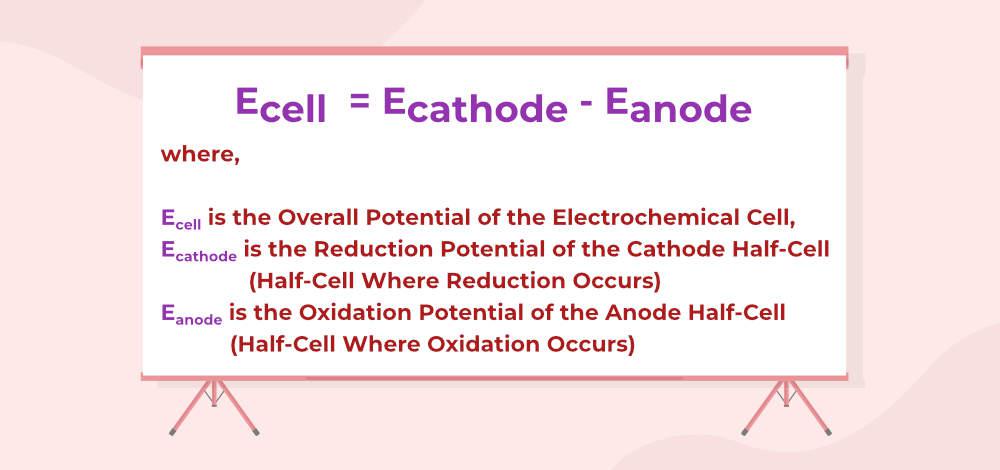
The cell potential formula is widely used to find the electric potential of the cell. The diagram given below shows the cell potential formula :
An electrochemical cell is made up of two half-cells, with each having a metal electrode immersed in a solution of its respective metal ions. In one half-cell, oxidation occurs, while in the other half-cell, reduction takes place. These half-cells are connected by a wire that allows electrons to flow from one half-cell to the other.
Note : The cell potential is the result of the difference in the reduction potentials between the cathode and the anode. It is calculated by subtracting the reduction potential of the anode from that of the cathode.
Mathematically, this is expressed as:
Ecell∘=E ∘red ,cathode−E∘red, anode
This difference in reduction potentials determines the overall voltage of the electrochemical cell, driving the electron flow from the anode to the cathode.
There are two main types of cell potential:
The standard cell potential Ecellrepresents the voltage generated by the electrochemical cell and is determined by the difference in the potentials of the two electrodes. To calculate this difference, we use the following equation:
E∘cell =E ∘red ,cathode−E∘red, anode - (1a)
Where,
The potential values are typically expressed in volts (V). Alternatively, this relationship can also be written as a sum of the reduction potential and oxidation potential, as shown below:
E∘cell =E ∘red ,cathode +E∘ox, anode - (1b)
Here, we shift the approach from subtracting the reduction potentials to adding the reduction potential of the cathode and the oxidation potential of the anode.
Since the oxidation potential is the negative of the reduction potential (E∘ox =−E∘red), both methods yield the same result.
The non-standard cell potential refers to the cell potential when the conditions deviate from the standard state (1 M concentration for solutions, 1 bar pressure for gases, and 298 K temperature). In non-standard conditions, factors such as the concentration of ions in solution, partial pressure of gases, and temperature affect the overall cell potential.
The Nernst equation is used to calculate the non-standard cell potential:
Ecell = E∘cell −0.0592/ n. log ( [ Red] cathode /[ Ox] cathode × [ Ox] anode / [ Red] anode)
Where,
This equation accounts for how changes in concentration (or pressure, for gases) affect the cell potential, showing that the voltage of the cell will vary depending on the actual concentrations of the ions involved in the redox reaction.
For example, if the concentration of reactants is higher or the products' concentration is lower than standard conditions, the cell potential will be higher than the standard potential. Conversely, the cell potential will decrease if the reverse is true.
Zn(s)+Cu2+(aq)→Zn2+(aq)+Cu(s)
Zn2+(aq)+2e−→Zn(s),E∘=−0.76V
Cu2+(aq)+2e−→Cu(s),E∘=+0.34V
Solution:
Identify the Half-Reactions and Their Standard Reduction Potentials
Zinc half-reaction (Anode)Zn2+(aq)+2e−→Zn(s),E∘=−0.76V
Copper half-reaction (Cathode):
Cu2+(aq)+2e−→Cu(s),E∘=+0.34V
Write the Cell Reaction
Zn(s)+Cu2+(aq)→Zn2+(aq)+Cu(s)
⁛ Zinc (Zn) is oxidized at the anode, and copper ions (Cu²⁺) are reduced at the cathode.
Calculate the Standard Cell Potential
E∘cell=E∘cathode −E∘anode
E°cathode (for Cu²⁺/Cu) = +0.34 V
E°anode (for Zn²⁺/Zn) = -0.76 V
E∘cell=0.34 V−(−0.76 V)
E∘cell=1.10V
Ni(s)+2Ag+(aq)→Ni2+(aq)+2Ag(s)
Solution:
Identify the Half-Reactions and their Standard Reduction Potentials
Silver half-reaction (Cathode)
Ag+(aq)+e−→Ag(s),E∘=+0.80V
Nickel half-reaction (Anode)
Ni2+(aq)+2e−→Ni(s), E∘=−0.23 V
Step 2: Write the Cell Reaction
Ni(s)+2Ag+(aq)→Ni2+(aq)+2Ag(s)
Nickel (Ni) is oxidized at the anode, and silver ions (Ag⁺) are reduced at the cathode.
Step 3: Calculate the Standard Cell Potential
E∘cell=E∘cathode −E∘anode
E°cathode (for Ag⁺/Ag) = +0.80 V
E°anode (for Ni²⁺/Ni) = -0.23 V
E∘cell=0.80 V−(−0.23 V)=1.03V
Zn(s) + Cu2+(aq) → Zn2+(aq) + Cu(s)
Solution:
The cell potential can be calculated using the formula:
Ecell = E°cathode - E°anode
E°cathode = +0.34 V (Cu2+/Cu)
E°anode = -0.76 V (Zn2+/Zn)Ecell = +0.34 V - (-0.76 V) = +1.10 V
The positive value of the cell potential indicates that the reaction is spontaneous in the forward direction, i.e., Zn(s) is oxidized and Cu2+(aq) is reduced. The reaction proceeds until the concentrations of the reactants and products reach equilibrium.
To measure the actual cell potential under non-standard conditions, the Nernst equation can be used. For example, if the concentrations of Cu2+ and Zn2+ are both 1.00 M and the cell is at 25°C, the cell potential can be calculated as,
Ecell = E°cell - (RT/nF) ln(Q)
Q = [Cu+2]/[Zn+2] = 1.00/1.00 = 1.00
Plugging in the values, we get
Ecell = +1.10 V - (0.0257 V) ln(1.00) = +1.10 V
Thus, the cell potential is the same as the standard cell potential under these conditions.
Cu(s) + Ag+(aq) -> Cu2+(aq) + Ag(s)
Standard reduction potentials are,
Cu2+(aq) + 2e- -> Cu(s) (E° = +0.34 V)
Ag+(aq) + e- -> Ag(s) (E° = +0.80 V)
Solution:
Given:
The reaction is:
Cu(s)+Ag+(aq)→Cu2+(aq)+Ag(s)
Standard reduction potentials:
Cu2+(aq)+2e−→Cu(s) ,E∘=+0.34V
Ag+(aq)+e−→Ag(s) ,E∘=+0.80V
Part A: Balanced Equation and Standard Cell Potential
Balanced Equation:
The half-reactions for the reduction and oxidation:For copper (Cu): Cu is oxidized from Cu(s) to Cu²⁺, so it is the anode (oxidation).
For silver (Ag): Ag⁺ is reduced to Ag(s), so it is the cathode (reduction).
The overall balanced reaction is:
Cu(s)+2Ag+(aq)→Cu2+(aq)+2Ag(s)
The standard cell potential is calculated using the formula:
E∘cell=E∘cathode∘−E∘anode
Thus,
E∘cell=+0.80 V−(+0.34 V)=+0.46 V
Part B: Standard Conditions (Cu²⁺ and Ag⁺ concentrations both 0.1 M)
Ecell=E∘cell=+0.46 V
Part C: Non-Standard Conditions (Cu²⁺ = 1 M and Ag⁺ = 0.1 M)
Reaction Quotient (Q):
Q=[Ag+][Cu2+]=0.11=10Nernst Equation:
The Nernst equation is given by:Ecell=Ecell∘−0.059nlogQWhere,
E∘cell=+0.46 V(calculated above)
n=2n (since 2 electrons are transferred)
Q=10
Now, substituting the values
Ecell=+0.46 V−0.059/2log10
Since log10=1
Ecell=+0.46 V−0.059/2×1=+0.46 V−0.0295 V=+0.4305V
Solution:
To calculate the cell potential, we need to find the reduction potentials for each half-reaction and then subtract the reduction potential of the anode from the reduction potential of the cathode.
Half-reactions for the given reaction are,
Fe3+(aq) + e- → Fe2+(aq) E° = +0.77 V
I2(s) + 2 e- → 2 I-(aq) E° = +0.54 V
Reduction Potential of the anode is the reduction potential of the species being oxidized, which is Fe3+ in this case. So, the reduction potential of the anode is +0.77 V.
The reduction potential of the cathode is the reduction potential of the species being reduced, which is I2 in this case. So, the reduction potential of the cathode is +0.54 V.
The cell potential (Ecell) is the difference between the reduction potentials of the cathode and anode:
Ecell = Ecathode - Eanode
Ecell = +0.54 V - (+0.77 V)
Ecell = -0.23 VTherefore, the cell potential for this reaction is -0.23 V,this means that the reaction is not spontaneous and the electrons will not flow from the anode to the cathode without an external energy source.

.png)