|
VOOZH | about |
|
VOOZH | about |
A Convex lens is a converging lens that brings incident light rays together at a point. These lenses are thicker at the center and thinner towards the edges.
Convex lens is a key part of many optical devices. It has outward-curving surfaces that bend light rays inward to meet at a focal point. This property allows it to magnify objects and improve vision.
In this article, we will learn about the Convex Lens, exploring its properties, the formation of images, the characteristics of the images, the formula for calculating power, and magnification, along with its diverse applications.
Table of Content
Convex lens, also known as converging lens is a type of lens that is thicker in the middle than at the edges. It bends light rays inward, helping to focus them to a single point. This makes objects appear larger and clearer. It is a lens that brings together parallel light beams. When light passes through the lens, all of the light bends to meet at a specific point known as Focus .
Convex lenses are used in many everyday items like eyeglasses, microscopes, cameras, and telescopes. Learning about convex lenses helps us understand how they work and their importance in technology and daily life.
The images formed by a convex lens can be real or virtual. The power of a convex lens is positive, and it is commonly used to correct hypermetropia.
Convex lens is a transparent lens that is thicker at the center and thinner at the edges and causes parallel rays of light to converge as they pass through it.
Here are some of the common examples of the convex lens:
A convex lens, similar to other lenses, is composed of various components and characteristics that influence its optical properties. The following are the main parts of a convex lens:
Convex lenses, also known as converging lenses, are used in various optical applications. They come in different shapes and forms, each with particular uses and characteristics. The main types of convex lenses include:
Convex lenses, being converging lenses, possess several distinctive properties. Here are the key properties of convex lenses:
The sign convention for a convex lens is as follows:
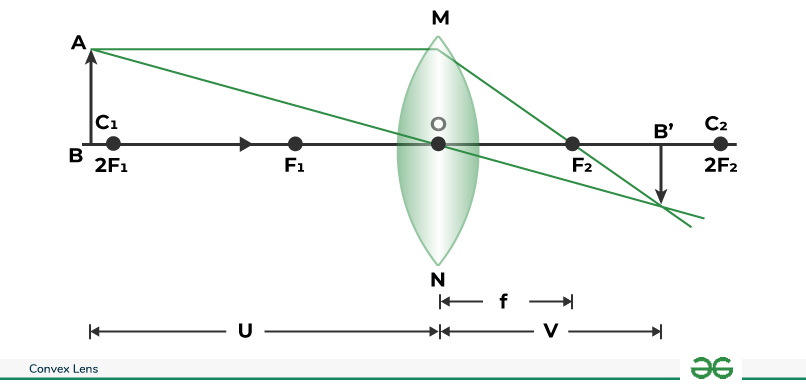
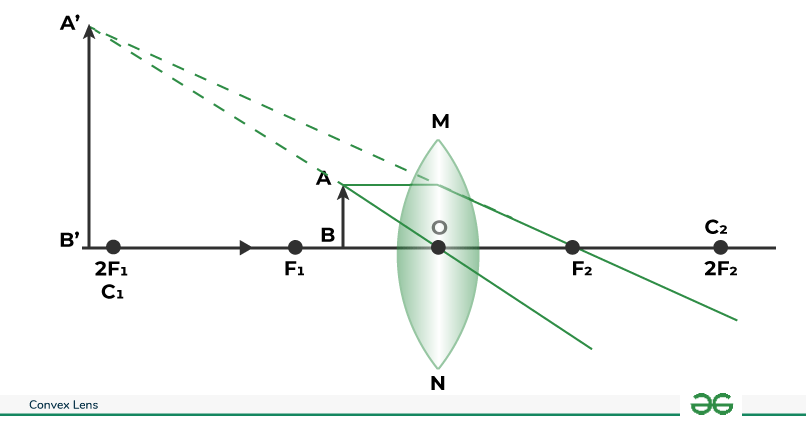
Ray Diagram: A ray diagram is a graphical representation to make you understand about how images are formed by lenses. Now, we will create a ray diagram for image formed by a convex lens in various cases.
Object at Infinity:
👁 Convex-lens-image formation when object is at infinity
👁 Convex-lens-image formation when object is beyond 2F
👁 Convex-lens-image formation when object is at 2F
👁 Convex-lens-image formation when object is between F and 2F
👁 Convex-lens-image formation when object is at F
👁 Convex-lens-image formation when object is between F and O
All the possible cases of image formation can be see
Object Position | Image Position | Image Size | Image Nature |
|---|---|---|---|
Beyond 2F | Between F and 2F | Smaller | Real, Inverted |
At 2F | At 2F | Same Size | Real, Inverted |
Between F and 2F | Beyond 2F | Larger | Real, Inverted |
At F | Infinity | Infinite | Real, Inverted (Highly Diminished) |
Between F and Lens | Beyond 2F | Larger | Virtual, Upright |
At Lens | At Lens | Magnified | Virtual, Upright |
Object Inside Lens | Between Lens and F | Larger | Virtual, Upright |
A convex lens is capable of forming both real and virtual images.
The lens formula is an equation that explains how the object distance (u), image distance (v), and focal length (f) of a lens are related. This formula works for both convex and concave lenses. In the case of a convex lens, the focal length is considered positive. The lens formula for a convex lens is:
(1/f) = (1/v)-(1/u)
Where:
- f represents the focal length of the lens.
- v represents the image distance (distance from the lens to the image formed).
- u represents the object distance (distance from the lens to the object).
For a convex lens, the magnification formula is the same as for a concave lens, except that the magnification for a convex lens is usually positive. This is because a convex lens converges light, creating a real, inverted image on the other side of the lens.
The magnification is denoted by “m”, is given by the formula:
m = himage/hobject
Where:
- m represents the magnification.
- himage represents the height of the image formed by the lens.
- hobject represents the height of the object.
In terms of object distance (u) and image distance (v), the magnification formula for a convex lens is:
m = v/u
Where:
- m represents the magnification.
- u represents the object distance (distance from the object to the lens).
- v represents the image distance (distance from the image to the lens).
The presence of a positive sign in the equation indicates that the image is formed on the opposite side of the object for a converging lens, like a convex lens.
The power of a convex lens is its ability to converge incident rays of light. The formula for the power of a convex lens is given by:
P = 1/f
where,
- P is Power
- f is focal length of the lens in m
Convex lenses possess positive focal lengths, which consequently results in the convex lens having a positive power.
The difference between concave and convex lens is tabulated below:
Property | Convex Lens | Concave Lens |
|---|---|---|
Nature of Lens | Converging lens | Diverging lens |
Principal Focus | Real | Virtual |
Focal Length | Positive | Negative |
Shape | Thicker at the center, thinner at the edges | Thinner at the center, thicker at the edges |
Examples | Camera, Human eye | Lights, Flashlights |
Some common uses of convex lenses are as follows:
Related Articles | |
|---|---|
Example 1: An object placed from a lens produces a virtual image at a distance of 5 cm in front of the lens. Calculate the focal length of the lens.
Solution:
Given:
- u = - 5
- v = - 25
Using the lens formula:
1/v - 1/u = 1/f
Substitute the known values:
(1/- 5) - (1/- 25) = (1/f)
Solve for f:
1/f = - 5+1/25
1/f = - 4/25
f = 0.16 cm
So, the focal length of the lens is 0.16 cm.
Example 2: What is the focal length of a convex lens, when a convex lens of focal length 30 cm in contact with a concave lens of focal length 20 cm?
Solution:
Given:
Focal length of the convex lens = 30 cm
Focal length of the concave lens = - 20 cm
Using the formula for the combination of lenses:
1/f = 1/f1 + 1/f2
1/f = (1/30) - (1/20) = -1/60
Therefore, combined focal length f = -60
Example 3:An object is places at a distance 40 cm from a thin converging lens of focal length; 10cm. Calculate the image distance.
Solution:
Given that
- f = 10 cm
- u = -40 cm
Using the lens formula:
1/v - 1/u = 1/f
Substitute the known values:
(1/v) - (1/ - 40) = 1/10
Solve for v:
1/v = (1/10) + (1/ - 40)
1/v = 3/40
Therefore, v = 40/3
So, the image distance is 40/3 cm
Q1. What is the position of image when an object is placed at a distance of 10 cm from a convex lens of focal length 10 cm?
Q2. A convex lens of focal length 0.10 m is used to form a magnified image of an object of height 5 mm placed at a distance of 0.08 m from the lens. Find the position, nature, and size of the image.
Q3. A convex lens produces an inverted image magnified three times of an object at a distance of 15 cm from it. Calculate the focal length of the lens.
Q4. A small object is so placed in front of a convex lens of 5 cm focal length that a virtual image is formed at a distance of 25 cm. Find the magnification.