|
VOOZH | about |
|
VOOZH | about |
When an electric charge moves, it produces an electric current and creates a magnetic field around it. This magnetic field can exert forces on nearby moving charges and magnets. Stationary charges do not produce magnetism, while moving charges can cause attraction or repulsion.
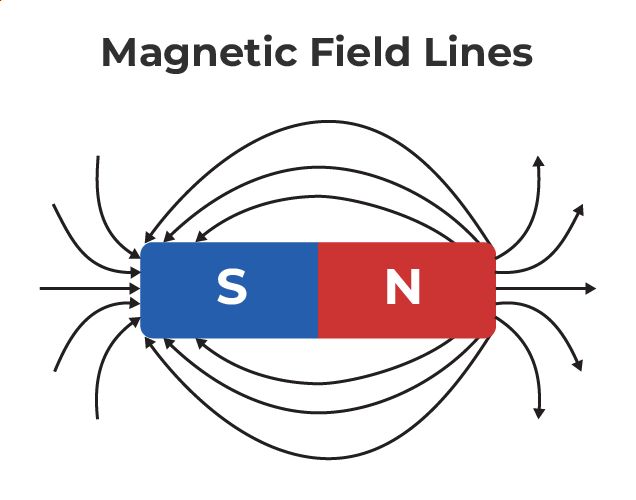
A moving charge creates a magnetic field, and the force experienced in a magnetic field is called the magnetic force. Charge is a fundamental property of matter that allows it to produce and experience electrical and magnetic effects. The region in space around a magnet where its magnetic influence is felt is called the magnetic field of the magnet.
If a point charge q moves with velocity v at position r in the presence of both an electric field Er and a magnetic field Br, the total force on the charge is given by:
F = q [Er + v × Br] = EElectric + Fmagnetic
This formula, known as the Lorentz force, was stated by H. A. Lorentz based on the experiments of Ampere and others.
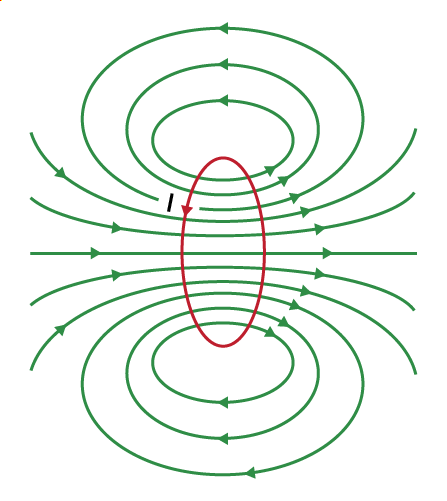
A magnetic dipole consists of two equal and opposite magnetic poles separated by a small distance. A current-carrying loop behaves like a magnetic dipole and produces a magnetic field similar to a bar magnet.
The magnetic dipole moment is a vector quantity that measures the strength and direction of a magnetic dipole. Its direction is from south to north, and its SI unit is A·m².
The torque on a magnetic dipole is:
Where,
- τ is the torque acting on the dipole
- m is the magnetic dipole moment
- B is the external magnetic field
A magnetic dipole consists of two equal and opposite magnetic poles (north and south), which together produce a magnetic field. Example: when a bar magnet is broken into smaller pieces, each piece behaves as an independent magnetic dipole, with its own north and south poles.
When an electric current flows through a circular loop, it behaves like a magnetic dipole. This happens because the moving charges in the loop generate a magnetic field, similar to that produced by a bar magnet. The loop tends to align itself in an external magnetic field, just like a magnetic dipole.
The magnetic dipole moment of a current-carrying loop is defined as the product of the current flowing through the loop and the area enclosed by it. For a coil having multiple turns, the dipole moment increases proportionally with the number of turns.
μ = nIA
Where,
- n is the number of turns in the loop
- I is the current flowing in the loop
- A is the area enclosed by the loop
The SI unit of magnetic dipole moment is ampere–meter² (A·m²), while in the CGS system, it is expressed in erg per gauss. Here, erg represents the unit of energy and gauss represents the unit of magnetic flux density.
A circular current-carrying loop behaves like a magnetic dipole because the flow of current in a closed loop produces a magnetic field similar to that of a bar magnet. The direction of this magnetic field is determined by the right-hand thumb rule. Due to this, the loop exhibits north and south pole behavior, making it equivalent to a magnetic dipole.
The magnetic dipole moment of a circular current loop is given by:
Where,
- n is the number of turns
- i is the current flowing in the loop
- r is the radius of the loop
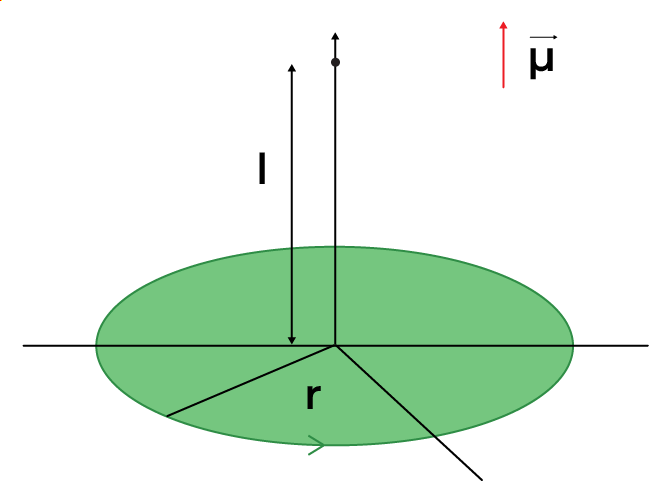
Consider a circular loop of radius R placed on a table, carrying a current i in the anti-clockwise direction. Let a point P be located on the axis of the loop at a distance l from its centre. The magnetic field at point P is given by:
For simplification, assume that the point P is very far from the loop (l >> R). Then, the magnetic field can be approximated as:
The area of the loop is:
Thus, the magnetic field can be expressed in terms of the magnetic dipole moment μ as:
where μ=iA is the magnetic dipole moment of the current loop.
This formula for the magnetic field of a current loop is analogous to the electric field of a dipole:
Here, is the electric dipole moment and r is the distance from the dipole.
Question 1: Two wires of the same length are shaped into a square and a circle. If they carry the same current, then the ratio of their magnetic moments is:
Solution: The magnetic moment of a loop is given by
Let the side of the square be a and the radius of the circle be r. Since the wires have the same length
The area of the square loop:
Thus, the magnetic moment of the square loop:
The area of the circular loop:
Thus, the magnetic moment of the circular loop:
The ratio of magnetic moments:
Question 2: A circular coil of 300 turns and a diameter of 14 cm carries a current of 15 A. The magnitude of the magnetic moment associated with the loop is going to be
Solution: Given:
Number of turns (N) = 300
Radius of coil (r) = 14/2 = 7cm = 7 × 10⁻² m
Current in coil (I) = 15A
Magnetic moment of a circular coil:
Substitute the values:
Question 3: A circular coil of 100 turns, each turn of radius 8 cm carries a current of 0.4 A. What is the magnitude of the magnetic field B at the center of the coil?
Solution: Given:
Number of turns (N) = 100
radius of each turn (r) = 8cm = 8 × 10⁻²m
Current flowing in the coil (I) = 0.4 A
permeability of free space (μ0) = 4π × 10-7 TmA-1
The magnetic field at the center of a circular coil is given by:
Substitute the values:
Question 4: A long straight wire in the horizontal plane carries 50 A in the north-to-south direction. Give the magnitude and direction of B at a point 2.5 m east of the wire.
Solution: Given:
Current in the wire (I) = 50 A
Distance of a point from the wire (r) = 2.5 m
permeability of free space (μ0) = 4π × 10-7 TmA-1
The magnetic field due to a long straight wire is:
Substitute the values:
Using the right-hand thumb rule, the magnetic field at a point east of the wire (current north-to-south) points into the page.
T, into the page
Question 1: A circular coil of 50 turns has a radius of 10 cm. It carries a current of 2 A. Find its magnetic moment.
Question 2: A straight wire 1 m long carries a current of 5 A. It is placed in a uniform magnetic field of 0.1 T perpendicular to the wire. Find the force on the wire.
Question 3: Two long parallel wires, 1 m apart, carry currents of 6 A and 9 A in the same direction. Find the force per meter between them.
Question 4: Two wires of equal length are shaped into a square and an equilateral triangle. Both carry the same current. Find the ratio of their magnetic dipole moments.
Question 5: A circular coil of 300 turns and radius 8 cm carries a current of 0.5 A. Find the magnetic field at a point on its axis, 20 cm from its centre.