|
VOOZH | about |
|
VOOZH | about |
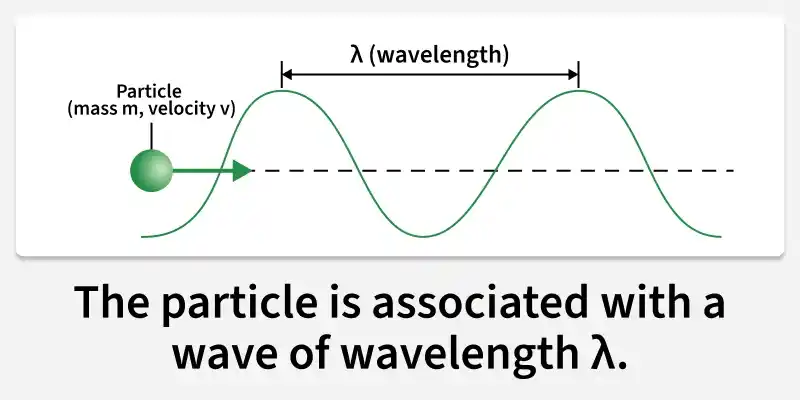
The de Broglie wavelength explains the wave nature of particles such as electrons, protons, and other moving objects. In 1924, French physicist Louis de Broglie proposed that not only light but also matter can behave like waves. According to the de Broglie hypothesis, every moving particle is associated with a wave called the matter wave. This means particles like electrons show both particle nature and wave nature, which is known as wave–particle duality.
Where,
- λ is the De Broglie wavelength,
- h is Planck's constant with the value of 6.62 × 10⁻³⁴ Js,
- m is the mass,
- v is the velocity of the particle.
The de Broglie wavelength of a particle is derived by using the formulas for its energy. Consider a photon with energy E, wavelength λ, and velocity equal to the speed of light c. The energy (E) of a photon is given as,
E = hc/λ ⇢ (1)
Also, we know that,
E = pc⇢ (2)
Equating (1) and (2), we get,
hc/λ = pc
h/λ = p
λ = h/p
This derives the formula for De Broglie wavelength of a particle
The concept of matter waves proposed by Louis de Broglie has several important applications in understanding the microscopic world:
Although very useful, the de Broglie concept has certain limitations:
Problem 1: Calculate the wavelength of an electron moving with a velocity of 100 m/s.
Solution:
We have,
m = 9.1 × 10⁻³¹
v = 100
Using the formula we get,
λ = h/mv
= (6.62 × 10⁻³⁴) / (9.1 × 10-31 × 100)
= 7.27 x 10 -6 m = 7270 m
Problem 2: Calculate the wavelength of an electron moving with a velocity of 40 m/s.
Solution:
We have,
m = 9.1 × 10⁻³¹
v = 40
Using the formula we get,
λ = h/mv
= (6.62 × 10⁻³⁴) / (9.1 × 10-31 × 40)
= 18200 nm
Problem 3: Calculate the wavelength of a particle of mass 2 × 10⁻²⁹ kg moving with a velocity of 10 m/s.
Solution:
We have,
m = 2 × 10-29
v = 10
Using the formula we get,
λ = h/mv
= (6.62 × 10⁻³⁴) / (2 × 10-29 × 10)
= 3310 nm
Problem 4: Calculate the velocity of a particle of mass 2 × 10⁻²⁹ kg and wavelength of 3313 nm.
Solution:
We have,
m = 2 × 10-29
λ = 3313 × 10−9
Using the formula we get,
λ = h/mv
= (6.62 × 10⁻³⁴)/(2 × 10-29) (3313×10⁻⁹)
= 10 m/s
Problem 5: Calculate the velocity of a particle of mass 4.5 × 10⁻²⁷ kg and wavelength of 2.72 nm.
Solution:
We have,
m = 4.5 × 10⁻²⁷
λ = 2.72 nm
Using the formula we get,
λ = h/mv
=> v = h/mλ
= (6.62 × 10⁻³⁴)/(4.5 × 10-27 × 2.72 × 10-9)
= 54 m/s
Problem 6: Calculate the velocity of a particle of mass 3.2 × 10⁻²⁸ kg and wavelength of 27.60 nm.
Solution:
We have,
m = 3.2 × 10⁻²⁸
λ = 27.60 nm
Using the formula we get,
λ = h/mv
=> v = h/mλ
= (6.62 × 10⁻³⁴)/(3.2 × 10-28 × 27.60 × 10-9)
= 75 m/s
Problem 7: Calculate the wavelength of a particle if its momentum is 2 × 1024 kg m/s.
Solution:
We have,
p = 2 × 10-24
Using the formula we get,
λ = h/p
= (6.62 × 10⁻³⁴)/(2 × 10-24)
= 0.331 nm