The human eye acts as a natural optical instrument that allows us to see objects by forming their images on the retina. For clear vision, light rays coming from an object must be properly focused on the retina. However, due to certain structural or functional defects in the eye, this focusing may not occur correctly. Such conditions are known as defects of vision. These defects lead to blurred or distorted images but can usually be corrected using suitable optical aids like lenses.
Some of the defects of vision and their corrections are:
1. Myopia (Short-Sightedness)
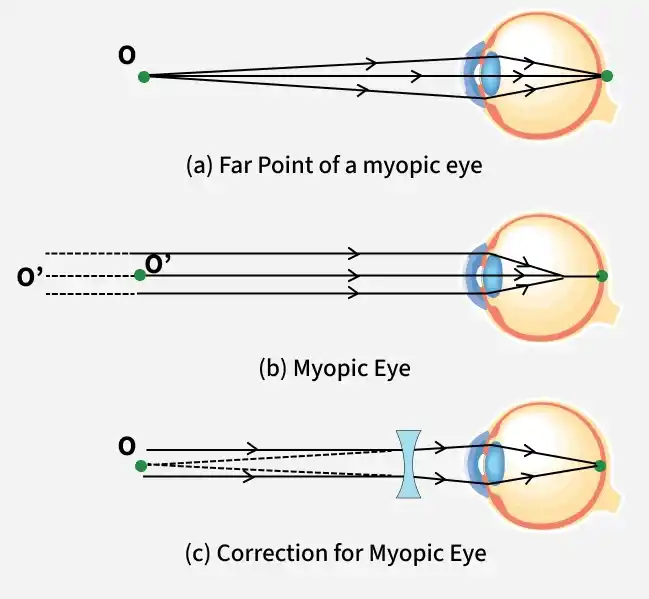
Myopia is a common defect of vision in which a person can see nearby objects clearly but has difficulty seeing distant objects.
The eyeball becomes elongated, increasing the distance between the lens and retina.
The eye lens becomes too curved, increasing its converging power.
As a result, parallel rays of light from distant objects converge before reaching the retina.
Effects:
Distant objects appear blurred.
The far point (the farthest point visible clearly) is less than infinity.
Correction:
Myopia is corrected using a concave (diverging) lens.
This lens diverges incoming parallel rays so that they appear to come from the far point of the eye, enabling the eye lens to focus them correctly on the retina.
2. Hypermetropia (Long-Sightedness)
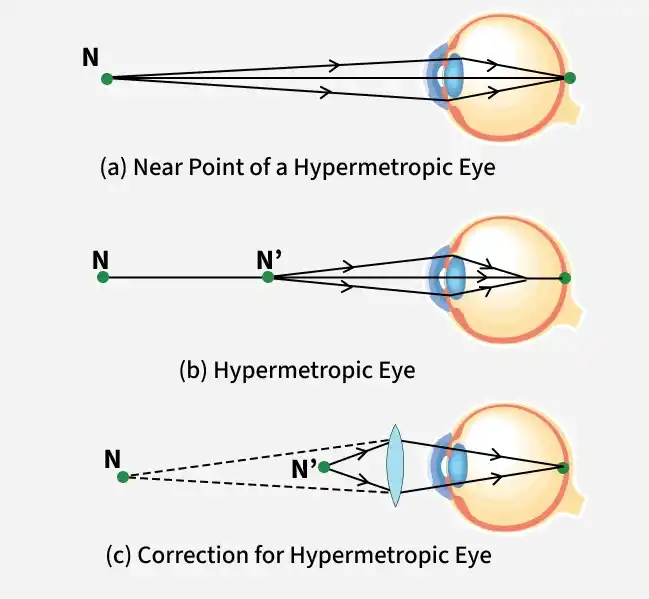
Hypermetropia is a defect in which a person can see distant objects clearly but cannot see nearby objects distinctly.