|
VOOZH | about |
|
VOOZH | about |
PN Junction Diodes and Zener Diodes are semiconductor devices used to regulate the flow of electric current in circuits. While both are built on similar principles, they are designed for different purposes.
The PN Junction Diode is a basic diode that allows current to flow in one direction, whereas the Zener Diode is a specialized diode designed to conduct in reverse bias beyond a specific voltage (known as the Zener voltage). In this article we will discuss the main difference between PN Junction Diode and Zener Diode.
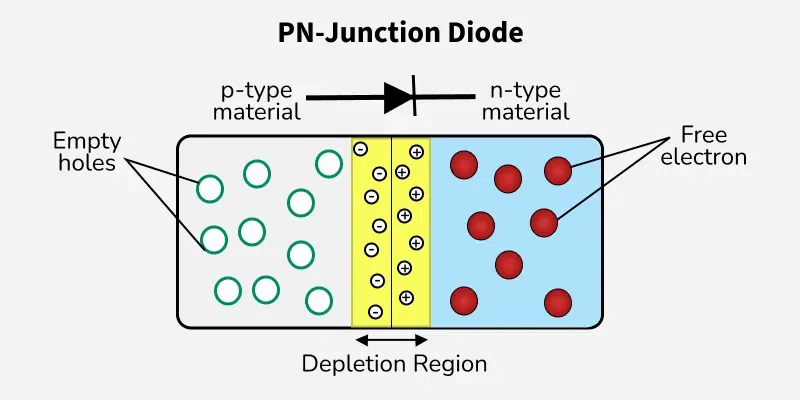
A PN Junction Diode is the most basic type of semiconductor diode. It is made by joining two types of semiconductor materials—P-type and N-type—to form a junction. The P-type material is rich in holes (positively charged), and the N-type material has an excess of electrons (negatively charged). When a voltage is applied to the diode, it only allows current to flow in one direction (from P to N, in forward bias), making it a rectifier.
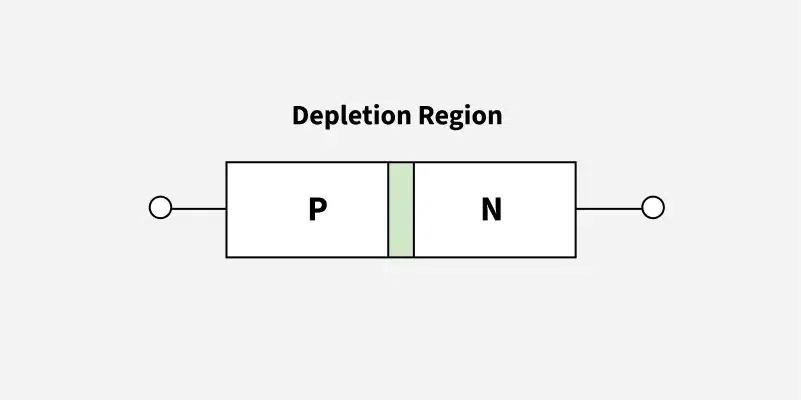
👁 PN-Junction DiodeP–n junctions are the active sites of semiconductor electronic devices like diodes, transistors, solar cells, LEDs, and integrated circuits. A bipolar junction transistor(BJT), for example, is made up of two p–n junctions connected in series in the configuration n–p–n or p–n–p, whereas a diode can be made up of a single p–n junction.Because it only permits current to travel in one direction, the PN junction diode is utilized for rectification. It's a type of switch that only lets forward current travel through it.
A Zener Diode is a special type of PN Junction Diode that is designed to operate in reverse bias in a controlled manner. When the reverse voltage exceeds a certain value (called the Zener voltage), the Zener diode allows current to flow in reverse, maintaining a stable voltage. This unique characteristic makes Zener diodes useful for voltage regulation and protecting circuits from voltage spikes.
The forward and reverse currents can both pass through the Zener diode. Because it supplies a constant voltage from the supply to the load whose voltage varies across a sufficient range, the Zener diode is utilized as a voltage regulator in an electronic circuit.
PN Junction Diode | Zener Diode |
| It is a semiconductor diode that only conducts in one way, namely forward. | The Zener diode is a type of diode that allows current to flow in both directions, forward and backwards. |
Rectification, current flow control | Voltage regulation, reverse voltage control |
| The reverse current effect damages the junction. | The reverse current effect does not damage the junction. |
| The doping level is low. | The doping level is high. |
Suitable for low to moderate power | Low power handling, not suitable for high-power circuits |
Less sensitive to temperature | Zener voltage can change with temperature |
| Ohms law is obeyed | Ohms law is not obeyed. |
Durable, but can easily fail if reverse voltage is too high. | Designed to withstand higher reverse voltages without permanent failure. |
Low bandwidth consumption as it’s used in simple applications like rectifiers. | Higher bandwidth consumption in voltage regulation, especially when high precision is needed. |
| Application: For rectification,power supplies, signal detection | Applications: Voltage stabilizer, motor protection and waveshaping.surge protectors, reference voltage sources |
Both PN Junction Diodes and Zener Diodes are essential components in electronic circuits, but they serve different purposes:
Choosing between these diodes depends on the application's requirements: use PN Junction Diodes for rectification and signal processing, and Zener Diodes for voltage stabilization and circuit protection.