|
VOOZH | about |
|
VOOZH | about |
Force is a push or pull acting on a body. In day to day life, we encounter powerful effects of force all around us. From walking, lifting, writing, closing and opening of doors, we are surrounded by the effects of force. It is one of the fundamental physical phenomena. We can't imagine our lives without force. Even planetary motion and various other natural activities are guided by the force.
In this article, we are going to learn about effects of force with a basic introduction of force and its types.
Table of Content
Force is the push or pull acting on an object. It is an external agent capable of changing a body's state of rest or motion.
Formula of force is given as the product of mass (m) and acceleration (a). Mathematically, it is represented as:
F = ma
Further acceleration a = v/t, where v is velocity and t is time hence F = mv/t
Now mv = p which is momentum, hence force in terms of momentum can be given as F = dp/dt.
Hence Force is the rate of change of momentum.
There are primarily two types of forces:
The forces that act on object either directly or through medium are called as contact forces. Examples of contact forces are frictional force, mechanical force, muscular force etc. If you consider example of pushing a box, when you apply force on box to push it there is contact between you and box, so this is muscular force which is an example of contact force.
The forces that act on object without making direct contact with object are called non-contact forces. Examples of non-contact forces are gravitational force, electrostatic force and magnetic force. For example, when we try move magnet near iron, the iron gets attracted towards the magnet even before we touch magnet to it, so this is the example of non-contact force.
Force is responsible for all kind of changes in state of motion happening around us. Although the effect of force is not limited to motion only, it has several other effects which are mentioned below:
Force involves two bodies which are interacting with each other. These interaction can be caused either by physical contact or without physical contact. The interactive nature of force can be understood from the forces acting in pairs. For example, when a rocket exerts force on the ground it lifts up, here the the two bodies are exerting forces on each other which are equal in nature. This kind of forces in pairs are called action and reaction force.
We can also understand it from the point of view of balanced and unbalanced force. For example, in a tug of war when two sides are applying equal force, the net force will be zero and no movement from either side will be observed. However, if one side will pull with more force the other side will lose. This shows the two sides are interacting with each other through force.
In this case, the resultant force on the object would be addition of two forces as both are acting in same direction.
Consider a person pushing a box to the right with a force of 10 Newton and another person also pushes that box to the right with a force of 5 Newton. In this net force acting on the box would be addition of these two forces . So net force acting on the box would be 15 Newtons in the right.
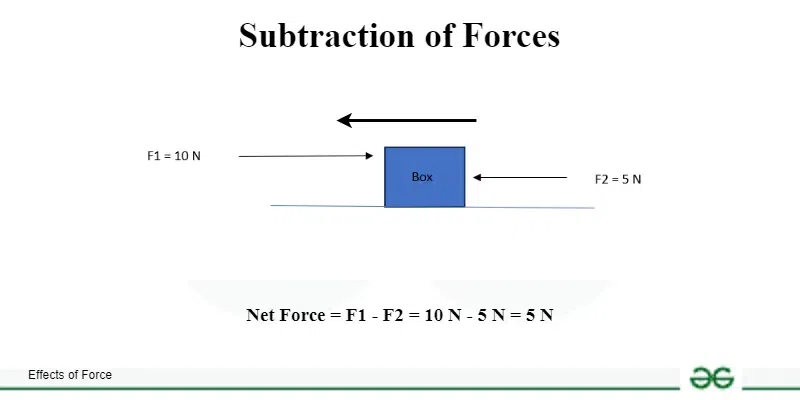
When two forces are applied on same object but in opposite direction then the resultant force on the object would be difference of two forces as both are acting in opposite direction. The movement of object will be in the direction of force with greater magnitude.
Consider a person pushing a box to the right with a force of 10 Newton and another person pushes that box to the left with a force of 5 Newton. In this net force acting on the box is calculated by subtracting these two forces. So net force acting on the box would be 5 Newtons and since magnitude of force in right direction is greater than the magnitude of force in left direction so 5 Newton is the force in right direction.
Force can cause the following impact on motion
Mathematically we can the impact of force on motion by using second law of motion. According to Newton's second law of motion force is equal to rate of change of momentum of object.
So let us derive it.
Let p is the momentum and t is time.
So by Newton's second law of motion
F = dp/dt
Now momentum p = mv,
Applying constant rule of derivative
F = d(mv)/dt = mdv/dt {As m is mass which is constant}
dv/dt = a = acceleration
Here, we can see that force is causing change in motion.
Hence we F = ma
When force is applied on object, it causes the change in shape of object. This change in shape is called deformation. Deformation is of two types depending on duration of change in shape
In elastic deformation, change in shape of object is temporary. The object regains its shape as soon as the force is removed. For example when steel is subjected to load it deforms elastically and regain it shape when load is removed. This can be best explained by Hooke's Law in Stress and Strain Curve.
When force is applied on object and shape of object changes permanently, it is called plastic deformation. Consider the above example, if in the above case the load is not release and we continue the load, the shape will deform permanently and initial shape will not be regained.
In this article we have studied effects of force, along with its basic introduction and types. We have understood that force does not only affect the state of motion but also impact the shape and size of object. We have also learnt to calculate net force in case of two forces acting in same and opposite directions.
Related Articles | |
|---|---|
Example 1: Net force applied on a car with mass of 1000 kg is 10000 N, what will be its acceleration ?
Solution:
Given,
m = 1000 kg
F = 10000 N
we have F = m × a;
10000 = 1000 × a
⇒ a = 10000/ 1000
⇒ a = 10 m/s2
Hence acceleration of car would be 10 m/s2 .
Example 2: A ball of mass 4 kg is moving with the initial speed of 5m/s and then suddenly comes to rest in 0.02 sec. Calculate the force that changed the state of the moving ball ?
Solution:
Given,
initial velocity u = 5 m/s
final velocity v = 0 m/s
time t = 0.02 sec
mass m = 4 kg
from initial velocity and final velocity we can find the acceleration of body
a = (v-u)/t = (0-5)/0.02 = -250 m/s2 .
Negative sign shows that it is retardation.
now to calculate force we have formula as
F = m × a
⇒ F = 4 × 250
⇒ F =1000 N
Hence force that changed state of ball is 1000 N.
Example 3: A 15 kg body slides along the floor with a constant velocity. What is the net force on the block ?
Solution:
Given,
M = 15 kg
It is given that body is sliding with constant velocity hence initial velocity is same as final velocity .
acceleration a = (v-u)/t = 0 m/s2 .
Net force acting on the body is F = m × a = 15 × 0 = 0 N.
Example 4: A ball is rolling with linear acceleration of 2 m/s2 and the net force acting on it is 39 N, calculate the mass of ball.
Solution:
Given,
F = 39 N
a = 2 m/s2
F = m × a
⇒ 39 = m × 2
⇒ m = 39 / 2 = 19.5 kg
Hence the mass of the ball is 19.5 kg.
Example 5: A person is pushing box to right with a force of 50 N and another person is applying force of 25 N on same box in left direction , what is the magnitude of net force acting on the body ?
Solution:
Given F1 = 50 N and F2 = 25 N
both forces are acting in opposite direction so net magnitude of force acting on body is
F = 50 - 25 = 25 N .