|
VOOZH | about |
|
VOOZH | about |
An electric field is a fundamental concept in physics, defining the influence that electric charges exert on their surroundings. This field has both direction and magnitude. It guides the movement of charged entities, impacting everything from the spark of static electricity to the functionality of electronic devices. Understanding electric fields will help you to understand how charged particles interact with each other and the surroundings, and guide various natural and technological phenomena.
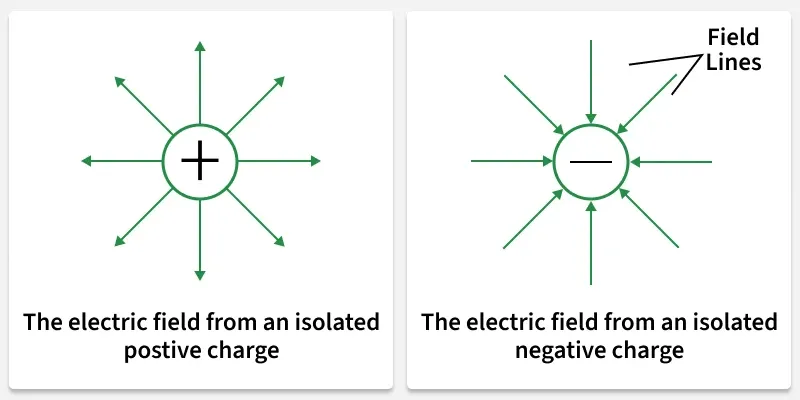
The direction of the electric field is taken as the direction of the force that is exerted on the positive charge. The electric field is radially outwards from the positive charge and radially inwards to the negative point charge, as shown in the picture given above.
The electric field is a vector quantity, which means it has both magnitude and direction.
Now, let us see some of the important terminologies related to the electric field that will be discussed below:
Mathematically electric field (E) is described at a given point is defined as the force (F) experienced by a test charge (q) placed at that point, divided by the magnitude of the test charge:
E = F/q
Electric field lines are imaginary lines used to depict the direction and strength of an electric field surrounding charged objects. They were introduced by the physicist Michael Faraday in the 19th century as a conceptual tool for understanding electric fields.
Electric field lines have different properties. Some of the properties are provided below:
Various methods are followed to calculate the electric field are as follows:
According to Coulomb's law, a force with electric charge q1 at position x1 exerts a force on a particle with charge q2 at position x0,(equation-1)
where
We know that the electric field is given as force per unit test charge. Let q be the test charge. Hence, the electric field is given as
Gauss's law states that the total flux linked with a closed surface is 1/ε0 times the charge enclosed by the closed surface. Hence, according to Gauss's Law, the electric field is given as follows:
It is easy to calculate the electric field using Gauss's law compared to Coulomb's law. If we carefully observe, Gauss's law is a replica of Coulomb's law.
Let's say you have a spherically symmetric charge distribution with total charge Q uniformly distributed within a sphere of radius R. We aim to find the electric field at a distance r from the centre:
From Gauss's Law
4πr2.E = Q/ε0
From this equation, you can solve for the magnitude of the electric field
E at a distance r from the centre is given as
This example illustrates how to use Gauss's law for a spherically symmetric charge distribution. See, the approach and the shape of the Gaussian surface can vary based on the symmetry of the charge distribution provided in the question.
Let us talk about the different types of charge distribution that are given below:
If the charge is distributed linearly over a body.
λ = dq/dl
Consider an infinitesimally small element of charge (dq) along the line, the electric field contribution (dE) from this element can be calculated using Coulomb's law: dE = k⋅dq/r2, where k is Coulomb's constant.
Integrate dE over the entire length of the line charge to obtain the total electric field E = ∫k⋅dq/r2
If the charge is distributed continuously over the surface of a body
σ = dq/ds
Consider an infinitesimally small element of charge (dq) on the surface, the electric field contribution (dE) from this element can be calculated using Coulomb's law: dE = k⋅dq/r2, where k is Coulomb's constant.
Integrate dE over the entire surface to obtain the total electric field E = ∫k⋅dq/r2
If the charge is distributed continuously over the volume of a body.
ρ = dq/dv
Consider an infinitesimally small volume element containing charge (dV) within the region. The electric field contribution (dE) from this volume element can be calculated using Coulomb's law: dE = k⋅dq/r2, where dq = ρ⋅dV and k is Coulomb's constant.
Integrate dE over the entire volume to obtain the total electric field E = ∫k⋅dq/r2
Now, let us see some of the applications of Gauss's law to find the electric field:
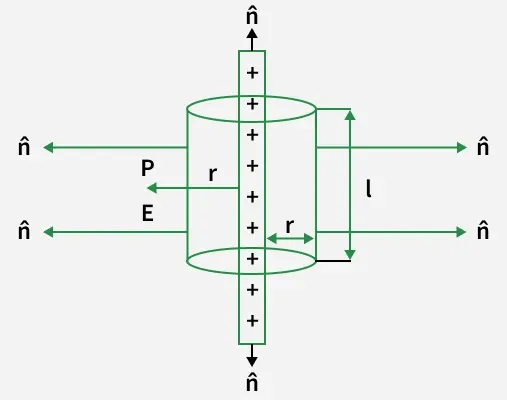
Suppose a line charge having linear charge density λ is given in the form of a thin charged rod.
To find the electric field intensity at point P along a wire, a cylindrical Gaussian surface is selected. This choice is made to apply Gauss's law for finding the electric field, E, at point P.
The electric flux passing through the end surfaces of the cylindrical Gaussian surface is, that is, Φ1 = 0.
And, the electric flux passing through the curved surface of the cylindrical Gaussian surface is given as:
Surface area of curved part is given as: S = 2πrl
Total charge enclosed by the Gaussian surface is q = λ × l
Surface area and charge of a Gaussian surface (Equation 5)
The electric flux through the curved surface of the cylindrical Gaussian surface is given as:
Φ = E. cos θ.S = E × 1 × 2πrl
Total electric flux is given as:
Φ = Φ1 + Φ2
Φ = 0 + E.cos θ.S
Φ = E × 2πrl
From Gauss's law, we know that,
Φ = q/ε0 = λl/ε0
2πrl × E = λl/ε0
Now, let us take a look at the electric field due to the Ring.
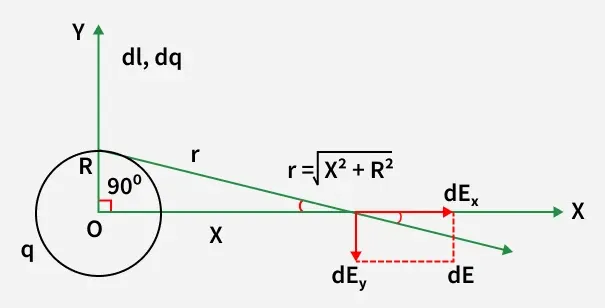
For Electric Field Intensity at Any Point on the Axis of a Uniformly Charged Ring, let us consider a wire forming a circular ring with negligible thickness and a radius of R, carrying a uniform charge +q distributed evenly around its circumference. We aim to calculate the electric field intensity at any point P along the axis of the loop, positioned at a distance x from the ring's centre, marked as O.
Let AB be the length of element dl.
The charge on the element AB is,
dq = (q × dl)/2πR
Electric field intensity at P due to charge element AB is,
|dE| = k dq/(CP)2
where, k = constant
|dE| = k dq/(R2 + x2)
Now, resolve the electric field intensity dE into two rectangular components, that is
dE sinθ along the y-axis and dE cosθ along the x-axis.
And for diametrically opposite elements of the charged ring, the perpendicular components of the electric field intensity will nullify each other, resulting in,
∫dE sinθ = 0.
Whereas components along the axis of the charged ring will undergo integration. That is, ∫dE cosθ.
Hence, the resultant electric field intensity E at P is | E | = ∫dE cosθ
In △OPC, cos θ = OP/CP = x/√(R2 + X2) and |dE| = k dq/(R2 + x2)
Therefore, |E| = ∫k × x × dq/(R2 + X2 )(√(R2 + X2 )
|E| = k × q × x/(R2 + X2 )3/2
The direction of E is along the positive x-axis of the loop.
Now, let us talk about the electric field due to a uniformly charged sphere.
Electric Field Outside the Shell
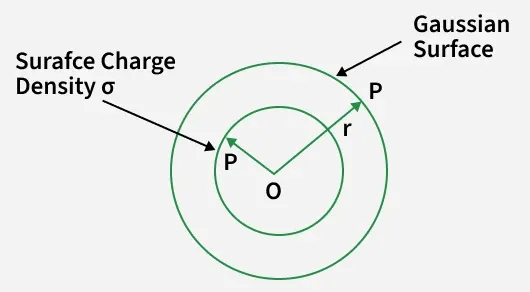
To find out the electric field intensity at a point P outside the spherical shell when OP = r.
The Gaussian surface was taken as a sphere having radius r, while the electric field intensity will remain the same at every point seen on the Gaussian surface.
Thus, Gauss's theorem becomes,
∮ = ∮
or it can also be given as,
E∮dS = q/ε0
E × (4πr2) = q/ε0
Therefore, the electric field becomes,
E =
From the above equation, we can say that the electric field outside the shell is similar to the electric field due to a point charge. Thus, outside the sphere, the electric field behaves as though it is due to a point charge (carrying all the charge of the shell) at the Centre of the shell.
Electric Field Inside the Shell
If the point P lies inside the spherical shell, then the Gaussian surface is the surface of a sphere having radius r. Since no charge is present inside the spherical shell, the Gaussian surface encloses no charge. Hence, q = 0.
To derive the value, you can put the value of q = 0 in the formula E = q/ε0, which will give the result zero.
Electric Field at the Surface of the Shell
At the surface of the shell, r = R
E = q/(4πR2ε0)
If σ is the surface charge density, then
q = (4πR2ε0).σ
Since, we have E = q/(4πR2ε0)
Putting value of q = (4πR2ε0).σ we get
E = σ/ε0
The applications of the electric field are mentioned below:
Example: A force of 100 N is acting on the charge 10 μC at any point. Determine the electric field intensity at that point.
Solution:
Given:
Force F = 100 N
Charge q = 10 μC
The electric field formula is given by
E = F / q
E = 100N / 10×10−6C
E = 107 N/C.
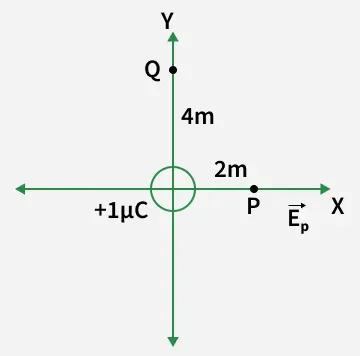
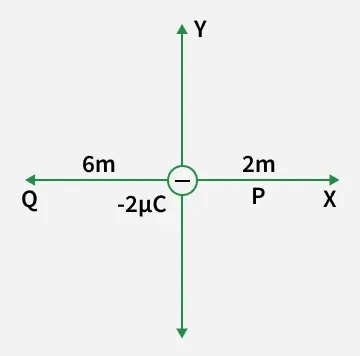
2. Calculate the electric field at points P, Q for the following two cases. (Figure is provided below.)
(a) For a charge of +1 µC placed at the origin.
Solution:
The magnitude of the electric field at point P is
Ep = {1/4πε }(q/r2 )
Ep = (9 × 109 × 1 × 10-6 )/4 = 2.25 × 10³ NC-1
Since the source charge is positive, the electric field points away from the charge,
So the electric field at the point P is given by
= 2.25 × 10³ NC-1
For the point Q;
EQ = 9 × 109 × 1 × 10-6/16 = 0.56 × 10³ NC-1
(b)For a charge of -2 µC placed at the origin
Solution:
The magnitude of the electric field at point P is
Ep = {1/4πε }(q/r2 )
Ep = (9 × 109 × 2 × 10-6)/4
Ep = 4.5 × 10³ NC-1
Since, the charge is negative, the electric field points towards,
So, the electric field at point P is given by
= -4.5 × 10³ NC-1
For the point Q = (9 × 109 × 1 × 10-6 )/36 = 0.5 × 10³ NC-1