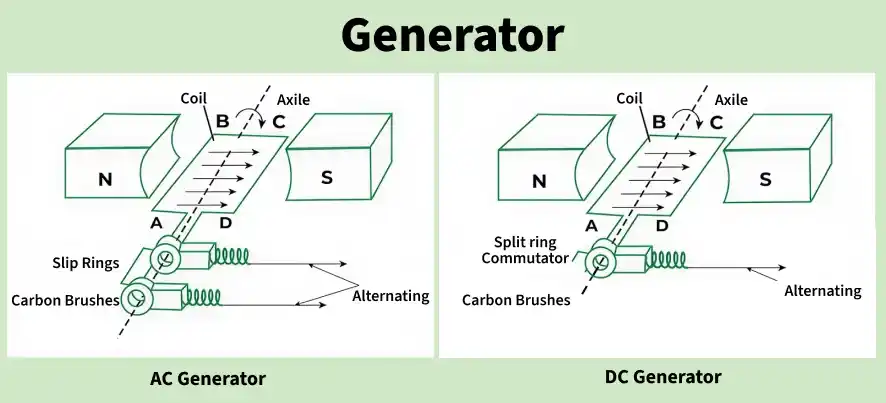
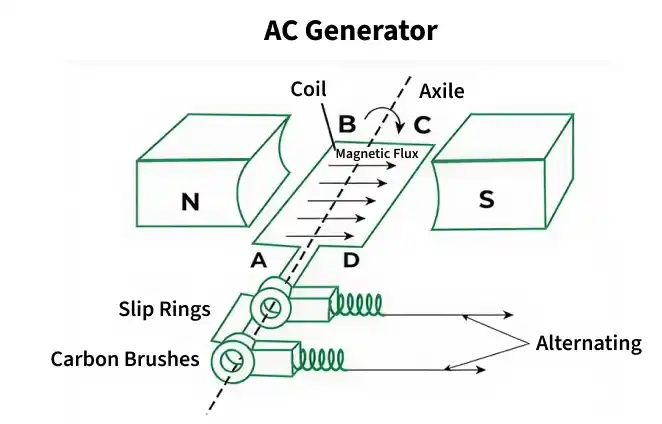
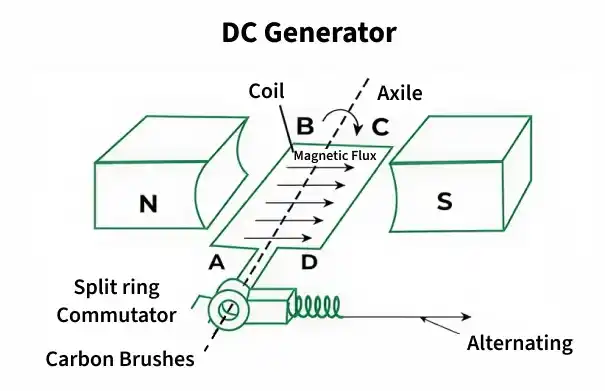
An electric generator is a device that converts mechanical energy into electrical energy. It plays a crucial role in producing electricity used in homes, industries, and power stations. The working of an electric generator is based on the principle of electromagnetic induction, discovered by Michael Faraday. When a conductor moves in a magnetic field, an electromotive force (emf) is generated, which produces an electric current.
An electric generator works on the principle of electromagnetic induction.
1. Electromagnetic Induction: It is the phenomenon in which an electric current is induced in a conductor when there is a change in the magnetic flux linked with it.
2. Magnetic Flux: Defined as the total number of magnetic field lines passing through a given area.
When the coil rotates, the magnetic flux changes continuously
This change in flux produces an induced emf
When a coil rotates in a magnetic field, an electric current is produced.
Faraday’s Laws of Electromagnetic Induction
Whenever there is a change in magnetic flux, an emf is induced in the closed circuit, and current flows.
The magnitude of the induced emf is directly proportional to the rate of change of the magnetic flux
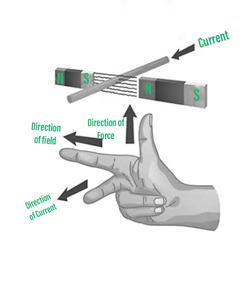
Fleming’s Right-Hand Rule
The direction of induced current can be determined using Fleming’s Right-Hand Rule: