|
VOOZH | about |
|
VOOZH | about |
Electric forces are responsible for many chemical reactions in the human body. Charged particles experience forces when they are placed in an electric field. When a charge moves in an electric field, work is done on it, and energy is stored as electrostatic potential energy.
Electric potential energy is the energy required to move a charge against an electric field. When a charge is placed in an electric field, it experiences a force, and work done against this force is stored as electric potential energy.
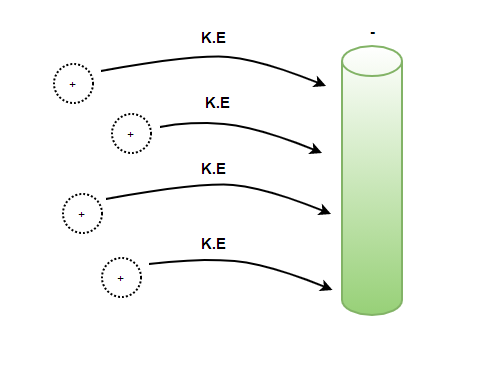
👁 ImageWhen positive charges are separated from a negatively charged plate, work is done against the attractive force, storing potential energy in the charges. When released, the charges move toward the plate, converting potential energy into kinetic energy.
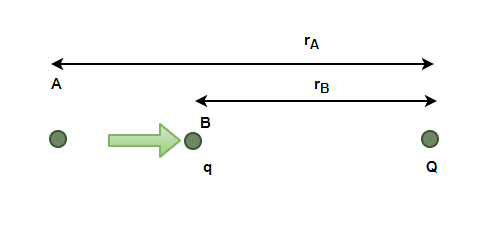
👁 ImageFor a two-charge system with charges q and Q given in the figure above, the change in electric potential energy in taking the charge q, from A to B is given by,
Electric potential is the potential energy per unit charge between two points in an electric field. It tells how much the potential energy of a unit positive charge changes when moved from one position to another and is denoted by V.
V =
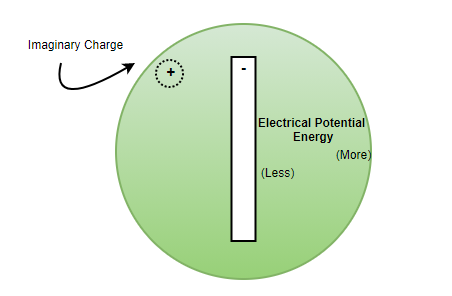
👁 ImageWhen a positive charge is moved farther from a negatively charged plate, more work is done on the charge, so the potential increases with distance from the plate, while the potential near the negatively charged plate is low.
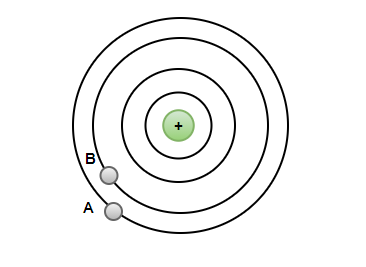
Consider a point charge as shown in the figure. In the figure, there are several concentric circles, which represent equipotential contours. This means that all the points on a single contour have the same electric potential.
👁 ImageThe aim is to calculate the electric potential due to this point charge between two points A and B. The electric potential difference is also called voltage, and it is measured in volts (V). Electric potential difference between A and B is given by:
Now, if rB =
Since = 0
The electric potential at a distance r from a point charge q is
For a system of point charges, the total electric potential at a point is equal to the algebraic sum of the potentials due to each individual charge at that point. Example: consider a system containing three charges Q1 Q2, and Q3. Let the distances of these charges from a point P be r1, r2 and r3 respectively. Then, the total electric potential at point P is given by:
Question 1: Find the potential at a distance of 1 m due to a charge of 2pC.
Solution: The potential due to a point charge is given by,
Here, q = 2 pC = 2 x 10-12C and r = 1 m.
Plugging the values into this equation,
V =
⇒ V =
⇒ V= 9 × 109 × 2 x 10-12
⇒ V= 18 × 10-3
⇒ V = 0.018 V
Question 2: Find the potential at a distance of 0.5 m due to a charge of 10pC.
Solution: The potential due to a point charge is given by,
Here, q = 10 pC = 10 x 10-12C and r = 0.5m.
Plugging the values into this equation,
V =
⇒ V =
⇒ V= 9 × 109 × 2 x 10-11
⇒ V= 18 x 10-2
= 0.18 V
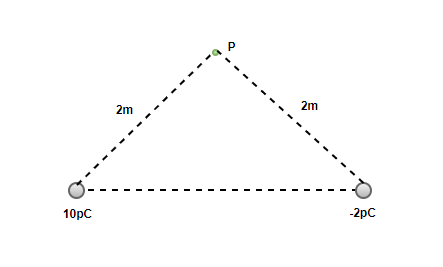
Question 3: Find the electric potential at a distance of 2 m due to charges 10 pC and −2 pC.
👁 ImageSolution: The potential due to a point charge is given by,
Here, q1 = 10 pC = 10 x 10-12C
q2 = -2 pC = -2 x 10-12C and r = 2 m.
Since there are two charges in the system, the total potential will be given by the superposition equation.
For two charges,
Plugging the values into this equation,
⇒ V= 36 × 10-3 V
V = 0.036V
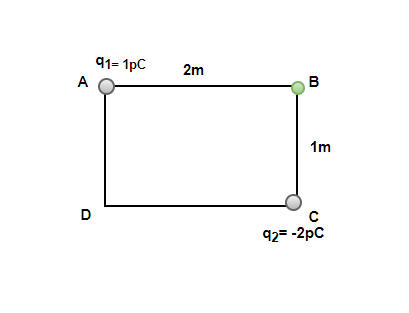
Question 4: Two charges are kept at opposite corners of rectangles as shown in the figure. Find the potential at the corner between them.
👁 ImageSolution: The potential due to a point charge is given by,
Here, q1 = 1 pC = 10-12C,
q2 = -2 pC = -2 x 10-12C
r1 = 2 m and r2 = 1 m.
Since there are two charges in the system, the total potential will be given by the superposition equation.
Substituting the values
Question 1: Find the electric potential at a distance of 3 m due to a charge of 5 pC.
Question 2: Two charges 4 pC and -6 pC are placed at distances 2 m and 4 m respectively from a point P. Find the net electric potential at P.
Question 3: Calculate the electric potential energy of a system containing charges 8 pC and 2 pC separated by a distance of 1.5 m.
Question 4: A charge of 12 pC is placed at the center of a circle of radius 0.2 m. Find the electric potential on the circumference of the circle.
Question 5: Three charges 2 pC, 3 pC, and -1 pC are placed at distances 1 m, 2 m, and 0.5 m respectively from a point P. Calculate the total electric potential at P.