|
VOOZH | about |
|
VOOZH | about |
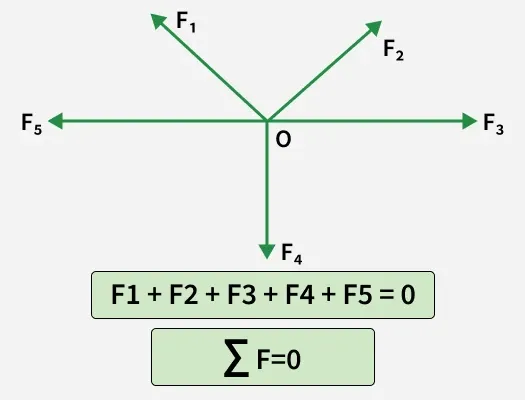
Concurrent forces are two or more forces whose lines of action intersect at a single common point. When such forces act on a body and their vector sum is zero, i.e., all forces acting at that point balance each other exactly, then the body is said to be in equilibrium. In this state, the body experiences no net force and no acceleration. As a result, neither the body's state of rest nor its uniform motion changes. This concept follows directly from Newton’s First Law of Motion.
Mathematically, equilibrium is expressed as
For a system of concurrent forces to be in equilibrium:
These conditions ensure that there is no resultant force in any direction.
Equilibrium of concurrent forces occurs when multiple forces acting at a single point have a zero resultant. It is broadly classified into two types:
A body is said to be in static equilibrium when:
Eg: A block resting on a floor with equal and opposite forces acting on it, or a book placed on a table.
A body is in dynamic equilibrium when:
E.g., an example of this would be a car traveling at a constant speed on a straight road.
(In SHM, dynamic equilibrium occurs only at the mean position where net force is zero.)
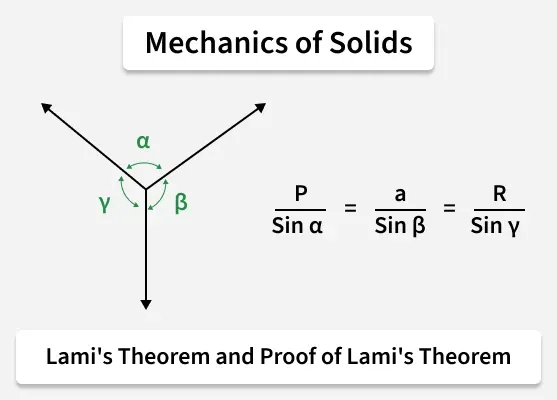
When three coplanar, non-parallel concurrent forces keep a body in equilibrium, Lami’s theorem applies:
It provides a direct method to calculate unknown forces.
Coplanar forces lie in the same plane. If they are concurrent and balanced:
Also Check,
Example 1: A box is on the top of a table. The box has a weight of 100 N, and two reciprocally opposite directed forces are applied horizontally with 50 N intensity each. Find out whether the current box condition is in equilibrium or not.
Vertical Forces:
- Weight of the box (downward force): W=100N
- Upward force exerted by the table (normal force): Fn=100N (to balance the weight)
Horizontal Forces:
- Force applied horizontally on the right: F1=50N
- Force applied horizontally on the left: F2=50N
Analysis:
- Vertically: W = Fn, so the box is not moving up or down.
- Horizontally: F1 = F2, so the forces cancel each other out, and the box doesn't move left or right.
Therefore, The box is stationary. It's neither moving up or down, nor left or right.
Example 2: Two wires hold the cross-street directional signal. In the first wire, the tension is 300 N, whereas in the second wire, it is 400 N. When this angle is equal to 60 degrees, find the weight of the traffic lights.
Let's denote:
T1 as the tension in the first wire (300 N)
T2 as the tension in the second wire (400 N)
W as the weight of the traffic lights (the force we want to find)
θ as the angle between the wires (60 degrees)
Using trigonometry, we can find the vertical components of the tensions:
For the first wire: T1y=T1sinθ
For the second wire: T2y=T2sinθ
Since the vertical components of the tensions are acting in opposite directions and balance the weight, we have:
T1y+T2y=W
Substituting the expressions for the vertical components of tensions:
T1sinθ+T2sinθ=W
300N×sin(60∘)+400N×sin(60∘)=W
(300×0.866)+(400×0.866)=W
259.8+346.4=W
W=606.2
Therefore,
the weight of the traffic lights is approximately 606.2 Newtons.
Example 3: A crate on a rough surface experiences a 300 N horizontal force to the right and a 400 N downward force. With a friction coefficient of 0.3, is it in equilibrium?
The maximum frictional force: Fmax = 𝜇 N = 0.3×400 = 120 N
Since the applied horizontal force exceeds this (300 N>120 N),
Therefore the crate is not in equilibrium as applied force > frictional force and it will move.
Problem 1: 10 N and 15 N act on an object at a point; these are two forces. According to them, the angle between them is 60 degrees. Calculation of the force’s magnitude and its direction is required.
Problem 2: Three forces pull a point in three different ways, lying at 30 degrees above the x-axis, 45 degrees below the x-axis, and 60 degrees to the left of the y-axis with magnitudes of 20 N, 30 N, and 40 N, respectively. Find the resultant force.
Problem 3: On an object, three forces are here: 8 N upward on the x-axis, -6 N downwards on the same axis, and 10 N upward on the y-axis. Set the level of intensity and the direction.
Problem 4: An object at rest experienced four forces: 20 N in the segment of 0 degrees, 30 N in one-quarter of the turn, 40 N in a half turn, and 50 N in the three hundred and sixty-degree segment. If the object is in equilibrium, find the size and direction of the resultant forces.