|
VOOZH | about |
|
VOOZH | about |
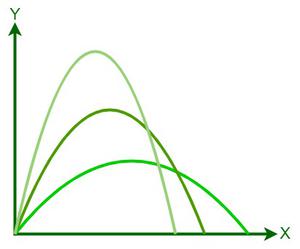
A projectile is any object launched into space with only gravity acting on it. Gravity is the primary force that influences a projectile's motion. This doesn't mean that other forces don't act on the projectile, but their impact is minimal compared to gravity. The trajectory of a projectile is the path it follows. Some examples of a projectile in real life are a bullet fired from a gun, a javelin thrown by an athlete, or an arrow released from a bow.
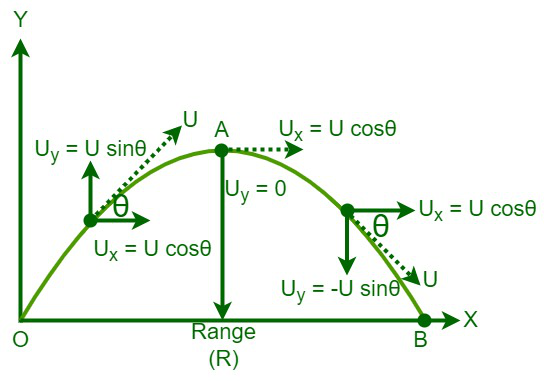
An important concept in projectile motion is that there are two simultaneous independent rectilinear motions:
We can make use of various equations of motion to find different parameters related to projectile motion:
If the initial velocity, acceleration, and time of flight are known, the final velocity can be determined using the formula below:
v = u + at
Where 'u' is the initial velocity, 'a' is the acceleration, and 't' is the time of flight.
We can also determine the displacement of a projectile using the initial velocity, acceleration, and time of flight, according to the formula below:
s = u t+ ½ at2
If the time of flight is not given, and the displacement of the projectile is given, then the final velocity can be calculated using the formula below:
v2 = u2 + 2as
The initial velocity and angle of projection can be used to calculate the horizontal component of the initial velocity:
Ux = U cos θ
The velocity in the horizontal direction will not change as the projectile will not experience acceleration in this direction since the acceleration due to gravity acts vertically down. Hence,
Vx = Ux
Furthermore, the range or horizontal displacement of a projectile is dependent on the horizontal component of the initial velocity and time of flight. The equation for the range or horizontal displacement of a projectile is given as:
x = Ux t
x = U cosθ t
Just like the horizontal component, the vertical component of the initial velocity also depends only on the initial velocity and angle of projection. It can be determined using the formula below:
Uy =U sin θ
The velocity in the vertical direction will change as the projectile experiences acceleration due to gravity which acts vertically down. Hence,
Vy = U sinθ − gt
The maximum height, or vertical displacement, of a projectile, depends on the initial velocity, acceleration due to gravity, and time of flight. The equation for the vertical displacement or maximum height of a projectile is given as:
y = Uyt − ½ gt2
y = U sinθ t − ½ gt2
Where 'y' is the vertical displacement of a projectile
U = initial velocity of the particle,
t = time of flight,
θ = angle of projection, and
g = acceleration of gravity
To calculate the vertical displacement of a particle in projectile motion using a calculator, follow these steps:
Step 1: Enter the initial velocity and time of flight into the corresponding input fields.
Step 2: Input 'x' in the 'Vertical Displacement at Time' field.
Step 3: Click the "Calculate the Unknown" button to get the result.
Step 4: The vertical displacement value will be displayed in the output field.
Given data,
Velocity (u) = 35 m/s
Time interval = 4 sec
Angle (θ) = 60°
Acceleration due to gravity = 9.8m/s2
We have,
Vertical displacement in the projectile motion of a particle is given by:
y = u sinθ t – ½ g t2
y = 35 × sin 60° × 4 - ½ × 9.8 × (4)2
= 121.243 - 78.4 {sin 60° = √3/2}
= 42.84 m
Hence, the vertical projectile displacement of the particle is 42.84 m.
Given data,
Velocity (u) = 50 m/s
Time interval = 2.5 sec
Angle (θ) = 45°
Acceleration due to gravity = 9.8m/s2
We have,
Vertical displacement in the projectile motion of a particle is given by:
y = u sinθ t – ½ g t2
y = 50 × sin 45° × 2.5 - ½ × 9.8 × (2.5)2
= 88.388 - 30.625 {sin 45° = 1/√2}
= 57.763 m
Hence, the vertical projectile displacement of the particle is 57.763 m.
Given data,
The vertical projectile displacement (y) = 35 m
Time interval = 5 sec
Angle (θ) = 30°
Acceleration due to gravity = 10 m/s2
We have,
Vertical displacement in the projectile motion of a particle is given by:
y = u sinθ t – ½ g t2
⇒ 35 = u × sin 30° × 5 - ½ × 10 × (5)2
⇒ 35 = 2.5 u - 125 {sin 30° = ½}
⇒ 2.5u = 160 ⇒ u = 64 m/s
Hence, the velocity at which an object is launched is 64 m/s
Given data,
The vertical projectile displacement (y) = 45 m
Time interval = 3.5 sec
Velocity (u) = 40 m/s
Acceleration due to gravity = 10 m/s2
We have,
Vertical displacement in the projectile motion of a particle is given by:
y = u sinθ t – ½ g t2
⇒ 45 = 40 × sin θ × 3.5 – ½ × 10 × (3.5)2
⇒ 45 = 140 sin θ – 61.25
⇒ 140 sin θ = 45 + 61.25 = 106.25
⇒ sin θ = 106.25/140 = 0.7589
⇒ θ = sin-1(0.7589) = 49.37°
In projectile motion, gravity influences the vertical displacement, creating a parabolic path. The vertical motion operates independently of the horizontal motion, and the vertical displacement can be determined using kinematic equations, taking into account the initial vertical velocity, time, and acceleration due to gravity.
Related Reads,