|
VOOZH | about |
|
VOOZH | about |
A spherical lens is a transparent optical element bounded by two spherical surfaces. It is used to refract light rays and form images of objects. Lenses are widely used in devices such as microscopes, cameras, and spectacles.
There are two main types of spherical lenses:
The lens that is thicker at the end than in the middle is called the concave lens. It is also called a diverging lens, as it spreads out the light rays that have been refracted through it. It has the ability to diverge the parallel beam of light.
The lens that is thicker at the middle than at the end is called a convex lens. It is also called a converging lens, as it converges the parallel beam of light into a point.
There are six different cases for image formation by a convex lens, which are discussed as follows:
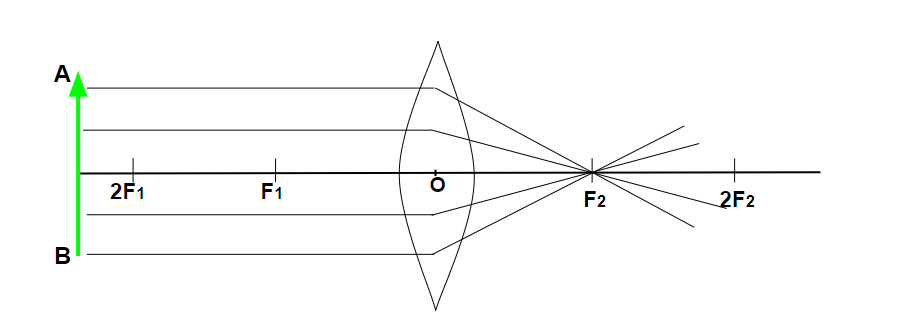
When object AB (shown in the figure below) is placed at infinity, that is, behind the 2F₁ of the convex mirror, the image formed after the refraction will be in focus at F₂, which is on the opposite side of the convex lens. The size of the image is smaller than the object, and the image will be real and inverted (i.e., upside down and downside up).
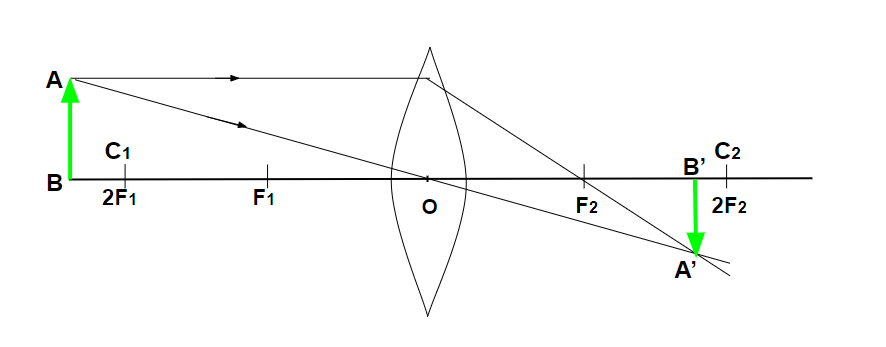
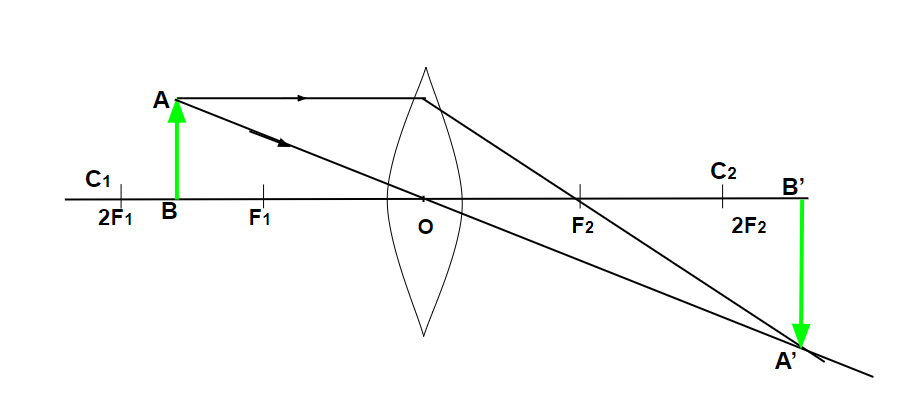
When the object is placed behind the center of curvature (C1) or behind Focus (2F1) of the convex lens, the image formed after the refraction will be between the foci of another side of the lens (i.e., F2 and 2F2). The size of the image is smaller than the object. The nature of the image will be real (can be seen on the screen) and inverted (upside down).
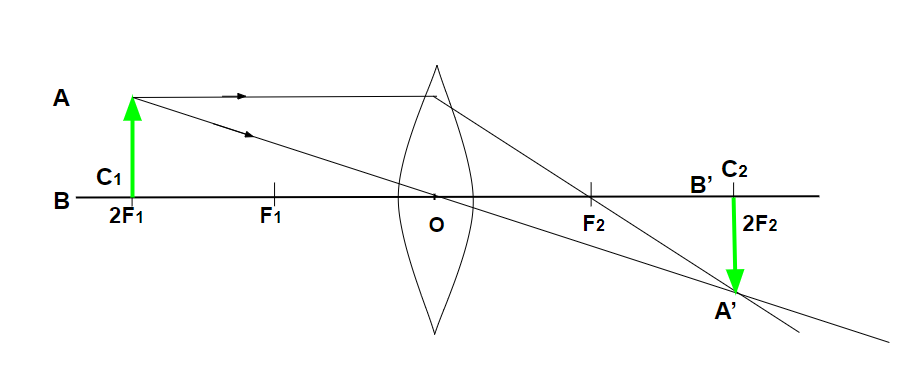
When an object is placed at the center of curvature (C1) or focus (2F1) of the convex lens, the image formed after the refraction will be at the center of curvature (C2) or focus (2F2) on the other side of the lens. The size of the image is the same as the size of the object. The nature of the image is real and inverted.
When an object is placed between the center of curvature and the focus (F1) of the convex lens, the image formed after reflection will be behind the center of curvature (C2). The size of the image will be greater than the object. The nature of the image will be real and inverted.
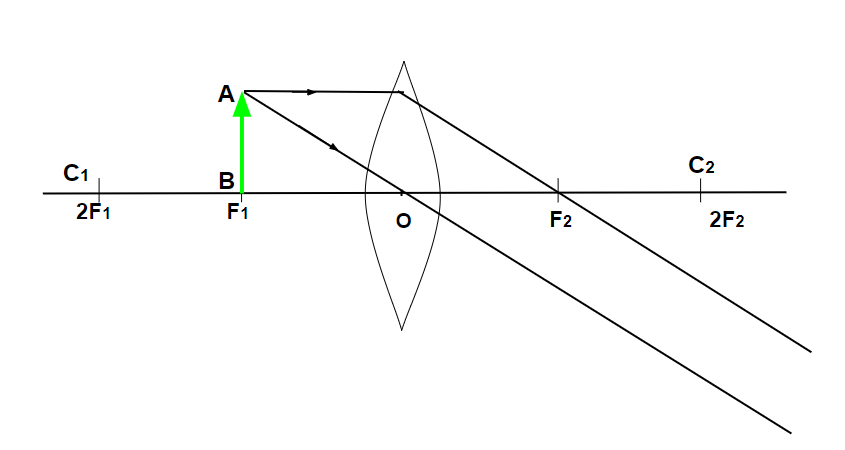
When an object is placed at the focus (F1) of a convex lens. The image formed after reflection will be at infinity (opposite side of the lens). The size of the object will be much larger than the object. The nature of the image will be real and inverted.
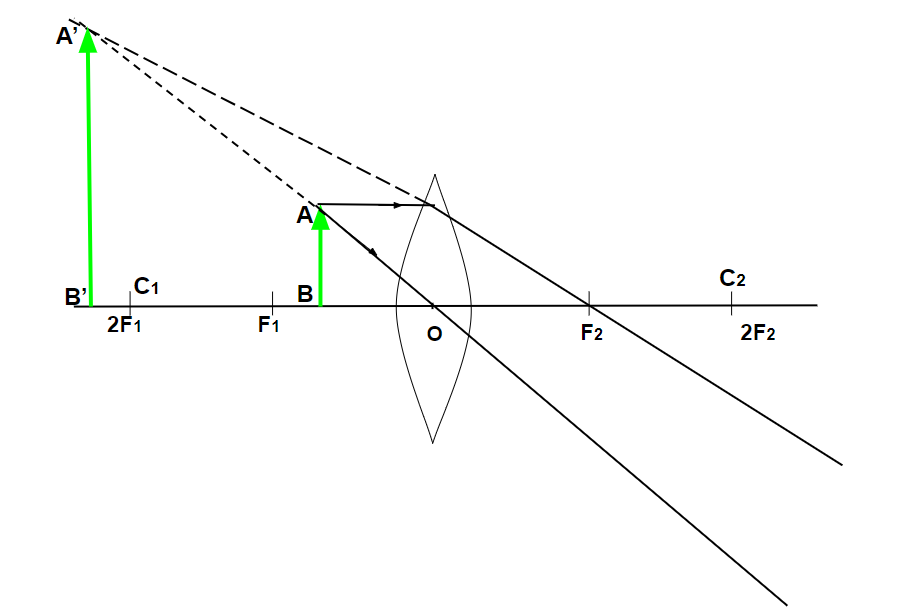
When the object is placed between the focus (F1) and the optical center (O) of the convex lens. The image is formed on the same side of the object behind the center of curvature (C) or focus (F1) of the lens. The size of the image will be larger than the object. The nature of the image will be Virtual & Erect.
| Object Position | Image Position | Nature of Image | Size |
|---|---|---|---|
| At infinity | At focus (F) | Real, inverted | Highly diminished |
| Beyond 2F | Between F and 2F | Real, inverted | Diminished |
| At 2F | At 2F | Real, inverted | Same size |
| Between F and 2F | Beyond 2F | Real, inverted | Enlarged |
| At F | At infinity | Real, inverted | Highly enlarged |
| Between F and O | On same side of lens | Virtual, erect | Enlarged |
There are only two different cases for the image formation by a concave lens, which are discussed as follows:
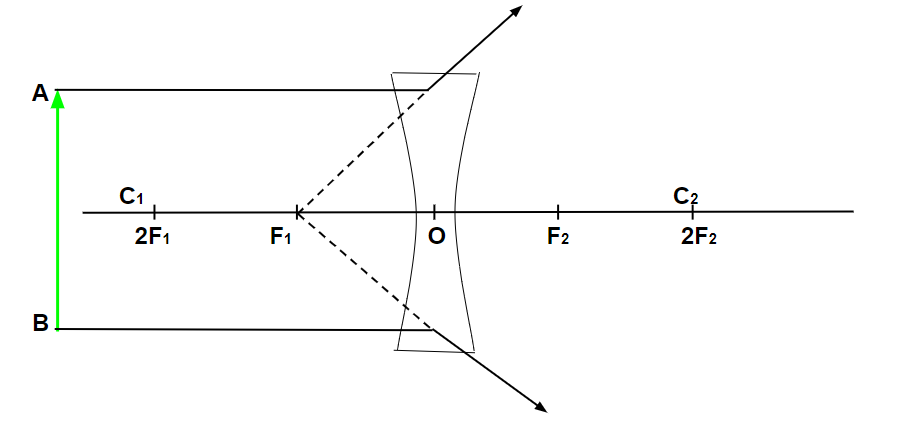
When an object is placed at infinity from the concave lens (shown below). The image formed after refraction will be at the focus (F1) on the same side of the object. The size of the image will be much smaller than the object. The nature of the image will be virtual and erect.
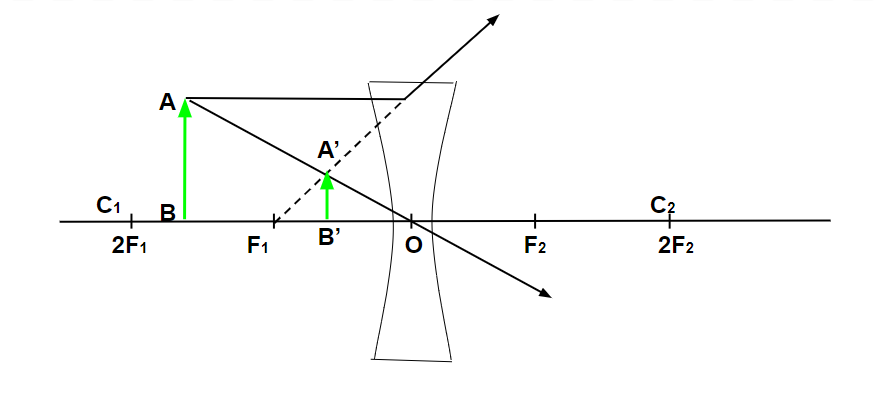
When the object is placed at any finite distance in front of the concave lens. The image formed after refraction will be between the optical center (O) and the focus (F) of the concave lens. The size of the image will be smaller than the object.
| Object Position | Image Position | Nature of Image | Size |
|---|---|---|---|
| At infinity | At focus (F) | Virtual, erect | Highly diminished |
| Anywhere between infinity and O | Between F and O | Virtual, erect | Diminished |
Question 1: What is the real image?
Answer: The image formed when rays of light meet at a certain point after reflection/refraction is real image. Real images can be displayed on screen.
Question 2: What is a virtual image?
Answer: The image formed when rays of light appear to meet at particular point is called virtual image.
Question 3: What is a ray diagram?
Answer: The type of diagram which helps to trace the path that light takes in order for a person to view a point on the image of an object is called a ray diagram.
Question 4: What will be the focal length of a lens if the radius is 16 cm?
Answer: The focal length is half of the radius of lens, i.e.
f= R / 2
= 16 cm / 2
= 8 cm
Therefore, the focal length will be 8 cm.
Question 5: What will be the focal length of a lens when it is cut along the principal axis?
Answer: There will be no change in the focal length of a lens when cut into two halves along the principal axis, because the focal length of the lens is half of the radius of curvature and radius of curvature will remain the same.