|
VOOZH | about |
|
VOOZH | about |
Magnetism has a mystical quality about it. Its capacity to change metals like iron, cobalt, and nickel when touched piques children's interest. Repulsion and attraction between the magnetic poles by observing the shape of the magnetic field created by the iron filling surrounding the bar magnet will be learned.
According to physicists, the forces that govern both magnetism and electricity are substantially greater than gravity in electromagnetism.
Inductance is an electrical circuit attribute that opposes any change in current in the circuit. Electrical circuits have an intrinsic feature called inductance. Whether desired or not, it will always be found in an electrical circuit. The inductance of a straight wire carrying electricity with no iron element in the circuit will be lower. Because the inductance of an electrical circuit opposes any change in current in the circuit, it is equivalent to inertia in mechanics.
Magnetic flux that is proportional to the rate of change of the magnetic field is known as induction. The induced EMF across a coil is related to the rate at which the current through it changes. Inductance is the proportionality constant in that relationship. H is the SI unit for inductance (henry). It is denoted by the letter L. The amount of inductance required to produce an EMF of 1 (V) volt in a coil when the current change rate is 1 Henry is defined as 1 H (Henry).
The following are some of the factors that influence inductance:
Faraday established the Electromagnetic Induction Law, which states that by altering the magnetic flux, an electromotive force is induced in the circuit. The concept of induction is derived from Faraday's law of electromagnetic induction. The electromotive force generated to counteract a change in current at a specific time interval is known as inductance.
Take a look at a DC source that has the switch turned on. When the switch is turned on, the current flows from zero to a specific value, causing a change in the flow rate. Consider the flux shift caused by current flow. The flux change is measured in terms of time, as follows:
dφ/dt
Use Faraday's law of electromagnetic induction to solve the problem.
E = N(dϕ/dt)
Where, N is the coil's number of turns, and E is the induced EMF across the coil.
Write the above equation as follows using Lenz's law:
E = -N(dϕ/dt)
For computing the value of inductance, the previous equation is adjusted.
E = -N(dϕ/dt)
∴ E = -L(di/dt)
N = dΦ = L di
NΦ = Li
Therefore,
Li = NΦ = NBA
Where, B denotes the flux density and A denotes the coil area.
Hl = Ni
Where H denotes the magnetic flux's magnetizing force.
B = μH
Li = NBA
L = NBA/i = N2BA/Ni
N2BA/Hl = N2μHA/Hl
L = μN2A/l = μN2πr2/l
There are two types of inductance. They are self-induction and mutual induction. Let's learn about them in more detail with proper definitions,
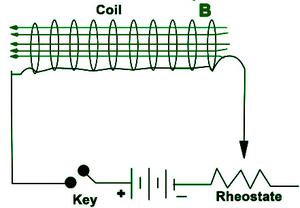
The magnetic flux associated with a coil or circuit changes anytime the electric current running through it changes. As a result, an emf is induced in the coil or circuit, which opposes the change that creates it, according to Faraday's laws of electromagnetic induction. This phenomenon is known as 'self-induction,' and the induced emf is referred to as back emf, while the current created in the coil is referred to as induced current.
But practical unit is henry (H). It's dimensional formula [L] = [ML2T-2A-2]
👁 ImageU = 1/2 (Li)i = Nϕi/2
The various formulae for L
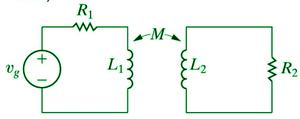
When the current going through a coil or circuit varies, so does the magnetic flux coupled to a neighboring coil or circuit. As a result, an emf will be induced in the next coil or circuit. Mutual induction is the term for this occurrence.
But practical unit is henry (H). It's dimensional formula [M] = [ML2T-2A-2].
👁 ImageK = Magnetic flux linked in secondary / Magnetic flux linked in primary
0 ≤ K ≤ 1
The various formulae for M
If two mutually inducing self-inductance coils L1 and L2 are connected in series and separated by a large enough distance that mutual induction between them is insignificant, then net self-inductance Ls = L1 + L2.
When they're near together, the net inductance is Ls = L1 + L2 ± 2M.
When two mutually inducting self-inductance coils L1 and L2 are linked in parallel and separated by a large distance, the net inductance L is 1/Lp = 1/L1 + 1/L2.
∴ Lp = L1L2/L1 + L2
When they are in close proximity to one another,
Lp = L1L2 - M2/L1 + L2 ± 2M
| Self Induction | Mutual Induction |
| The coil's self-inductance is a property of the coil. | The characteristic of a pair of coils is mutual inductance. |
| When the main current in the coil declines, the induced current resists the decay of current in the coil. | When the main current in the coil declines, the induced current created in the nearby coil opposes the decay of the current in the coil. |
| When the coil's primary current grows, the induced current opposes the expansion of current in the coil. | When the coil's primary current grows, the induced current created in the adjoining coil opposes the coil's current development. |
Things to Keep in Mind
Question 1: Three coils are wired together in a series. Each coil has an inductance of 5H, 4H, and 6H, respectively. Calculate the inductance equivalent.
Solution:
Given: L1 = 5H, L2 = 4H, L3 = 6H
The series inductance all sum as
L = L1 + L2 + L3
∴ L = 5 + 4 + 6
∴ L = 15H
Question 2: What factors have an impact on inductance?
Answer:
The following are some of the factors that influence inductance:
- The inductor's wire has a specific number of turns.
- The material that was used to make the core.
- The core's appearance.
Faraday established the Electromagnetic Induction Law, which states that by altering the magnetic flux, an electromotive force is induced in the circuit. The concept of induction is derived from Faraday's law of electromagnetic induction. The electromotive force generated to counteract a change in current at a specific time interval is known as inductance.
Question 3: Define a coil's self-inductance. Establish a S.I. unit for it.
Answer:
The property of a coil that opposes the growth or decay of the current flowing through it is known as self-induction.
Henry is the SI unit of self-inductance (H).
Question 4: Consider a 500-turn solenoid coiled on an iron core with a relative permeability of 800. The solenoid's length is 40 cm, and its radius is 3 cm. The current changes from 0 to 3 A. Calculate the average induced emf for this change in current at 0.4 second intervals.
Solution:
N = 500 turns, μr = 800, Length = 40 cm = 0.4 m
Radius, r = 3 cm = 0.03 m
Change in current, di = 3 – 0 = 3 A
Change in time, dt = 0.4 sec
Self-inductance is given as
L = μN2Al = μ0μrN2πr2/l
∴ L = (4)(3.14)(10-7)(800)(5002)(3.14)(3 × 10⁻²)2/0.4
∴ L = 1.77 H
ε = L di/dt = 1.77 × 3/0.4
∴ ε = 13.275 V
Question 5: Explain Combination of Inductance.
Answer:
- Series:
If two mutually inducting self inductance coils L1 and L2 are connected in series and separated by a large enough distance that mutual induction between them is insignificant, then net self inductance Ls = L1 + L2.
When they're near together, the net inductance is Ls = L1 + L2 ± 2M.
- Parallel:
When two mutually inducting self-inductance coils L1 and L2 are linked in parallel and separated by a large distance, the net inductance L is 1/Lp = 1/L1 + 1/L2.
∴ Lp = L1L2/L1+L2
When they are in close proximity to one another,
Lp = L1L2 - M2/L1 + L2 ± 2M
Question 6: Write the difference between Self Inductance and Mutual Inductance.
Answer:
| Self Induction | Mutual Induction |
| The coil's self inductance is a property of the coil. | The characteristic of a pair of coils is mutual inductance. |
| When the main current in the coil declines, the induced current resists the decay of current in the coil. | When the main current in the coil declines, the induced current created in the nearby coil opposes the decay of the current in the coil. |
| When the coil's primary current grows, the induced current opposes the expansion of current in the coil. | When the coil's primary current grows, the induced current created in the adjoining coil opposes the coil's current development. |
Question 7: The inductance of a coil is 6 H, and the supply frequency is 70 Hz. What is the reactance?
Solution:
Given: L = 6H, f = 70Hz
Solution:
X = 2πfL
X = 2 × 3.14 × 70 × 6
X = 2637.6 Ω
Problem 1: Calculate the energy stored in a 5 H inductor when a current of 3 A is flowing through it.
Problem 2: A coil has 500 turns and a magnetic flux of 0.02 Wb is linked with it when a current of 2 A flows through it. Calculate the inductance of the coil.
Problem 3: In an RL circuit, the resistor has a resistance of 10 Ω and the inductor has an inductance of 2 H. Calculate the time constant of the circuit.
Problem 4: A current in a coil changes from 3 A to 1 A in 0.5 seconds, inducing an EMF of 4 V. Calculate the inductance of the coil.
Problem 5: Two coils are placed close to each other, and a change in current of 2 A in one coil induces a voltage of 3 V in the other coil. If the change in current occurs over 0.01 seconds, calculate the mutual inductance between the coils.
Problem 6: What is inductance? Describe it in your own words.
Problem 7: Two inductors, 3 H and 6 H, are connected in series. Calculate the total inductance of the combination.
Problem 8: Two inductors, 3 H and 6 H, are connected in parallel. Calculate the total inductance of the combination.
Problem 9: In an AC circuit, an inductor of 4 H is connected to a 50 Hz supply. Calculate the inductive reactance of the inductor.