|
VOOZH | about |
|
VOOZH | about |
Before we explore how force can affect the state of motion of a body, let’s first look at what force is. Force is an interaction between two or more bodies that, when unopposed, causes a change in the state of motion of an object.
By the definition of force, it is clear that force is something that causes a change in the state of motion of an object. The interaction of forces can be described as a push or a pull on an object.
- Any change in the state of motion always corresponds to either a change in the speed of the body and/or a certain change in the direction of motion of the body.
- A certain change in speed could mean speeding up (acceleration) or, in other cases, speeding down (deceleration).
For instance,
Table of Content
Remember playing tug-of-war with our friends? In the game of tug-of-war, two teams pull a single rope. The team that can pull the rope by a certain amount despite the other team pulling it wins the game. Can you guess what exactly is going on there? In that game, two forces are acting in opposite directions concerning each other.
To learn different types of forces and the relationship between force and motion, click these topics below :
Let's explore various factors that influence how forces interact and their effects on objects.
Example: Two people pushing a heavy car or any heavy box in the same direction. Whenever any heavy load is transported from one place to another many people apply forces in the same direction to move the box.
Example: Consider two workers pushing a heavy load in the opposite direction. The net force on an object is zero if the two forces acting on it in opposite directions are equal in magnitude and if any unequal forces are applied then the box moves in a direction in which a greater force is applied.
People playing in a tug of war pull the rope on opposite sides and whichever team pulls it with a greater force wins.
Example: Imagine two girls playing the game of circling by holding hands with each other. If there had been no such interaction between them, they could not have been able to move making rounds.
The direction and magnitude of forces should be equal and opposite in these cases so that each one of them can move with the same speed and enjoy the fullest.
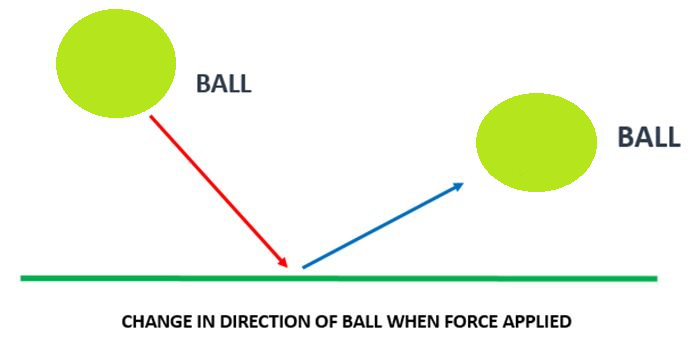
Example: A fielder catches a cricket ball coming to him with great speed and brings it to rest. Ram hits the ball and changes its direction of motion.
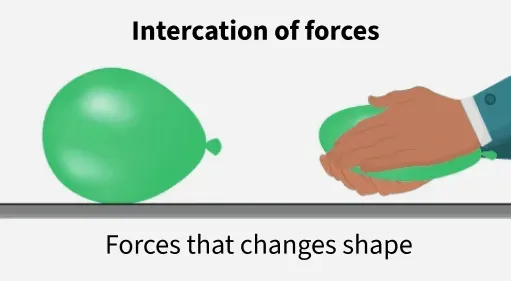
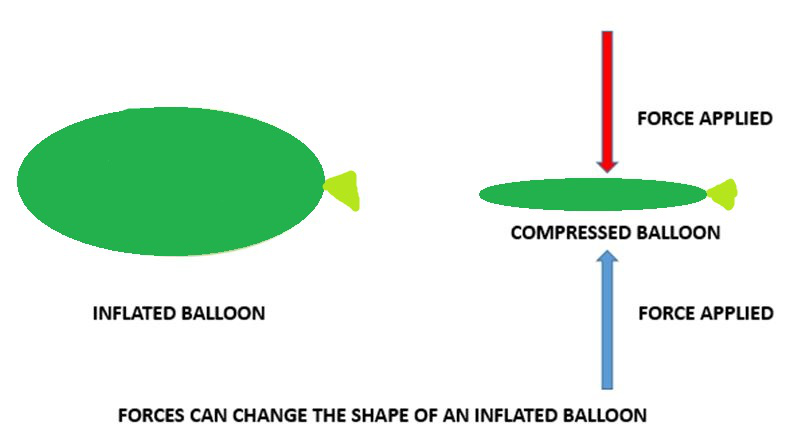
An interaction of Force can Change the Shape of a body:
Example: Upon pressing any inflated balloon with two hands compresses or changes the shape of the balloon. While making the dough we change the shape of the dough as we need.
⁛ Hence, we can conclude that force can only act on any object, substance, or matter if there exists an interaction between the two bodies.
⇨If there is no such interaction between the body and the applied force then the body will not experience any force.
⇨As in case someone cannot move a box without touching it. We cannot move a car by simply not touching it. We cannot win the game of tug of war by not touching the rope.
⇨All these examples prove that there needs to be an interaction for the forces to act until and unless it is not the case of charged material or bodies in which non-contact interactions exist.
👁 ImageQuestion 1: Calculate the force acting on an object when two persons, person A tries to push it by touching it with a force of 60N, and from the other person B an opposite force is being applied to stop the object from moving of magnitude 69 N. Calculate the resultant force and the direction to which the object moves.
Solution:
As we know the object will move towards the direction of the force applied by person B as he exerted a greater force.
The resultant force = 69N – 60N = 9N in the direction applied by B.
Hence, the resultant force on the object is 9N
Question 2: In a game of cricket a batsman hits the ball with a force of 80N which was coming with a force of 30N. Will the batsman be able to hit the ball at a larger distance? Calculate the net force on the ball.
Solution:
Yes, the batsman will be able to hit the ball as he applied a greater force. The resultant force on the ball = 80N – 30N = 50N. Which will go in the opposite direction from where it was coming.
Question 3: A man was struck with his car in a hole. He tried to push the car alone, but he did not succeed. It was imagined that he applied a force of 40 N to push the car. He called for help. Two people came to help him. One which can apply a force of 70N and another which can apply a force of 10N. From which person should he take help and why? Imagine the reaction force exerted by the car to be 100N.
Solution:
The man should take the help of person who can apply a force of 70N. As then only the resultant force will be able to overcome the reaction force exerted by the car and the man will be able to move his car.
Given force exerted by the man = 40N
Force exerted by first person = 70N
Force exerted by second person =10N
The resultant force = 40N + 70N = 110N, which is greater than 100N hence it will overcome it.
The resultant force with the other person = 40N + 10N = 50N, which is lesser than 100 hence, it will not overcome it.
Related Reads: