|
VOOZH | about |
|
VOOZH | about |
Optics is the study of light and its behaviour when it travels through different media and interacts with objects. It explains how light is produced, how it moves in straight lines, and how it undergoes reflection, refraction, and image formation, helping us understand various natural and optical phenomena.
Light is a form of electromagnetic radiation that enables us to see objects around us. It travels as waves and also behaves like tiny particles called photons. Light does not require a material medium for propagation and can travel through a vacuum with a speed of c = 3 × 10⁸ m/s. Light exhibits several phenomena such as reflection, refraction, diffraction, interference, and polarisation.
The energy of electromagnetic radiation is inversely proportional to its wavelength. It means that radiation with a shorter wavelength has higher energy, while radiation with a longer wavelength has lower energy. The relationship between energy and wavelength is given by:
Where:
- E = Energy of radiation
- h = Planck’s constant
- c = Speed of light in vacuum
- λ = Wavelength of radiation
The phenomenon in which a ray of light, after striking a smooth and polished surface, returns into the same medium is called reflection of light. Reflection occurs according to certain laws and is responsible for the formation of images in mirrors.
The behaviour of light during reflection is governed by two important laws known as the laws of reflection. These laws explain how a light ray behaves after striking a reflecting surface.
First Law of Reflection: According to the first law of reflection, the incident ray, the reflected ray, and the normal drawn at the point of incidence all lie in the same plane. This law explains that when a ray of light strikes a reflecting surface, the reflected ray does not travel randomly. The incident ray, reflected ray, and the normal remain confined to a single plane, which helps in determining the exact direction of reflected light.
Second Law of Reflection: According to the second law of reflection, the angle made by the incident ray with the normal at the point of incidence is always equal to the angle made by the reflected ray with the normal.
i = r
Where:
A mirror is a smooth, polished reflecting surface that reflects almost all the light falling on it and forms images of objects by the process of reflection of light. It is used to see clear images of objects placed in front of it and works on the laws of reflection.
Mirrors are smooth and polished reflecting surfaces that form images by reflecting light rays. Depending upon the shape and curvature of the reflecting surface, mirrors are classified into three main types.
1. Plane Mirror
A plane mirror is a mirror having a flat, smooth, and polished reflecting surface. It reflects light uniformly according to the laws of reflection and forms clear images of objects placed in front of it. Plane mirrors are commonly used in homes, dressing tables, and optical instruments.
2. Concave Mirror
A concave mirror is a spherical mirror whose reflecting surface is curved inward towards the centre of the sphere. It reflects parallel rays of light in such a way that they converge at a fixed point called the principal focus. Due to this property, a concave mirror is also known as a converging mirror.
3. Convex Mirror
A convex mirror is a spherical mirror whose reflecting surface bulges outward. It reflects light rays in such a way that they spread out after reflection, due to which it is called a diverging mirror. Convex mirrors provide a wider field of view compared to plane mirrors.
When light rays reflect from a mirror, they form images of objects. These images are mainly classified into two types depending on how the light rays meet after reflection.
1. Real Image
A real image is formed when the reflected light rays actually meet (intersect) at a point. It can be obtained on a screen because the light rays physically converge at the image location.
2. Virtual Image
A virtual image is formed when the reflected light rays appear to meet at a point but do not actually intersect. It cannot be obtained on a screen because the light rays only seem to come from the image position.
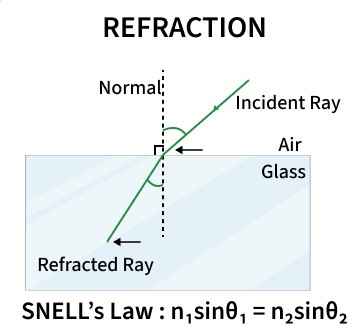
Refraction of light is the phenomenon in which a ray of light bends when it passes from one transparent medium to another due to a change in its speed. This change in direction occurs because different media have different optical densities, which affect the speed of light.
The refractive index of a medium is a physical quantity that describes how much the speed of light is reduced when it enters that medium from vacuum. It indicates how strongly a medium bends or refracts light. A higher refractive index means light travels more slowly in that medium.
Where:
- n = Refractive index
- c = Speed of light in vacuum
- v = Speed of light in the medium
Snell’s law describes the relationship between the angle of incidence and the angle of refraction when light passes from one medium to another. It states that the ratio of the sine of the angle of incidence to the sine of the angle of refraction remains constant for a given pair of media. This law is fundamental in understanding how light bends at the boundary of two different media.
n1 sinθ1 = n2 sinθ2
Where:
- n1 and n2 = Refractive indices of the first and second medium
- θ1 = Angle of incidence
- θ2 = Angle of refraction
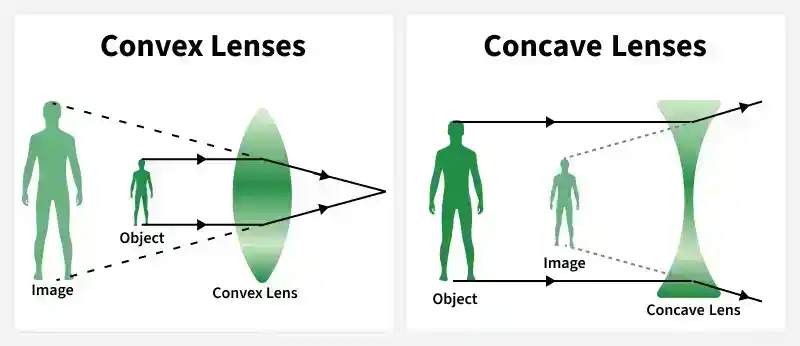
A lens is a transparent optical device made of glass or plastic that refracts light rays and forms images by either converging or diverging them. It works on the principle of refraction of light and is widely used in optical instruments.
Lenses are mainly classified into two types based on their shape and the way they bend light.
1. Convex Lens
A convex lens is a transparent lens that is thicker at the centre and thinner at the edges. It converges parallel rays of light to a point called the principal focus, so it is also known as a converging lens.
2. Concave Lens
A concave lens is a transparent lens that is thinner at the centre and thicker at the edges. It diverges parallel rays of light, so it is also known as a diverging lens.