|
VOOZH | about |
|
VOOZH | about |
Kinetic energy is the energy possessed by an object due to its motion. It is produced when a force acts on an object and does work on it, causing the object to accelerate.
The work done on the object gets converted into kinetic energy, which depends on its mass and speed. A moving object can do work, and a faster-moving object can do more work than a slower one of the same mass.
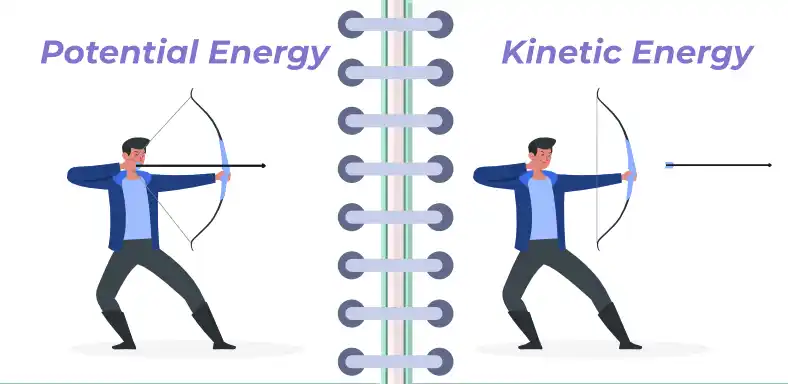
Examples: A moving bullet, blowing wind, a speeding stone, a rotating wheel, and an arrow released from a bow all possess kinetic energy.
Kinetic energy is measured in various units, which are
The dimension Formula for kinetic energy is [M1L2T-2]
As the kinetic energy of an object depends on its mass and speed, therefore mathematically, the kinetic energy is defined as,
where,
m is the mass of the object,
v is the speed or velocity of the object
Mass (m) is a scalar quantity, and velocity (v) is a vector quantity. The formula for kinetic energy is,
From the above formula, it is observed that velocity is squared, and it is known that the square of any vector quantity is a scalar quantity.
Hence, kinetic energy is a scalar quantity.
Consider an object having mass m, initial velocity, u, and final velocity, v.
Suppose when a constant force, F is applied to it, it displaces to a distance s.
Now, work is done by the object that is responsible for changing its velocity; the work done is:
W = F × s ......(1)
Let its velocity change from u to v, and a is the acceleration produced.
Now, using the equation of motion that relates u, v, s, and an as,
v2 – u2 = 2as
Solving the above expression for s as
But it is known that the net force acting on an object is defined as:
F = ma
Now, Substitute ma for F and for s in the equation (1) and solve to calculate W.
Suppose the object is starting from its initial position, i.e. u = 0, then:
It is clear that the work done is always equal to the change in the kinetic energy of an object. So, the kinetic energy possessed by an object of mass, m and moving with a uniform velocity, v is
Radiant energy is a form of kinetic energy, which is the physical energy of matter resulting from electromagnetic radiation. It is radiated from matter into the surrounding environment. Example: Ultraviolet light, Gamma rays, and X-rays all have electromagnetic radiant energy.
Thermal energy can also be known as heat energy. It is generated by the kinetic energy of the motion of atoms when they collide with each other. Example: Hot Springs, Heated Swimming pools have thermal energy.
Sound energy is the energy produced by the vibration of an object. It travels through the medium but cannot travel in a vacuum or space, as there are no particles to act as a medium. Example: Tuning Forks, Beating Drums have sound energy.
Electrical energy can be obtained from the free electrons that are of positive and negative charge. Example: Batteries have electrical energy.
The sum of kinetic energy and potential energy is called mechanical energy. It can neither be created nor destroyed, but it can be converted from one form to another. Example: Satellites orbiting around the Earth, Moving Cars all have mechanical energy.
Question 1: A vehicle having a mass of 150 kg is moving with a uniform velocity of 4 m/s. What is the amount of kinetic energy possessed by the vehicle?
Solution: Given,
Mass of the vehicle, m = 150 kg,
Velocity of the vehicle, v = 4 m/s
Kinetic of the vehicle is,
Hence, the kinetic energy of the vehicle is equal to 1200 J.
Question 2: A ball having a mass of 2 kg is thrown up with a speed of 10 m/s. What is the kinetic energy stored in the ball at the time of throwing?
Solution: Given,
Mass of the ball, m = 2 kg,
Velocity of the ball, v = 10 m/s.
Kinetic of the ball is,
Hence, the kinetic energy of the ball is equal to 100 J.
Question 3: An asteroid is coming towards the earth. Its velocity is 1000 km/s. Its estimated kinetic energy is almost 4 × 10¹⁵ J. Find out the mass of the asteroid.
Solution: Given,
Kinetic energy of the asteroid, K.E. = 4 × 10¹⁵ J,
Velocity of the asteroid, v = 1000 Km/s = 106 m/s
Kinetic of the asteroid is given as,
Hence, the mass of the asteroid is equal to 8000 kg.
Question 4: A car of mass 1200 kg accelerates from 20 m/s to 40 m/s. Calculate the change in kinetic energy of the car.
Solution: Given
Mass, m = 1200 kg
Initial velocity, u = 20 m/s
final velocity, v = 40 m/s
Question 5: A solid cylinder of mass 10 kg and radius 0.5 m rolls without slipping with a linear speed of 4 m/s. Find its total kinetic energy.
Solution: For rolling objects
Total K.E. = Translational K.E. + Rotational K.E.
Translational K.E.
Rotational K.E. (solid cylinder, I = 1/2 mr2 ):
Total K.E.
Question 1: A motorcycle of mass 200 kg is moving at a speed of 15 m/s. Calculate the kinetic energy of the motorcycle.
Question 2: A train of mass 5 × 10⁵ kg is moving at a speed of 90 km/h. Calculate its kinetic energy in joules.
Question 3: A solid sphere of mass 12 kg and radius 0.3 m rolls without slipping with a linear speed of 6 m/s. Find its total kinetic energy. (Use I = 2/5 mr2 for a solid sphere.)
Question 4: A 1.5 × 10⁴ kg rocket is launched vertically with a speed of 250 m/s. Calculate its kinetic energy just after launch.
Question 5: A cyclist of mass 60 kg moves with a speed of 10 m/s. Calculate the kinetic energy of the cyclist.