|
VOOZH | about |
|
VOOZH | about |
Latent heat is the amount of heat energy that a substance absorbs or releases during a change of state (phase change) without any change in its temperature. When a substance changes from one state to another, such as solid to liquid or liquid to gas, heat is required to break the forces between its particles. This heat does not increase the temperature, so it is called latent heat, meaning “hidden heat.”
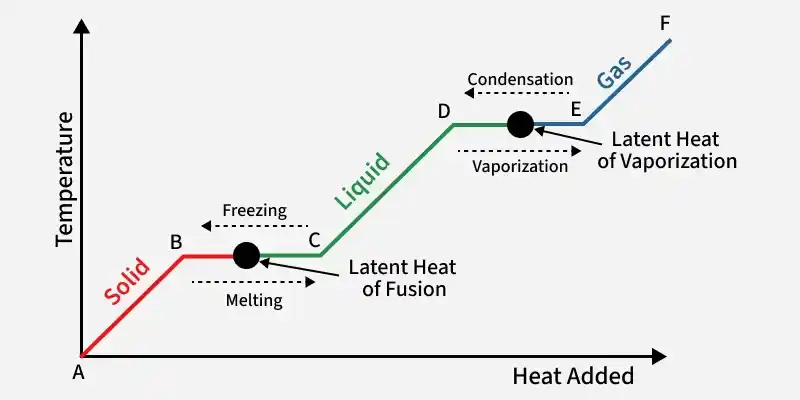
The graph given below shows the change in various forms of matter and the heat related to each process.
A → B: Heating of Solid
B → C: Melting (Latent Heat of Fusion)
C → D: Heating of Liquid
D → E: Boiling (Latent Heat of Vaporisation)
E → F: Heating of Gas
Q = ML
- L = Latent Heat
- Q = Amount of Heat Released or Absorbed
- M = Mass of Substance
Examples of Latent Heat
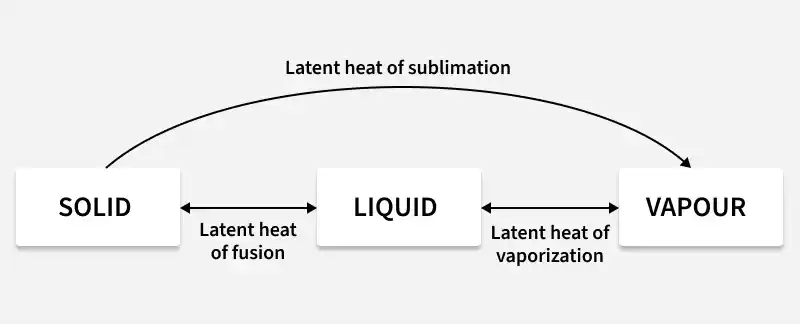
Depending on the type of change of state involved, latent heat is classified into different types
It is the amount of heat required to transform 1 kg of solids into liquid by melting and yet maintaining the temperature constant, and it is called latent heat of fusion.
Example:
- Q = heat energy
- m = mass
- Lf = latent heat of fusion
Latent heat of vaporization is the amount of heat required to convert 1 kg of a liquid into vapour at its boiling point without any change in temperature.
Example:
- Q = heat energy
- m = mass
- Lv = latent heat of vaporisation.
- Q = heat energy supplied (in joules)
- m = mass of the substance (in kg)
Specific latent heat is defined as the amount of heat energy required to change the state of 1 kg of a substance at a constant temperature, without any change in temperature.
It is similar to latent heat, but in specific latent heat the mass of the substance is fixed as 1 kg, which makes comparison between substances easy.
- L = specific latent heat
- Q = heat absorbed or released
- m = mass of a substance
Sensible heat is the heat energy that causes a change in temperature of a substance without changing its state.
When sensible heat is supplied to a body:
Example 1: Find the latent heat of a 20 kg substance if the amount of heat required for the phase change is 600 kcal.
Solution: Given,
Q = 600 Kcal
M = 20 KgFormula for latent heat is given as:
L = Q ⁄ M
= 600 / 20
= 30 Kcal/KgHence, the latent heat required for phase change is 30 Kcal / Kg.
Example 2: Find the mass of ice required to lower the temperature of 500 g of water at 20°C to water at 0°C. Given, the specific latent heat of ice is 336 J/g, and the specific heat capacity of water is 4.2 J/g°C.
Solution: Heat absorbed by Ice = Heat released by water
mIceL = mwaterc∆θ
Given,
mwater = 500 g = 0.5 kg
c = 4.2 J/ g°C
L = 336 J /g
∆θ = 20°C - 0°C = 20°CmIce×336 = 500×4.2×20
mIce = (500×4.2×20) / 336
= 125 g
The required amount of ice is 125 gram