|
VOOZH | about |
|
VOOZH | about |
Laws of Reflection is a principle or rule that governs the phenomenon of reflection of light. The law of reflection states that a light ray will reflect off a surface at the same angle that it hit it when it comes into contact with it. The angle at which a light beam strikes a surface is known as the angle of incidence, and the angle at which the beam of light bounces off the surface is known as the angle of reflection. You can always determine how a light ray will behave, i.e., what direction it will go in and at what angle, by observing a single light ray approach and bounce off a flat mirror. In general, this is how the law of reflection works.
Now let us learn more about the Laws of reflection by understanding the concepts like What are the Laws of reflection? its formula, verification of laws of reflection, Laws of reflection for plane and rough surfaces, and examples of them.
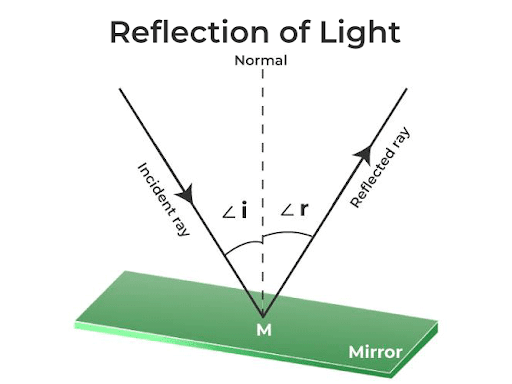
The process due to which the light rays fall on the surface, and get bounced back is known as a reflection of light. Light is recognized for its highly predictable behaviour. The behaviour of a ray of light as it reflects would satisfy a definite law known as the law of reflection if it could be seen approaching and reflecting off of a flat mirror. The law of reflection is shown in the diagram below.
There are several terms associated with the reflection of light which is as follows:
The ray of light that straightaway falls on the reflecting surface from the object or a source is known as an incident ray.
The ray of light which is supposed to be reflected back after striking the reflecting surface is known as the reflected ray.
The angle that is formed between the incident ray and the general at the point of incidence is known as the angle of incidence, and it is generally represented by ∠i.
The angle that is formed between the reflected ray and the general at the point of incidence is known as the angle of reflection, and it is generally represented by ∠r.
A straight line perpendicular to the reflecting surface that acts as a separation between the plane of incidence and the plane of reflection is known as the normal.
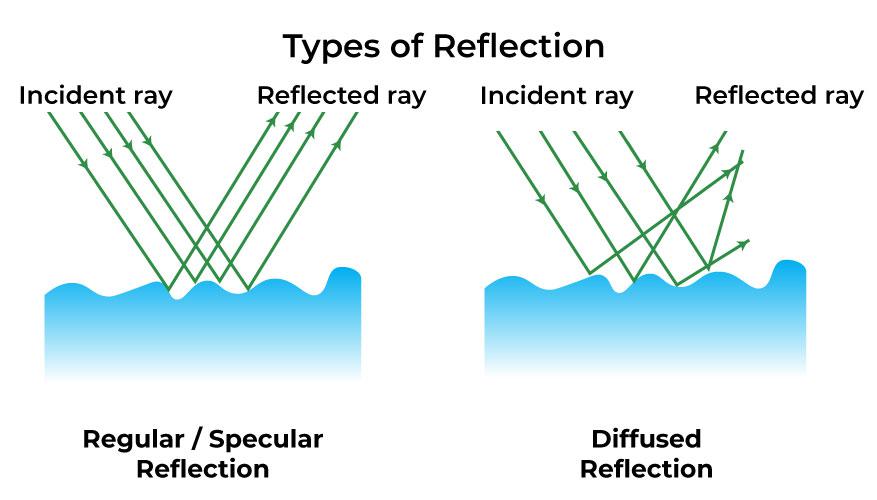
There are two types of Reflection, which are as follows:
This reflection type is created by plane mirrors with smooth surfaces. The image formed is precise and sharp. Such that, all the light rays falling on the surface are reflected equally in a uniform manner. It is also known as Specular Reflection.
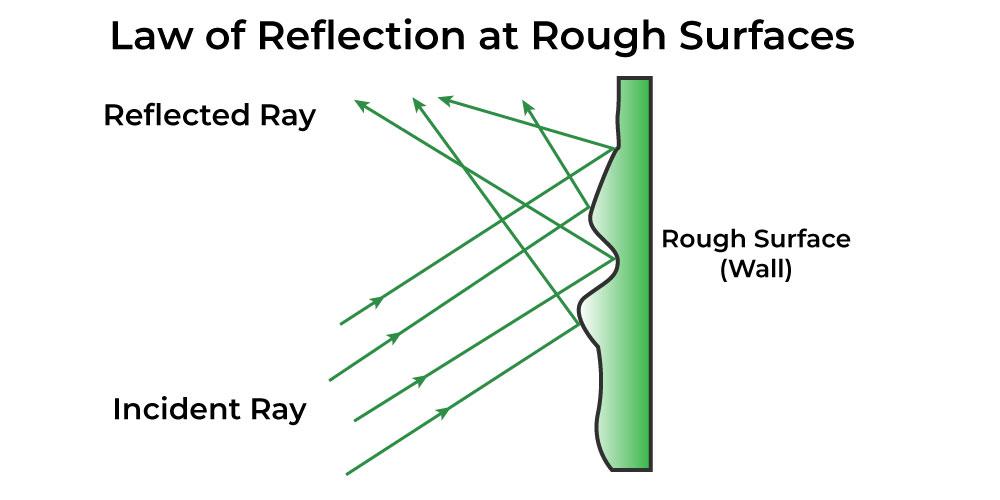
It is referred to as uneven or diffused reflection when light reflects from a rough surface in an erratic manner. As a result, the brightness and reflection quality is diminished. It is also known as Diffused Reflection.
The image added below shows the types of reflection.
The two laws of Reflection are,
The Law of Reflection Formula is the term used for the essential relation stated in the Laws of Reflection i.e. the relationship between the angle of reflection and the angle of incidence.
The Laws of Reflection Formula can be stated as:
Angle of Incidence = Angle of Reflection
Reflected Angle = Incident Angle
∠i = ∠r
where,
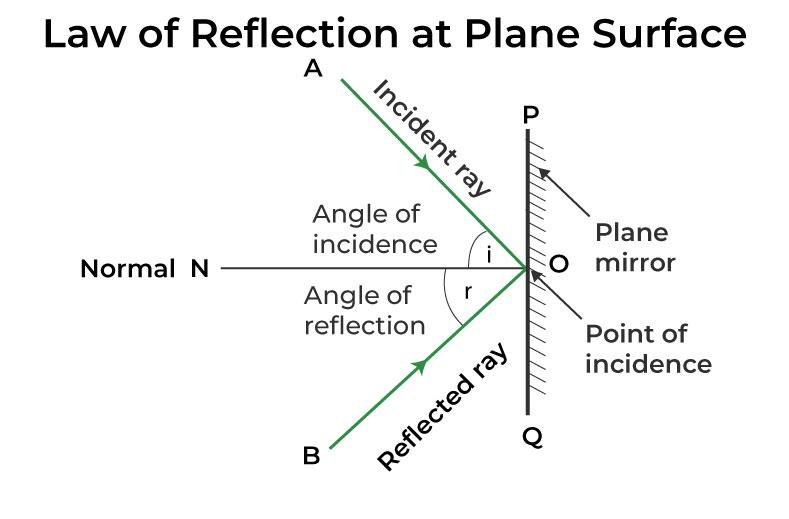
Angle of incidence is defined as the angle made by the incident ray and the Normal. It is denoted using the ∠i.
Angle of reflection is defined as the angle made by the reflected ray and the Normal. It is denoted using the ∠r.
For regular reflection. i.e. reflection from the regular surface, angle of incidence is always equal to angle of reflection.
We can easily calculate the angle of incidence and the angle of reflection by drawing a normal line that is perpendicular to the reflecting surface.
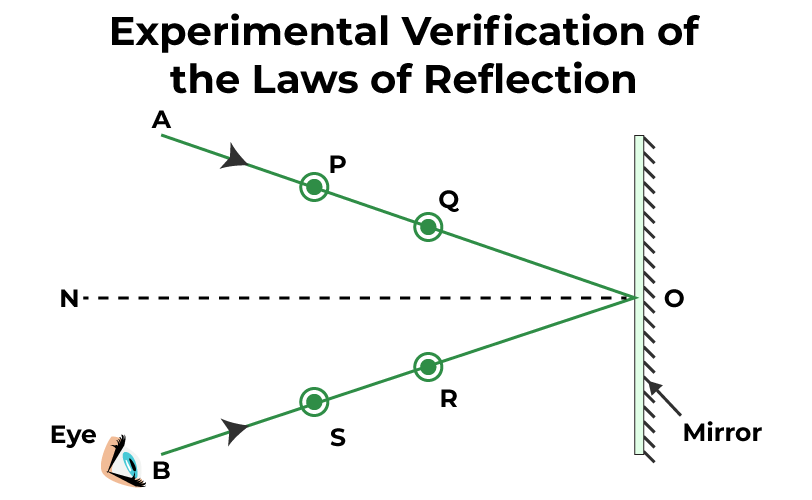
The laws of reflection can be verified by the following experiment, as shown in the figure below:
A plane mirror refers to a mirror with a flat (planar) reflective surface. The light rays when striking a plane mirror, the angle of reflection equals the angle of incidence always. The angle of the incidence refers to the angle between the incident ray and the surface normal (an imaginary line perpendicular drawn to the surface). In a similar way, the angle of reflection is the angle between the reflected ray and the normal at the point of incidence.
Concave and convex mirrors are some of the widely used mirrors which come under the spherical mirrors and can produce virtual images of an object similar to a plane mirror. On the contrary side, the images formed by them are not always of the same size as the object as in the case of a plane mirror. The image by a convex mirror, the virtual image formed is always diminished in size, however in the case of a concave mirror when the object is placed somewhere between the focus and the pole of the mirror, an enlarged virtual image can be seen. However, when we need a virtual image of the same size a plane mirror is preferred over spherical mirrors.
When light reflects from a rough surface in an irregular pattern, it is known as irregular or diffused reflection. Let's use an example to better grasp this. Imagine that a wall is illuminated. Parallel light rays will not reflect in a parallel pattern. Diverse directions are where the light that reflects spreads. The law of light reflection is at work here as well.
There are several use cases where the understanding of the reflection of light help, some of those use cases are as follows:
Example 1. If the angle of incidence is 30 degrees then find the angle between normal and the surface.
Answer:
Angle between surface and normal is always equal to 90 degree.
Example 2. What will be the angle of reflection for the incident angle of 45°?
Answer:
We know that,
∠ i = ∠ r
Therefore, ∠r = 45°
Hence, the angle of reflection will be 45°
Example 3. What will be the angle of incidence for the reflected angle 40°?
Answer:
We know that,
∠ i = ∠ r
Therefore, ∠i = 40°
Hence, the angle of incidence will be 40°
Example 4. What will be the incident angle if the angle between the mirror surface and the incident ray is 50°?
Answer:
We know that,
∠i + angle between mirror and incident ray = 90°
Therefore, ∠i + 50° = 90°
Therefore, ∠i = 90° - 50°
Therefore, ∠i = 40°
Hence, the incident angle is 40°